
Reaching One’s Summit
A simple explanation behind “documenting the ascent”
Did you know that just under 1,000 people attempt to climb Mount Everest every year? Of those, about 500 will succeed in reaching its peak, which stands at over 29,000 feet above sea level.
If you’re like me, that first number might seem a little low while the second one seems rather high. Just 1,000 attempts a year to climb Earth’s highest mountain? (And that includes the Sherpas, guides, and professional climbers who scale it regularly.) You’d think a few hundred people a day would be lined up to cross a feat like that off their bucket lists, especially given the considerably generous 50% success rate above.
About that success rate.
As one might imagine, it wasn’t always so generous. In fact, it was only about a third as high in 1990, trending upward as more guides and better equipment became readily available.
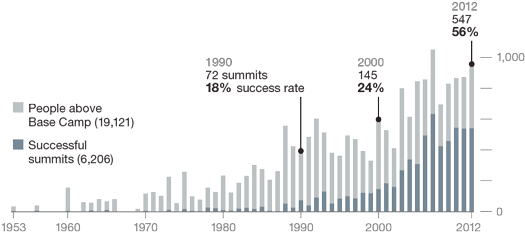
Even still, through August 2015, 7,001 summits of Everest have been made, with “only” 282 deaths.
I don’t know about you, but if my lifelong dream was to climb to the top of Mount Everest and you told me there was “only” a 4% chance it’d kill me, I’d be on that mountain tomorrow (with a Sherpa, of course).
Fear of Failure, or…?
I can’t claim to be any sort of expert on mountain climbing, but when I come across statistics like these, I tend to get curious.
Is it Everest’s deadly reputation or history that prevents more people from trying? Is it simply less of a goal for people than one might think? Is it too expensive? Is it less satisfactory because many have already achieved it? Or is it — dare I say — just too easy, now?
This is where I’m supposed to call attention to an alternate theory: that people are actually just looking at the negative end of the success rate; that they’re choosing to see the glass half empty because they’re simply afraid of failing. (After all, half of all climbers still don’t make it to the top, generally speaking.)
Anyone who’s spent time reading articles on business or otherwise has seen his or her fair share of material covering “the fear of failure” and how to deal with, conquer, master, or overcome it.
Here’s the thing, though. People elect not to chase their dreams for all sorts of reasons: fear, laziness, susceptibility, complacency, and obligation chief among them. Why (or in this case, why not) can only be answered by the individual, as everyone has their own reason(s) for not pursuing. It takes self-reflection and awareness to uncover that part.
I tend to focus more on the how and the what. Specifically, how are people who do elect to follow their dreams overcoming the things — like fear — typically holding others back? And what gives them the courage and/or audacity to even make the attempt in the first place?
Zero to Seven Thousand and One
Long before Mount Everest became “too easy” to climb, there was Edmund Hillary. He, along with another guy, became the first to ever reach Everest’s summit (that we know of, no one else ever came back before, so…) back in 1953.
sum·mit (noun): 1. the highest point of a hill or mountain. 2. the highest attainable level of achievement.
Prior to Hillary’s ascent, the success rate of scaling Everest was 0% and the death rate was basically 100%… but he went up that damn mountain anyway.
Why, you ask?
As I said, it could be one or any number of reasons. Maybe he legitimately liked the challenge of being the first one, or maybe he was looking to test his physical limitations. Maybe he was just in the right place at the right time, or the most qualified, or the craziest S.O.B. they could find. Or, maybe it was always his dream to one day climb the world’s tallest mountain.
Whatever the case, he set out to accomplish a goal and his efforts landed him on Time’s list of the 100 most influential people of the 20th century. But in order to better understand the what and how, we need to look at the bigger picture.
According to his Wikipedia page, Edmund Hillary’s interest in climbing began at age 16, during a school trip to Mount Ruapehu. A few years later, he completed his first major climb, reaching the summit of Mount Ollivier, near the Southern Alps. At age 33, he conquered Everest.
All it takes is those three short sentences to come to a general understanding that what Hillary did was follow his passion all the way to the top of Everest, and how he did it was by way of 17 years of practice and training.
Whether he knew it or not, he started climbing Everest at age 16, not 33.
And that, my friends, is what I’m most intrigued by in all of this.
Making “The Ascent”
Whether or not you know exactly what your Mount Everest is, I think there’s an inherent advantage to considering early on what’s required in reaching its summit and taking steps in the right direction toward getting there.
People tend to focus too heavily on the end result, when in fact the magic is all in the journey.
We look to the person standing atop the mountain in admiration, curiosity, and even envy, and don’t stop to give all the “little things” he/she did to get there a first thought, much less a second.
Given the example above, it’s highly likely that Mr. Hillary didn’t know full well that climbing Mount Everest would one day be a goal of his at age 16. But over the course of the next 17 years, he took the necessary steps to achieve that goal.
He climbed a lot of little mountains — and I’m sure he suffered a few broken bones — in pursuit of what would eventually become his dream.
At 32, I admittedly still don’t know exactly what my Mount Everest is, but I do know it involves business. And while I haven’t (yet) built a huge, successful business of my own, I did spend 5+ years working at one, and I’ve done a lot of little things to help prepare me for it, even dating back to my adolescence. (Stories for another time, I suppose.)
This article is one of those little things. What I’m doing here lives at the intersection of what I’m good at and what I’m passionate about, and I’m using it as a means of self-expression.
Having the ability to so easily get one’s thoughts out into the world is a powerful thing.
For me, it’s a step in the right direction as I communicate what I’ve learned about my journey… even while I’m still on it.
I’ve already begun climbing my mountain, even if I’ve yet to learn where the summit lies.
Are you making progress on yours?