
celt
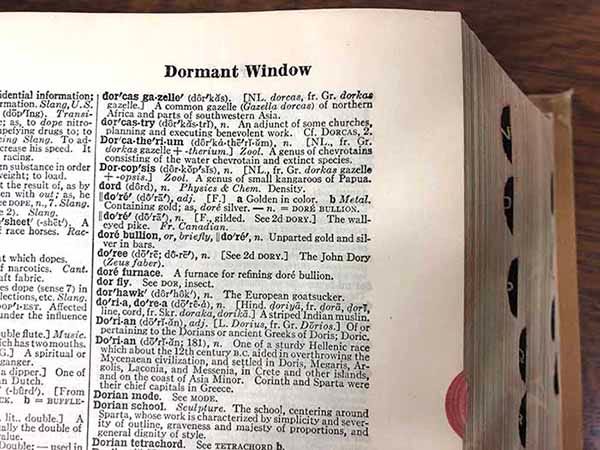
A newly-discovered old dord!
Today’s New York Times Spelling Bee letters:
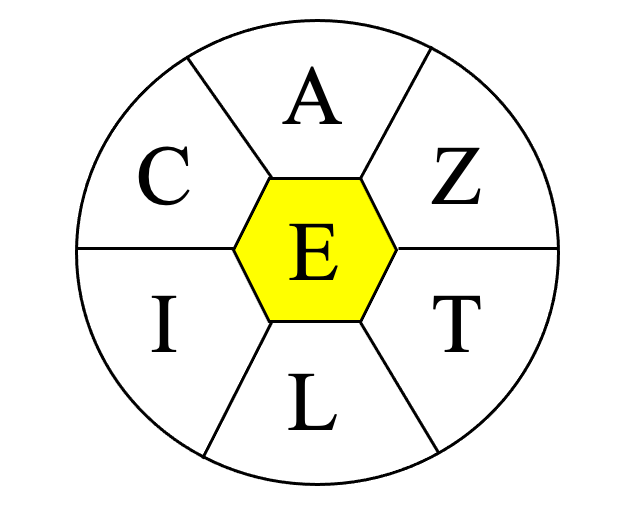
A, C, I, L, T, Z, and center E (all words must include E)
Merriam-Webster says…
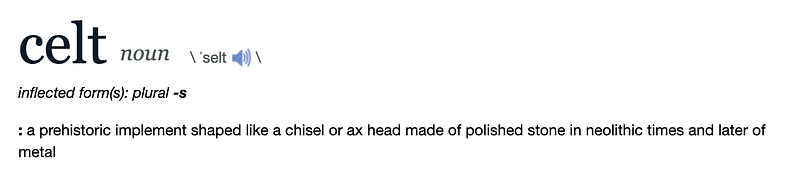
Silly little dictionary! Don’t you know that celt can’t possibly be a word if The New York Times says it ain’t?
For a complete list of rejected words, check out the Spelling Bee Master.
What’s your favorite dord* from today’s puzzle?
My Two Cents
The story of the ghost word dord is fascinating. I always provide a link to it at the end of every article, but you can click here if you want to read it now. (Just please come back afterwards and continue scrolling down.) I jokingly call the words I write about in this column dords because although they appear in the dictionary, the Spelling Bee game likes to pretend they don’t exist. And by that I mean that when you type in the word and hit the Enter button, you get this message:

When I did this today, I figured the reason the Spelling Bee rejected Celt was because it’s a proper noun, and proper nouns are not part of the game. But then when I looked up the word… lo and behold, it turns out there’s a celt that has a lowercase “c”!
What was even more fascinating was discovering that the origin of the term could have been a mistake. In other words, celt might be a ghost word, or dord.
The other question, of course, is if one reads it as selt or kelt? Well, that depends. If you’re referring to the prehistoric tool, then the “c” is definitely pronounced as an “s”. But if you’re talking about Celtic with a capital C, then it depends on your whether you’re a fan of the Indo-European culture or the Boston basketball team.
Merriam-Webster has an article explaining how the uppercase Celt came to have two different pronunciations.
Following its French and Latin predecessors, early pronunciation of Celt was actually \SELT\. (In French and Latin, the ‘c’ is pronounced \s\, as in the last name of the French painter Paul Cézanne and in Latin century.) The pronunciation \KELT\ started being heard as early as the 18th century, which, in time, ushered in the variant spelling Kelt. The variants were introduced by language and history academics who believed that the pronunciation of Celt should reflect the initial \k\ sound in the ancient Greek Keltoi and the Classical Latin Celtae… Outside of academia, the variant Kelt never caught on, and it is rarely if ever used today; however, the \k\ pronunciation for Celt and Celtic has since flourished.
What a tool!
Archeologists refer to certain prehistoric tools made of stone or bronze as celts. And they don’t need to have been made in territories that were once populated by Celtic people. For example, this picture shows celts made by the Olmecs, an ancient culture located in parts of what is now Mexico.
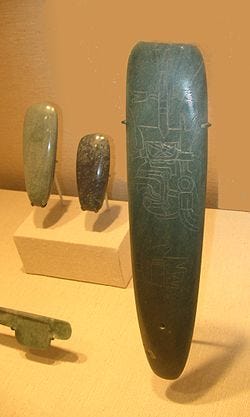
Stones with a square-shaped profile and a rounded top that are used for chopping trees or woodwork are known as shoe-last celts. That’s because they truly resemble lasts, those foot-shaped molds that shoemakers use.
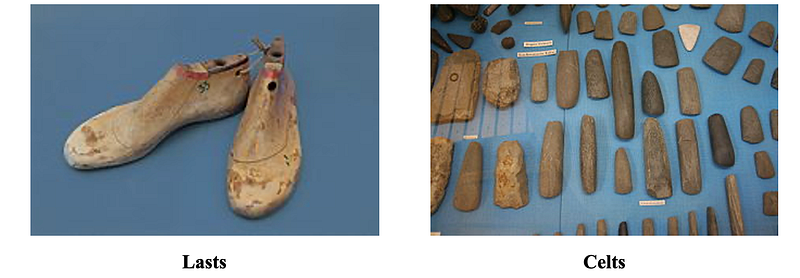
Okay… maybe they don’t truly resemble each other. But some archeologist at thought so at some point in time, and decided to give this type of celt that name. Everyone else just went along with it, and now it’s too late to go back.
What’s very interesting about celt, as I mentioned earlier, is the etymology of the term itself. Our friends at Merriam-Webster state simply that it comes from the Late Latin celtis, meaning “chisel”. The 1911 Encyclopedia Britannica backs that possibility, but also posits that it could be “derived from the Welsh cellt, a flintstone (that being the material of which the weapons are chiefly made, though celts of basalt felstone and jade are found); from being supposed to be the implement peculiar to the Celtic peoples.” The modern, online entry in the Britannica is moot about the origin.
However, the Online Etymology Dictionary has a fascinating explanation:
“stone chisel,” 1715, according to OED from a Latin ghost word (apparently a mistake of certe) in Job xix.24 in Vulgate: “stylo ferreo, et plumbi lamina, vel celte sculpantur in silice;” translated, probably correctly, in KJV as, “That they were graven with an iron pen and lead in the rock for ever.” But assumed by others to be a genuine carving tool, partly because it was in the Bible, and thereafter adapted by archaeologists as a name for a class of prehistoric implements.
KJV refers to the King James Version, an early 17th-century translation of the Bible (including several apocryphal books) commissioned by King James, who happened to be both James VI (Scotland) and James I (England and Ireland).
Now, the translation into English of the Job Chapter 19 verse 24 was correct. The problem was the Latin in the Vulgate Bible from the 4th century, later printed in 1592 and thus widely distributed. In English the passage should read, more or less, as “that they were inscribed with an iron tool on lead, or engraved in rock forever!” That “forever” had been previously translated from the Hebrew into Latin as vel certe (but surely). However, the 1592 Vulgate has vel celte instead.
Because the biblical text is talking about tools and carving, vel celte was assumed to refer to an ancient chisel. Some people started adopting the term celt for the stone-aged tools they were unearthing, and just like with the lasts, the name stuck. According to the Oxford English Dictionary, it’s likely that a folksy etymology via the Latin celtis was created later.
I’m not sure if celtis is actually a word in Latin and could thus be a convenient coincidence. If any of my eagle-eyed readers happens to be an expert on that language and can illuminate us in the comments section, we would be eternally grateful from the bottom of our… shoe-molded lasts.
Top(un)spin
Although the dictionary doesn’t mention it, there is another meaning for the word celt, one that is a bit “rebellious”, if you will. The more widely-used term is rattleback, which also does not appear in Merriam-Webster’s reference book… so I can’t provide one of those stirring dictionary screenshots like I usually do.
A rattleback is a type of top that seems to have a say when it comes to how it spins. There is a preferred direction ––either clockwise or counterclockwise–– and if you spin it the opposite way, this “rebellious celt” will start to shake and rattle (but not roll), stop, and then reverse its spin.
Don’t believe me? Take a look!
Other names for this amazing top include anagyre, Celtic stone, druid stone, rattlerock, Robinson Reverser, spin bar, and wobble stone. The ones found in the wilderness are typically made of stone. Commercial spinning celts can be made of plastic, wood, or even glass, and have been sold under the names ARK, Bizzaro Swirl, Space Pet, and Space Toy. I looked these up on Amazon, but found the toy listed as rattleback.
The basic explanation for this phenomenon comes from “the growth of instabilities on the other rotation axes, that are rolling (on the main axis) and pitching (on the crosswise axis)”, according to Wikipedia’s text. The pitching instability extracts so much energy from the spin that it reverses.
If you want to delve deeper into the mathematics of this spinning celt, you can check out the online slides of Keith Moffat, which are referenced by Wikipedia. (Press NEXT at the top to advance the slides.) Fair warning: I understood nothing, so I went back to videos of rattlebacks spinning. Like this one:
Now you know. Next time you’re in Celtic territory, visit a museum and check out their collection of primitive tools. Then you can tell your family and friends you saw a Celtic celt. No one will have any idea what you’re talking about, of course… because the editors of the Spelling Bee decided that celt is a dord*.
You can check out my previous entry on another dord* here:
*What the heck is a dord, you ask? Here’s the answer: