
Celiac Disease Is Not A Gluten Allergy
Celiac Disease is an immune-mediated chronic condition

Ignorance is annoying
One evening, when I was newly diagnosed, I was out for dinner and drinks with my team after a soccer game. I was just learning how to navigate a gluten-free (GF) diet at home, and very awkwardly figuring out how to eat in a restaurant without getting sick.
It was 2009 and gluten-free menu options were extremely limited.
Instead of items being marked as GF right on the menu, like they do in a lot of places now, I had to ask for an allergy binder. It was up to me to go through the binder, look up any food I thought I might like, then search through to see if it had gluten under the various allergens listed.
I was already socially awkward and anxious, and this certainly didn’t help. It made me very uncomfortable. As I was stressing over what I could possibly eat, a teammate asked, “why don’t you just take a pill like I do for lactose intolerance?”
Because I can’t. It doesn’t work that way. At all.
Over the few years that followed, I encountered a mixture of dismissive folks, people who wanted to accommodate but had no idea how, and people who refused to even try.
In the summer of 2012, I was six month pregnant, and we travelled to France for my husband to attend a conference for his job. I speak French and also had a French language allergy card, in case my dialect or vocabulary wasn’t up to the task of explaining my needs.
Some of the places I entered to inquire quickly confirmed they couldn’t accommodate my dietary needs before I had even finished asking the question.
What is Celiac disease?
Celiac disease (CD) is a specific autoimmune disorder of the small intestine. Celiac disease is not a food allergy, a sensitivity, nor an intolerance. It’s a chronic condition which can’t be treated or cured with medication. In Celiac disease, the immune system reacts against gluten, a protein found in wheat.
Similar to other autoimmune disorders, the immune system overreacts to what it detects as a “foreign invader”, damaging healthy tissue in the process. Damage is caused to the villi, which line the small intestine.
Villi play an important role in our overall health. In particular, villi absorb vitamins, minerals and other nutrients from the food we eat. When they are damaged, we end up with malnutrition and nutrient deficiencies.
Villi also produce an enzyme called lactase, which helps us break down lactose and absorb nutrients from dairy products.
I was considered lactose intolerant for much of my life. When I was finally diagnosed with CD and went on a 100% gluten-free diet, my villi healed, began producing lactase again, and I was no longer lactose intolerant.
The most common symptoms of CD are gastrointestinal issues, fatigue, and weight loss. That said, many people have atypical presentations and present with a different symptom profile, like I did.
Neurological symptoms of CD
Celiac disease can cause a number of neurological symptoms, ones that medical professionals may not consider related, especially if the patient does not present with typical GI symptoms.
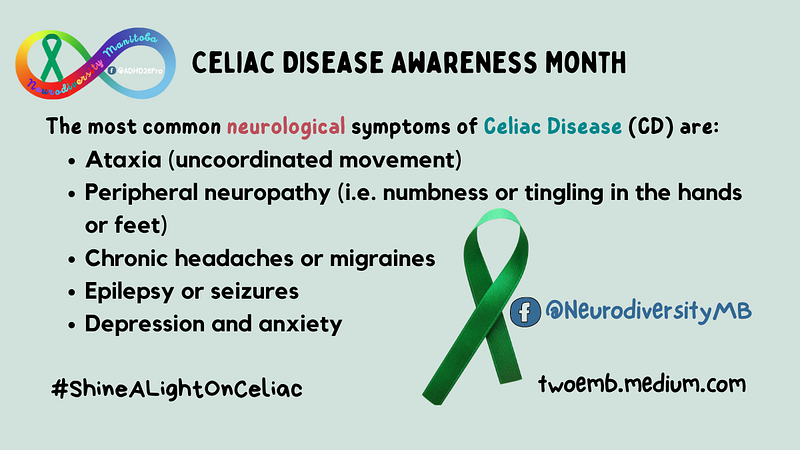
The most common neurological problems which can be caused by CD are:
- Ataxia (weakness, uncoordinated movement)
- Peripheral neuropathy (i.e. numbness or tingling in the hands or feet)
- Chronic headaches or migraines
- Epilepsy or seizures
- Depression and anxiety
Lo and behold, there is also evidence that untreated Celiac disease can cause ADHD-like symptoms, and can worsen ADHD symptoms in those (like me) who do have ADHD.
Celiac Disease, especially when not properly diagnosed and treated with a gluten-free diet, can increase our risk for developing a number of comorbid conditions. The most common are type 1 diabetes, hypothyroidism, and Addison’s disease.
Difficulties with diagnoses
It’s believed as many as 90% of CD cases remain undiagnosed. I was diagnosed at age 26, after years of ongoing health issues. As a child I had eczema; I have allergies and asthma, all conditions which are common amongst Celiacs.
In my early twenties I began having worsening health issues, including seizures. After a lifetime of minor-to-moderate health issues, things finally came to a head. It still took a full year, but after much testing and many doctor’s visits, I finally received an accurate diagnosis.
It certainly hasn’t been an easy adjustment. I still often can’t eat at buffets or pot-luck meals, and I take a risk every time I eat food from a restaurant.
On the other hand, I’m quite fortunate. I have an autoimmune disease that is entirely controlled by diet, and my health has greatly improved after almost 13 years gluten-free.
Restaurants have more GF menu options and there are more GF products available in grocery stores, albeit a lot more expensive.

What we need most are awareness and education, especially for medical professionals who may miss the less obvious signs and miss an opportunity to diagnose CD before those symptoms become life-altering, or even life-threatening.
© Jillian Enright, Neurodiversity MB

When you join medium, as a member you’ll have access to unlimited reads for only $5 per month. If you use my referral link, I’ll earn a small commission, and you’ll earn my undying gratitude.
Related Stories
Celiac Disease And Epilepsy
My personal experiences with seizures and idiopathic epilepsy
medium.com
References
Damjanov, I., & Morović, A. (2009). The Gastrointestinal System. Ivan Damjanov (Ed.). Pathology Secrets (3rd Ed.), 235–262. Mosby. https://doi.org/10.1016/B978-0-323-05594-9.00012-X
Durazzo, M., Ferro, A., Brascugli, I., Mattivi, S., Fagoonee, S., & Pellicano, R. (2022). Extra-Intestinal Manifestations of Celiac Disease: What Should We Know in 2022? Journal of Clinical Medicine, 11(1), 258. MDPI AG. https://dx.doi.org/10.3390/jcm11010258
Jamnik, J., Villa, C. R., Dhir, S. B., et al. (2017). Prevalence of positive coeliac disease serology and HLA risk genotypes in a multiethnic population of adults in Canada: a cross-sectional study. BMJ Open. https://doi.org/10.1136/bmjopen-2017–017678
Lebwohl, B., Söderling, J., Roelstraete, B., Lebwohl, M. G., Green, P., Ludvigsson, J. F. (2021). Risk of skin disorders in patients with celiac disease: A population-based cohort study. Journal of the American Academy of Dermatology, 85(6), 1456–1464. https://doi.org/10.1016/j.jaad.2020.10.079
Niederhofer, H., & Pittschieler, K. (2006). A Preliminary Investigation of ADHD Symptoms in Persons With Celiac Disease. Journal of Attention Disorders, 10(2), 200–204. https://doi.org/10.1177/1087054706292109


