
Celebrating the Death of a Maiden
What is whispered in your ear, preach from the housetops
.jpg)
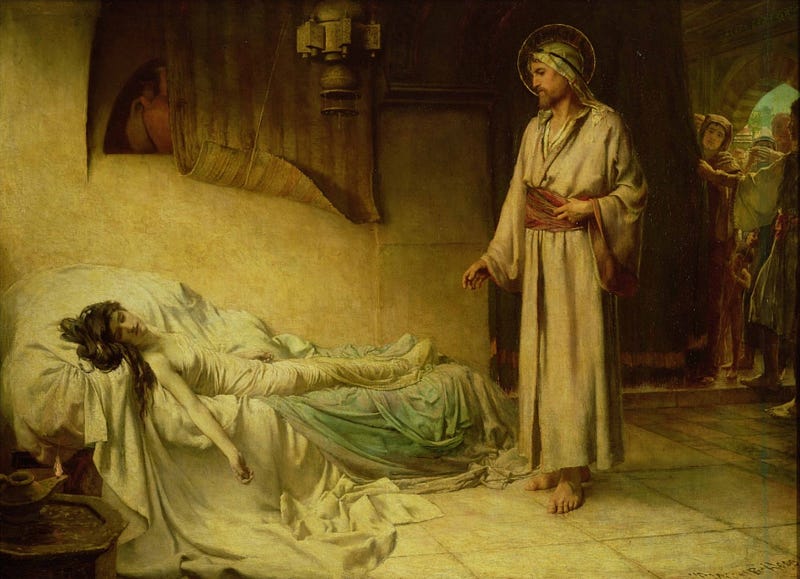
Jesus Heals the Daughter of Jairus
Here is another of the miracles performed by Jesus. This one is convenient because it is found in all three synoptic Gospels. This makes it useful for validating my theory that there is a hidden message contained within the three texts, hidden within the subtext.
So what does it all mean? Essentially, the woman who bled for twelve years and the twelve-year-old girl are the same woman. They are all women.
The theory which I am testing it against is the generally accepted theory of Q. Q stands for Quelle which is the German word for ‘Source’. This theory is that Mark was written first and then Matthew and Luke independently rewrote Mark using additional material from this Greek proto-Gospel, code-named “Q”.
You can catch up on my thrilling adventures attempting to defeat Q and its influential theory in my mind-opening article:
So here we are. Let us get right to it. First, let’s take a look at the parallels from a distance, in order to get the bird’s eye view as it were.
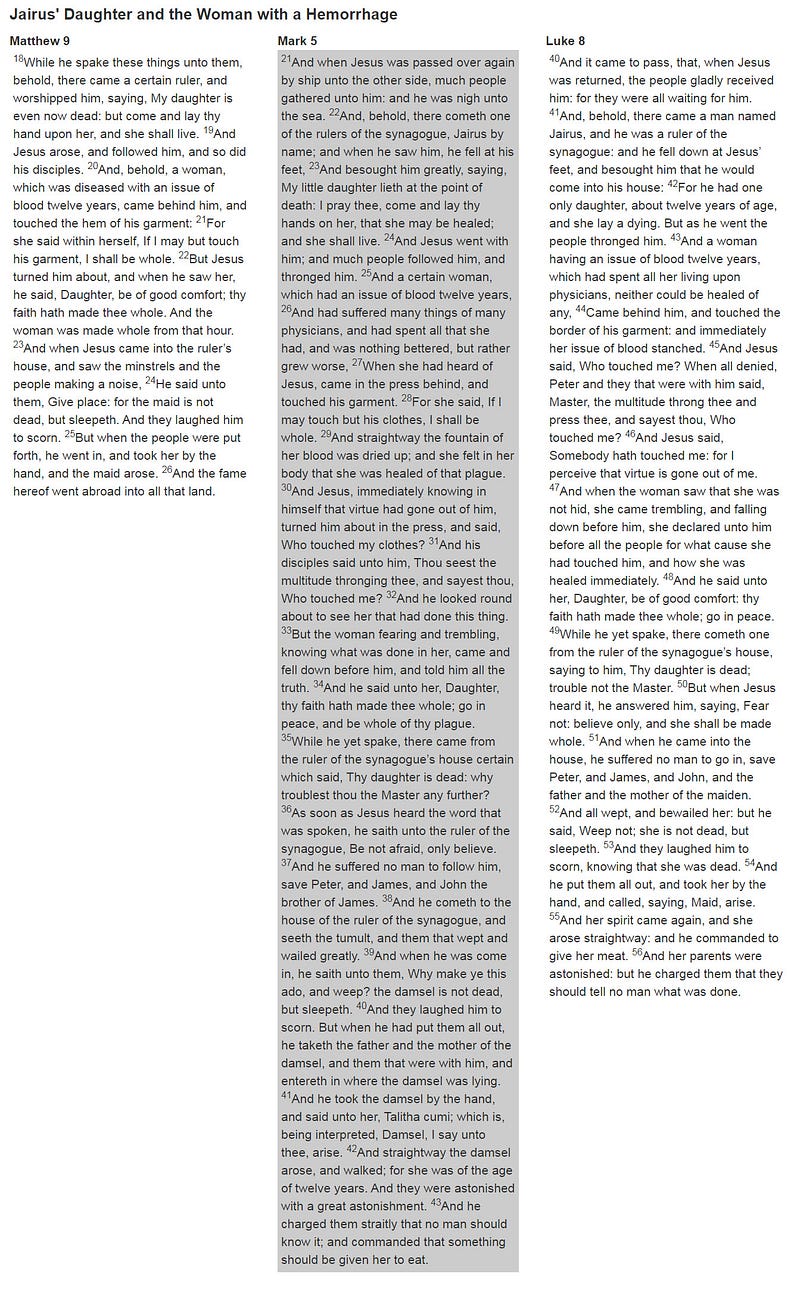
The View From Above
The View From Mark
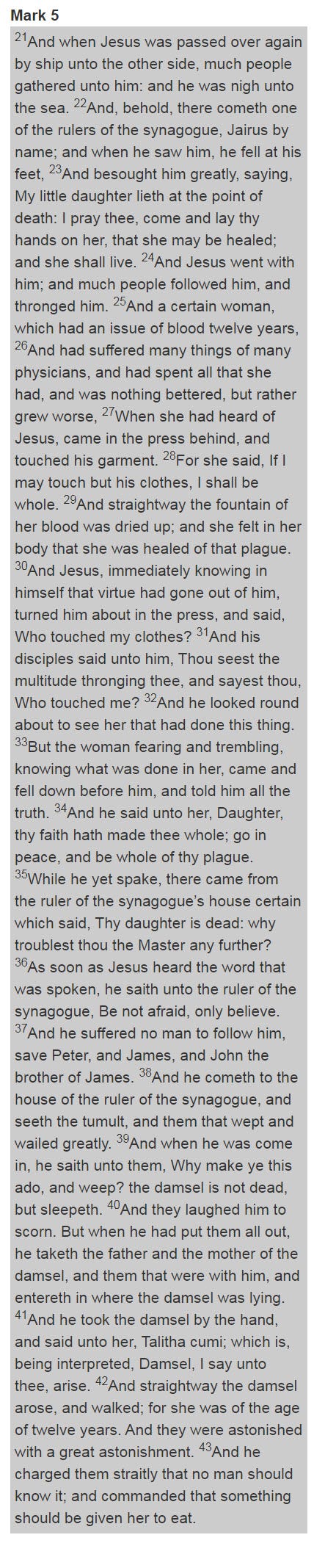
Wow, that’s a real eyeful. Mark has a lot to say, especially when compared to the other synoptic Gospels. Mark usually contains the shortest version of any story contained within multiple Gospels.
That is one of the reasons that Mark has always been seen as the earliest Gospel. The understanding is that as a story is retold, elements are added, little embellishments here and there.
But we can see here that the version from Mark is the longest of the three. At this point, we are going to move a bit closer until we are focused completely on the parallel from Mark.
Mark provides all of the pertinent details, setting the scene:
Jairus, one of the big guys in the synagogue, comes begging for help. You see, his daughter is on the verge of death, and Jairus was thinking that if Jesus came and touched her and said a prayer or two that maybe she’d be healed and wouldn’t die.
Jesus is like, “Sure, let’s go,” so they set out on their way. But, there is this one specific woman, and she has been bleeding for, Jesus, it has been about twelve years. She has gone to all the doctors but none of them could help.
She has heard that Jesus is around and she thinks that maybe, if she can touch His robe, that she’ll get healed, somehow. So there He is, in this big crowd of people and she shoves her way in there and touches His robe. And then she is healed, somehow.
Jesus feels some of his virtue flow out of Him so he asks his gang who it was that touched his clothes. And they are all like, “Dude, you are in the middle of a mob all pushing in on you. What do you mean, ‘Who touched my clothes?’”
But that woman who almost bled-out, she comes over to Jesus and falls on her knees telling him what she has done. Jesus is like, “Okay, we’re cool. Go out there and enjoy your new fresh feeling. Play tennis if you want.”
Somebody from the Jairus’ house comes and tells Jairus that he can stop bothering Jesus Christ Superstar because his daughter is dead already.
Jesus is like, “Don’t worry. Believe in miracles. Peter, James, and John with me. The rest of you, set up a perimeter and keep the crowd back.”
They push their way through the mourners who are shuffling back and forth in front of the villa in a shell-shocked daze.
“Stop all of your weeping and wailing, the wee lassie is just napping,” Jesus announces.
But they laugh at him and draw frowny-faces on the walls with blood and ashes. Jesus goes to where the little girl is lying and clears the room except for the girl's mother and father plus Jesus and his lieutenants: P, J, and J.
Once they were alone, Jesus tells the girl, “girl, get up.” The twelve-year-old gets up. He tells her parents to feed her and not to tell anyone what had happened.
The View From Matthew
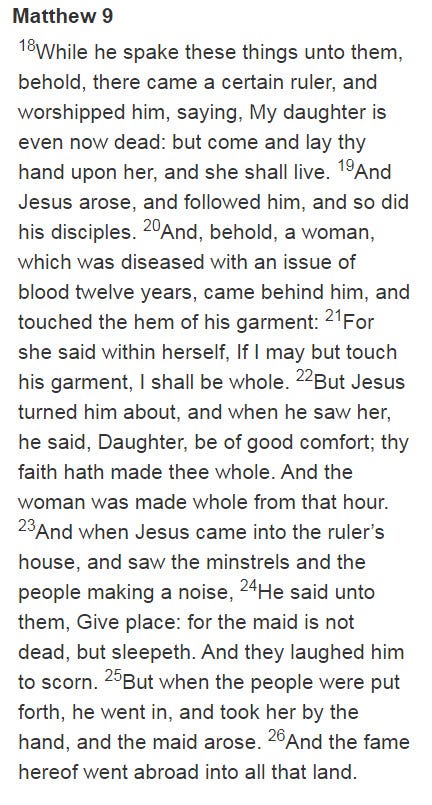
Mark really laid things out in detail. I’m not sure how much Matthew can add.
There is a certain ruler is this telling. Matthew doesn’t bother using the name Jairus from Mark. The name itself means “God enlightens.”
In this version, his daughter is already dead before he goes to find Jesus.
The woman touches the hem of His garment rather than just the cloth as in Mark.
Finally, we come to the crowd at the ruler’s house. Strangely enough, Matthew speaks of minstrels making a ruckus.
The word that King John translates as “minstrels” was originally the Greek word aulétés: a flute player. It almost reads like a celebration, rather than an act of mourning.
On the Playing of Flutes
The mention of a flute player adds another darker layer to the story. Flute playing was an important feature in the cultic worship of the mother goddess Cybele. In addition to priestesses and temple prostitutes, this goddess cult had castrated priests known as the Galli. Lucian wrote of them in his work On the Syrian Goddess (Strong, 1913):
During these days they are made Galli. As the Galli sing and celebrate their orgies, frenzy falls on many of them and many who had come as mere spectators afterwards are found to have committed the great act. I will narrate what they do. Any young man who has resolved on this action, strips off his clothes, and with a loud shout bursts into the midst of the crowd, and picks up a sword from a number of swords which I suppose have been kept ready for many years for this purpose. He takes it and castrates himself and then runs wild through the city, bearing in his hands what he has cut off. He casts it into any house at will, and from this house he receives women’s raiment and ornaments. Thus they act during their ceremonies of castration.¹ Chapter 51
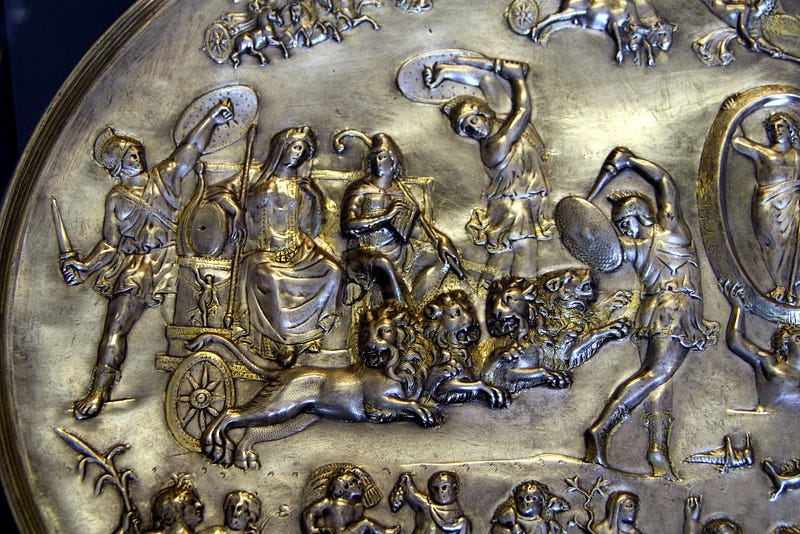

In his On the Nature of Things, the poet Lucretius gives another description of the Galli (Bailey, 1921):
To her [the Idean Mother] do they assign the Galli, the emasculate, since thus they wish to show that men who violate the majesty of the mother and have proved ingrate to parents are to be judged unfit to give unto the shores of light a living progeny. The Galli come: and hollow cymbals, tight-skinned tambourines resound around to bangings of their hands; The fierce horns threaten with a raucous bray; The tubed pipe excites their maddened minds in Phrygian measures; they bear before them knives, wild emblems of their frenzy, which have power the rabble’s ingrate heads and impious hearts to panic with terror of the goddess’ might.²
Flute playing signaled the presence of devotees of the Great Mother. They worshipped the feminine to such an extent that if a man wished to become a priest in the cult he would have to first castrate himself. But let’s look beyond the whole emasculation issue and just think about a cult that worships the Great Mother having a celebration outside the home of a little girl who has just died.
Hold that thought.
There is one little bit of data I would like to add. Directly preceding that section above from Matthew is this verse:
17 Nor do men put new wine into old skins, otherwise the skins burst and the wine is poured out, and the skins will be destroyed; but they put new wine into new skins, and both are preserved together. (Mat 9:17 DBY)
Visualize that. New wine put into old wine sacs makes the wine sacs burst, flushing out all the unfertilized wine in a tide of red. You should definitely have those old sacs exchanged for fresh, probably about once a month.
Speaking of which, what about that poor woman? The one who has been bleeding for … how many years? Twelve years. That’s a long time. You know what the Bible says:
19 And if a woman have an issue, and her issue in her flesh be blood, she shall be put apart seven days: and whosoever toucheth her shall be unclean until the even. 20 And every thing that she lieth upon in her separation shall be unclean: every thing also that she sitteth upon shall be unclean. 21 And whosoever toucheth her bed shall wash his clothes, and bathe himself in water, and be unclean until the even. 22 And whosoever toucheth any thing that she sat upon shall wash his clothes, and bathe himself in water, and be unclean until the even. 23 And if it be on her bed, or on any thing whereon she sitteth, when he toucheth it, he shall be unclean until the even. 24 And if any man lie with her at all, and her flowers be upon him, he shall be unclean seven days; and all the bed whereon he lieth shall be unclean. (Lev 15:19–24 KJV)
And that’s just for a woman having her normal period. The “Curse of Eve.”
The View From Luke
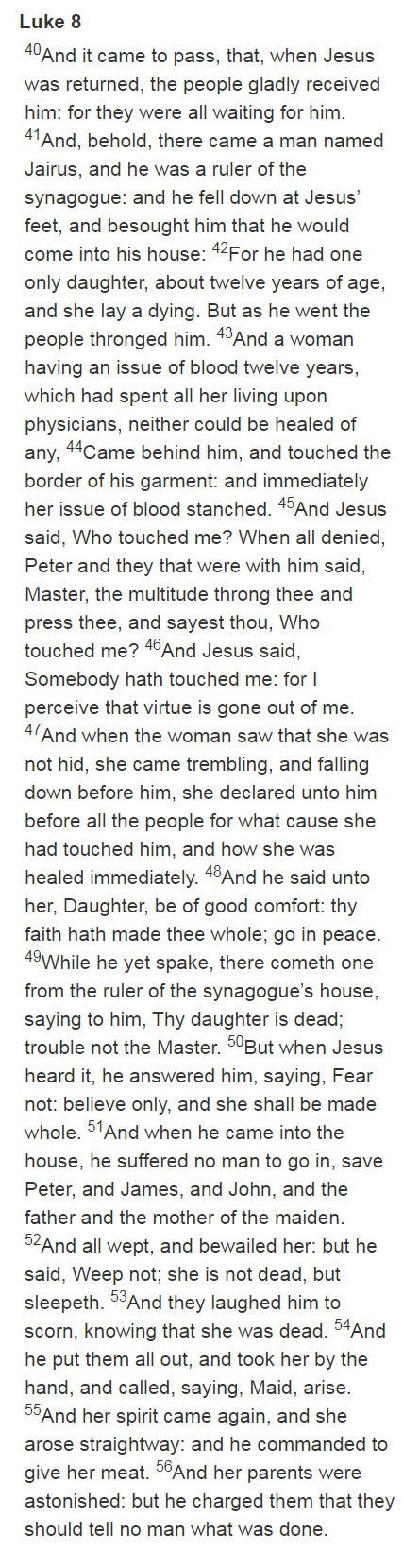
This leaves us with Luke.
Luke goes back to Mark and gives us all the same details except Luke mentions the bleeding woman touching the border of His garment just as Matthew had the woman specifically touching the hem of the garment.
Luke also has the crowd thronging Jesus, while the original Greek word sympnígō means ‘to choke’. Jesus is really wedged in there tight.
So the woman touches the edge of Jesus's robe and her flow of blood immediately ceases. Jesus knows because he feels the virtue flow out of him. The Greek word is dunamis and it means ‘power, might, and strength’.
The woman falls down before him, trembling. Weakened, no doubt, from her constant loss of blood.
Jesus told her that it was all good. He even called her Daughter.
This is ironic because the next thing that happens is someone comes from Jairus’s house to tell him that his daughter is dead.
Jesus says not to worry, that he can make the little girl all better. The crowd is definitely crying and not celebrating this time.
Jesus goes and clears the room. He tells the girl to get up, she does. This time he is careful to mention to the parents that they need to feed her some meat.

Making the Two into One
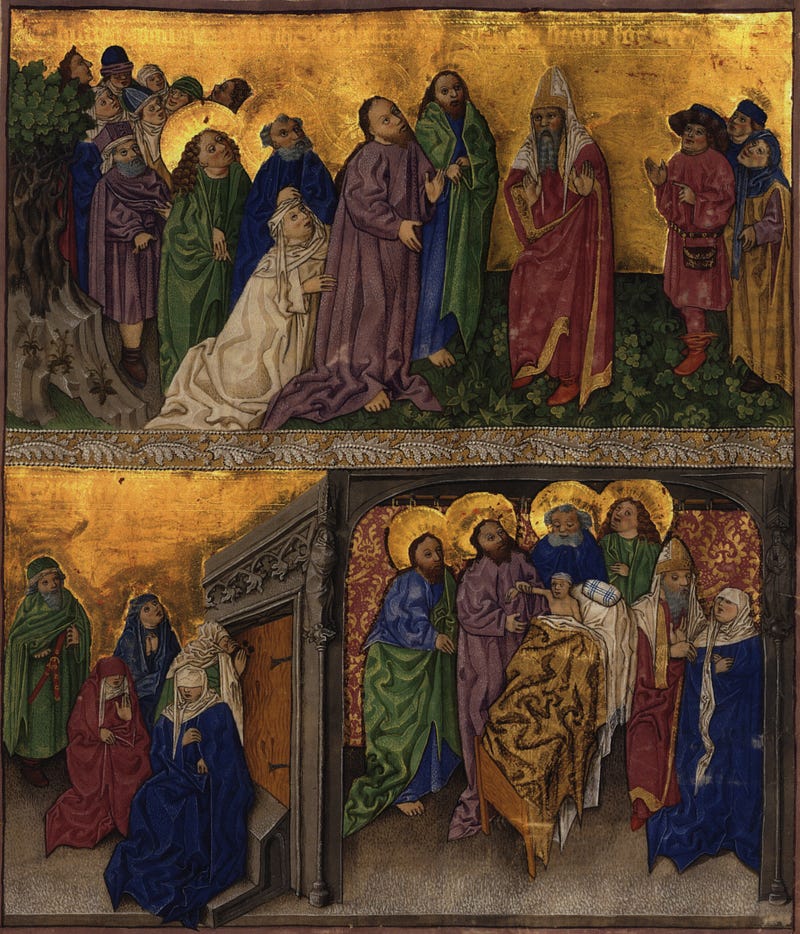
So what does it all mean? Essentially, the woman who bled for twelve years and the twelve-year-old girl are the same woman. They are all women.
The twelve-year-old girl is dying. She is bleeding. She is leaving behind her time of innocence and becoming instead something abhorrent, something unclean, along with everything she touches and everywhere she sits or lies.
The worshippers of the Great Mother are celebrating the death of the little girl and the birth of a menstruating woman. But Jairus, the ruler of the synagogue, whose very name means ‘God enlightens’, does not want that fate for his daughter.
Jesus has the solution. It is hidden in the story of the woman touching the hem of His robe. As Jesus is being pressed upon, squeezed, and wedged so tightly that no one can see what is happening, Jesus feels the strength flow out of him.
The woman falls trembling to her knees because she is weak from loss of blood. Strength equals blood. Jesus feels the strength flow out of him when the woman touches the fabric. Touching the hem allows blood to flow into the absorbent fabric. But no one can see because the transfer takes place within the press of bodies.
Jesus is describing a mechanism for concealing the young woman’s onset of menstruation. Basically, he is suggesting a strip of fabric be held securely against the girl's body to conceal the flow of blood.
The young woman arises a maiden still, the secret of her bleeding hidden from all prying eyes so that she may continue to live life as a little girl while defying God’s law.
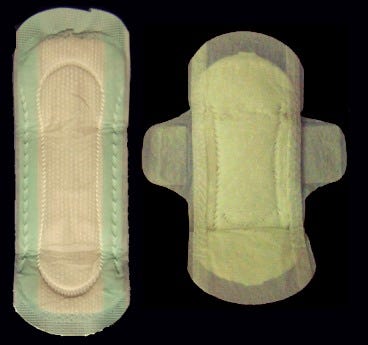

This is why Jesus tells her parents to keep it a secret. He also tells them to feed the girl some meat, to keep her iron levels up.
- Strong, H. A. (1913). The Syrian Goddess by Lucian. London.
- Bailey, C. (1921). Lucretius on the nature of things. Clarendon Press.