
The #1 Skill That Will Make You a Better Data Scientist
And 3 ways to help you master it.

Here’s a sentence I’ve read/heard lots of times.
A data scientist should know Python, statistics, math, machine learning, SQL, …
That’s true. Every data scientist needs those technical skills to extract data, clean data, build models and work with colleagues who have a similar background.
But what happens when you have to share your insights with non-technical people? Well, your technical skills won’t be enough.
Think of that colleague who never wrote a single line of code in his/her life, your boss who barely works with Excel, and stakeholders who don’t care about your model, but its impact on the business.
These non-technical folks are everywhere. This is why your communication skills are as important as your technical skills and will help you stand out from the pack.
Communication Skills
As a data scientist, you need to communicate your insights with others. There are different ways to do this. You can do it through presentations (spoken communication), emails/reports (written communication), and even code (but in this case, only those who code will be able to understand you!).
Here are 3 ways to improve your communications skills as a data scientist.
Get better at presentations
At the end of most projects, you have to share your findings in a presentation. Your audience might be your team, a single stakeholder, a board of directors, or people at a conference.
Although the techniques you use to handle each audience will vary from audience to audience, the foundation of a great presentation lies in great communication skills.
Most of the technical stuff we work with might seem boring to non-technical people so you need to turn these “boring topics” into exciting stories. How?
- Focus on the benefits of your findings. Put on your audience’s shoes and answer the #1 question of every presentation: Why should I care?
- Use metaphors and analogies to make complex things easy to understand
- Avoid using jargon. Don’t use words that only data scientists will understand
- Make numbers more meaningful. Focus on the impact on the business every number has rather than on the number itself
- Sell your ideas with power, energy, and charisma
- Needless to say, work on eye contact, posture, and hand gestures
I took some of these techniques from the book “The Presentation Secrets of Steve Jobs.” Again, some techniques might change with the type of audience.
With a technical audience, you need to focus more on the technical issues and edge cases. In contrast, a broad audience cares more about the result, so you need to use elements like visualizations to make your findings easier to understand. This leads us to our next point.
Master Storytelling & Data Visualizations
As a data scientist, you probably use tools like Python, Tableau, or Power BI to make visualizations. Although visualizations make our findings easy to understand for non-technical people, if you don’t have the right narrative to share data insights, you won’t make a positive impact on your audience.
Good visualizations with great storytelling are key to communicating your ideas. As a data scientist, you can’t live with only one of them, but need to make them work together.
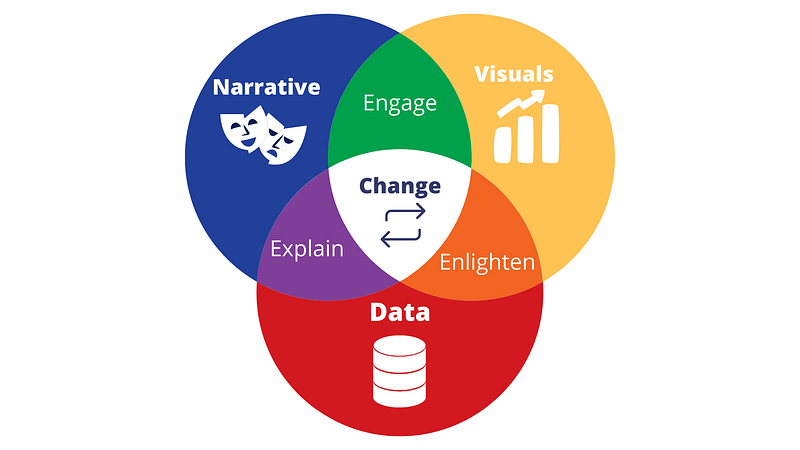
If you explain your data insights with good visualizations and narrative, you’ll be able to explain your findings in terms anyone can relate to.
Mastering storytelling with data takes time. According to the book “Storytelling with Data: A Data Visualization Guide for Business Professionals” there are 6 key lessons you need to learn to tell stories with data: understand the context, choose an appropriate visual display, eliminate clutter, focus attention where you want it, thing like a designer and tell the story.
Improve your communication skills by writing articles (like this one)
Sometimes it’s hard to practice our spoken skills. You might have little time, be an introvert, or have no audience to talk to. Here’s when you can use your writing skills to become a better communicator. Remember, the structure of an article is similar to a speech.
Don’t believe me? I’ll showcase some speech features that are present in an article (introduction, body, and conclusion).
A good introduction should be able to tell readers that the article will be relevant and useful for them (why should I care?). Also, you should explain things as if readers were middle schoolers (use great storytelling, analogies and avoid using jargon)
But that’s not all! You have to keep the promise in the body of the article. You can use elements like visualizations to not bored readers with plain text and keep them engaged.
Finally in the conclusion, like in any presentation, you sum up the most important points of your piece.
There you have it! A simple way to become a better communicator that is right in your computer’s text editor.
Would you like to improve your communication skills and make extra income? Join my email list with 10k+ people to get my free ebook: Code Less Earn More.
If you enjoy reading stories like these and want to support me as a writer, consider signing up to become a Medium member. It’s $5 a month, giving you unlimited access to thousands of Python guides and Data science articles. If you sign up using my link, I’ll earn a small commission with no extra cost to you.