avatarOscar Nieves

Free AI web copilot to create summaries, insights and extended knowledge, download it at here

3018

Abstract

/cdn-images-1.readmedium.com/v2/resize:fit:800/1*1SHnFRLh8p4mraICGV26Zw.png"><figcaption></figcaption></figure><h1 id="6b32">Example 2</h1><p id="21c6">Integrate</p><figure id="174d"><img src="https://cdn-images-1.readmedium.com/v2/resize:fit:800/1*ZJ8-4FETPhnmLQArTtlXig.png"><figcaption></figcaption></figure><p id="7398">where C is defined by the circle |z| ≤ 3.</p><p id="e3a8">The contour encloses a single pole z = 1 of order n = 2. Therefore, by applying Equation 2 and using the fact that complex-valued functions follow the same differentiation rules and real-valued functions, we get</p><figure id="31f4"><img src="https://cdn-images-1.readmedium.com/v2/resize:fit:800/1*qirWmdoQOYwyjmoPNK4BRg.png"><figcaption></figcaption></figure><h1 id="4ea2">Example 3</h1><p id="aca7">Evaluate</p><figure id="7521"><img src="https://cdn-images-1.readmedium.com/v2/resize:fit:800/1*mPb8-GN4q-9GwC80O7GR_g.png"><figcaption></figcaption></figure><p id="11eb">where C is given by |z — 3| < 2.</p><p id="243c">In this case, C is a circle of radius 2 centred at z = 3. Furthermore, there are two different poles for this function, one at z = 0 and one at z = 2, both which have order n = 1. The pole z = 0 does not lie within |z — 3| < 2, but z = 2 does. Because of this, the pole z = 0 can be moved into the numerator to create a new function:</p><figure id="2c6e"><img src="https://cdn-images-1.readmedium.com/v2/resize:fit:800/1*GJM01uh1Te_zC8wVBOtVAg.png"><figcaption></figcaption></figure><p id="f47e">Then, we apply Cauchy’s integral formula to obtain</p><figure id="408d"><img src="https://cdn-images-1.readmedium.com/v2/resize:fit:800/1*wBW9K5rLaU4v0xkDtE75Wg.png"><figcaption></figcaption></figure><h1 id="49dc">Example 4</h1><p id="94ce">Evaluate</p><figure id="fcc6"><img src="https://cdn-images-1.readmedium.com/v2/resize:fit:800/1*KnKypyF-yAtlo11-aF2A8w.png"><figcaption></figcaption></figure><p id="b157">for C: |z| < 2.</p><p id="d0b8">The denominator is not in a form that is conducive to using Cauchy’s integral formula, therefore we must try and factorize it somehow. Using the quadratic formula, we find the following roots:</p><figure id="8473"><img src="https://cdn-images-1.readmedium.com/v2/resize:fit:800/1*lZ32NNSTDGfKjPkODi7hKA.png"><figcaption></figcaption></figure><p id="ac3f">which means the following factorization is possible:</p><figure id="39f5"><img src="https://cdn-images-1.readmedium.com/v2/resize:fit:800/1*39UaoSQh0dQ1f9u1ErieXA.png"><figcaption></figcaption></figure><p id="8bcc">and looking at the modulus of each root we see that</p><figure id="31d7"><img src="https://cdn-images-1.readmedium.com/v2/resize:fit:800/1*QAPibiWH_NLebYIS5dtwPw.png"><figcaption></figcaption></figure><p id="c185">both of which lie in |z| < 2. Because of this, we cannot use the same trick as we used in Example 3, because both poles contribute to the integral. Instead, we must separate this into a sum of integrals by applying the method of partial fractions. We start by writing</p><figure

Options

id="53b3"><img src="https://cdn-images-1.readmedium.com/v2/resize:fit:800/1*Mh_FSE5A5oHCp1wW9YayZw.png"><figcaption></figcaption></figure><p id="8083">and multiplying both sides by the denominator of the LHS, we obtain</p><figure id="117f"><img src="https://cdn-images-1.readmedium.com/v2/resize:fit:800/1*Tbp9Jcyd3QzGLDB1xpUeqw.png"><figcaption></figcaption></figure><p id="6f97">to find the coefficients A and B, we use the roots of z we found earlier. Starting with z1 = — 1 + i, we get:</p><figure id="bb68"><img src="https://cdn-images-1.readmedium.com/v2/resize:fit:800/1*zdtV_yClrk--8eq7-OUBgw.png"><figcaption></figcaption></figure><p id="fd52">Then, using z2 = — 1 — i, we get</p><figure id="caa1"><img src="https://cdn-images-1.readmedium.com/v2/resize:fit:800/1*768RkzoRayRtj829Bq2HmA.png"><figcaption></figcaption></figure><p id="9464">and therefore the integral is split into two simpler ones:</p><figure id="77c4"><img src="https://cdn-images-1.readmedium.com/v2/resize:fit:800/1*oiQ_87lA_LLMfq_i_JxKtw.png"><figcaption></figcaption></figure><p id="b1fb">each of which is evaluated using Cauchy’s integral formula:</p><figure id="a4b7"><img src="https://cdn-images-1.readmedium.com/v2/resize:fit:800/1*wxZP8KgaiaBXACcRJQJq7g.png"><figcaption></figcaption></figure><figure id="8a5e"><img src="https://cdn-images-1.readmedium.com/v2/resize:fit:800/1*GfwGOlVIZGUxoMND5zjuPw.png"><figcaption></figcaption></figure><h1 id="0285">Example 5</h1><p id="9539">Our final example is the integral</p><figure id="6698"><img src="https://cdn-images-1.readmedium.com/v2/resize:fit:800/1*wLFA1NNf-Js2eU52NlHuNA.png"><figcaption></figcaption></figure><p id="5a7f">on an arbitrary contour C enclosing z = 2 twice in a clockwise manner. This one sounds a bit weird, so let’s unpack it: first, C is an arbitrary contour enclosing z = 2. What does that mean? It means C can have any shape, as long as it is a Jordan curve, so this does not affect the value of the integral. In fact, Cauchy’s integral formula implies precisely this: the value of the integral is independent of the shape of C and only relies on the poles enclosed within it. Second: the contour encloses z = 2 <b>twice</b> in a clockwise manner. By default, we use anti-clockwise orientation for contour integrals, but in this case, clockwise means we multiply the final answer by a negative sign. The fact that it goes around <b>twice </b>means that the integral will have 2 times the usual value (the number of times we traverse C becomes a multiple of the integral).</p><p id="9a60">Hence, putting this all together and applying Cauchy’s integral formula gives us the final answer:</p><figure id="19e5"><img src="https://cdn-images-1.readmedium.com/v2/resize:fit:800/1*BD1_FXWGDujoLM2qyz-ydQ.png"><figcaption></figcaption></figure><p id="2ac0">Cauchy’s integral formula is an extremely powerful tool used throughout applied mathematics, physics and engineering. Now that you know the basics, you can tackle a large variety of integrals.</p></article></body>

Cauchy’s Integral Formula
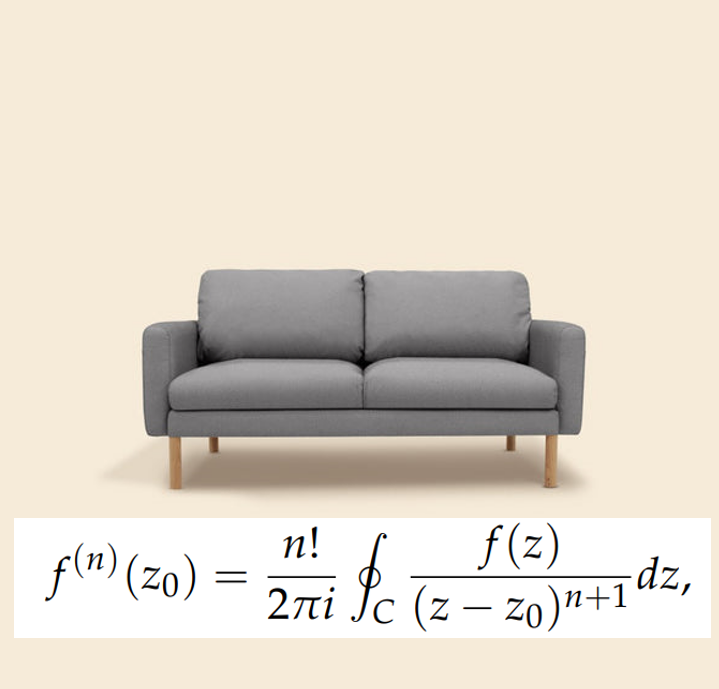
In my previous article (Contour integrals — a simple introduction) I discussed how to perform integrals of complex-valued functions in the complex plane, along a defined contour C by using techniques from line integrals on the real plane. In this article, we will look at slightly more complicated examples of contour integration in which the integrand contains a rational singularity, that is: there is some number z which makes the denominator zero.

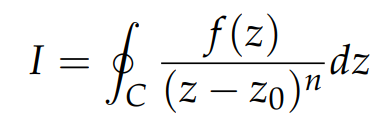
Consider for instance the integral
Equation 1

which is taken around some contour C. C is assumed to be a Jordan curve, meaning that it is closed and does not intersect itself at any point (examples of Jordan curves include circles, ellipses, etc.). This integral has a singularity (also known as a pole) at z = z0 if and only if z0 is enclosed within C. Suppose for instance, z0 = 3, but the curve C is a unit circle, then by definition |z|<1 meaning that z0 = 3 lies outside of C, and so it is not a singularity in that case.

Cauchy’s integral formula is stated as follows:

or more commonly

Equation 2

where the (n) superscript denotes the nth derivative of the function f(z), and it is evaluated at the point z=z0. Let us now look at a couple of examples.

Example 1

Evaluate the integral
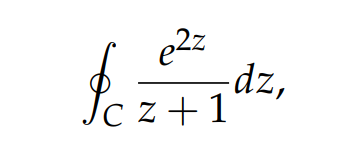
along the contour, C defined by |z| < 2.

Here, we look at the denominator and note how it is the same as writing (z+1)¹. The value which makes it zero is z = — 1, and this lies within |z| < 2 so we say it is a pole of order 1. Next, we look at the function in the numerator, which is
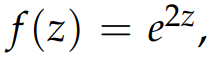
According to Equation 2, the integral evaluates to the (n-1)th derivative of f(z) where n is the order of the pole. Since this pole has order n = 1, the derivative will be the 0th derivative, which is basically the function itself, and therefore:

Example 2

Integrate
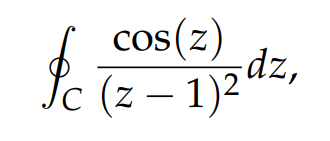
where C is defined by the circle |z| ≤ 3.

The contour encloses a single pole z = 1 of order n = 2. Therefore, by applying Equation 2 and using the fact that complex-valued functions follow the same differentiation rules and real-valued functions, we get

Example 3

Evaluate
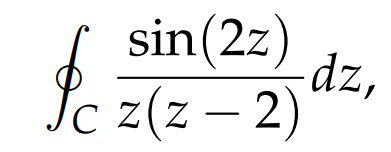
where C is given by |z — 3| < 2.

In this case, C is a circle of radius 2 centred at z = 3. Furthermore, there are two different poles for this function, one at z = 0 and one at z = 2, both which have order n = 1. The pole z = 0 does not lie within |z — 3| < 2, but z = 2 does. Because of this, the pole z = 0 can be moved into the numerator to create a new function:
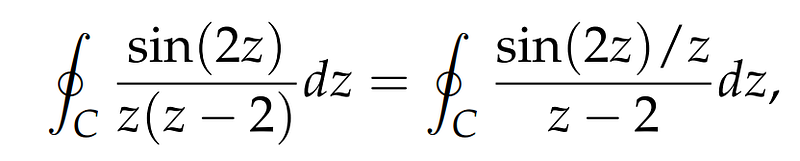
Then, we apply Cauchy’s integral formula to obtain

Example 4

Evaluate
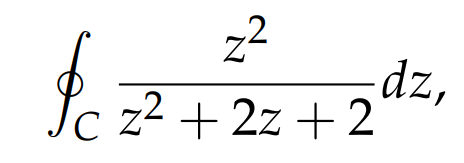
for C: |z| < 2.

The denominator is not in a form that is conducive to using Cauchy’s integral formula, therefore we must try and factorize it somehow. Using the quadratic formula, we find the following roots:

which means the following factorization is possible:

and looking at the modulus of each root we see that

both of which lie in |z| < 2. Because of this, we cannot use the same trick as we used in Example 3, because both poles contribute to the integral. Instead, we must separate this into a sum of integrals by applying the method of partial fractions. We start by writing

and multiplying both sides by the denominator of the LHS, we obtain

to find the coefficients A and B, we use the roots of z we found earlier. Starting with z1 = — 1 + i, we get:

Then, using z2 = — 1 — i, we get

and therefore the integral is split into two simpler ones:

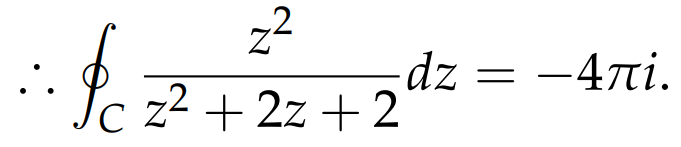
each of which is evaluated using Cauchy’s integral formula:

Example 5

Our final example is the integral
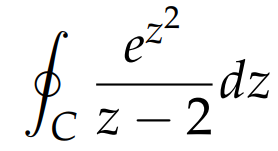
on an arbitrary contour C enclosing z = 2 twice in a clockwise manner. This one sounds a bit weird, so let’s unpack it: first, C is an arbitrary contour enclosing z = 2. What does that mean? It means C can have any shape, as long as it is a Jordan curve, so this does not affect the value of the integral. In fact, Cauchy’s integral formula implies precisely this: the value of the integral is independent of the shape of C and only relies on the poles enclosed within it. Second: the contour encloses z = 2 twice in a clockwise manner. By default, we use anti-clockwise orientation for contour integrals, but in this case, clockwise means we multiply the final answer by a negative sign. The fact that it goes around twice means that the integral will have 2 times the usual value (the number of times we traverse C becomes a multiple of the integral).

Hence, putting this all together and applying Cauchy’s integral formula gives us the final answer:

Cauchy’s integral formula is an extremely powerful tool used throughout applied mathematics, physics and engineering. Now that you know the basics, you can tackle a large variety of integrals.

Mathematics
Education
Physics
Engineering
Science
Recommended from ReadMedium