

Contour integrals — a simple introduction
When dealing with functions of complex variables, such as f(z) where z = x + iy, their integration with respect to z must be done in a slightly different way than integrals of real-valued functions. The techniques are usually a bit difficult for university students to pick up, especially because complex analysis as a subject of study can get very abstract and hairy, when it doesn’t need to be. I will explain here how to do contour integrals on the complex plane, without talking about all the abstract stuff which non-mathematicians wouldn’t need to know anyway.
Consider the following integral:
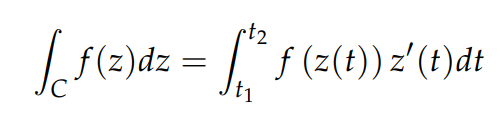
where C denotes some contour (could be open or closed) between two different points on the complex plane, whose endpoints are denoted by t1 and t2, where t is some parameter. For instance, the variable
z(t) = x(t) + iy(t)
is made up of a real part x(t) and an imaginary part y(t), both of which are functions of this parameter t. x(t) and y(t) are what describe the contour C. For example, if the contour C is a parabola y=x² with x going from x = 0 to x = 1, then we can easily set x=t (the independent parameter) and y=t² (the dependent parameter). The end points are then given by the value of x, so:
0 ≤ t ≤ 1
in that case. Now, remember that f(z) can be any function of z.
Example 1
Consider for instance:
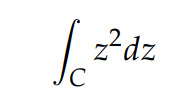
where C is given by that parabola we just discussed, so x=t and y=t² for t=[0,1]. The idea here is to then use Equation 1 to evaluate this integral in Equation 2. First, we express f(z) = z² as a function of t explicitly:
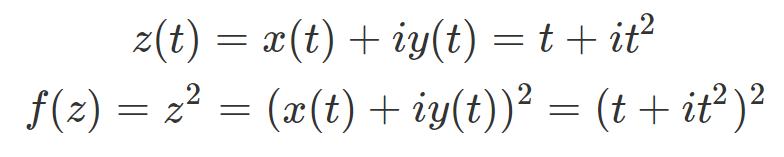
Then, we differentiate z(t) with respect to t:

Then substituting these into Equation 1 and applying the limits t1=0 and t2=1 we get:
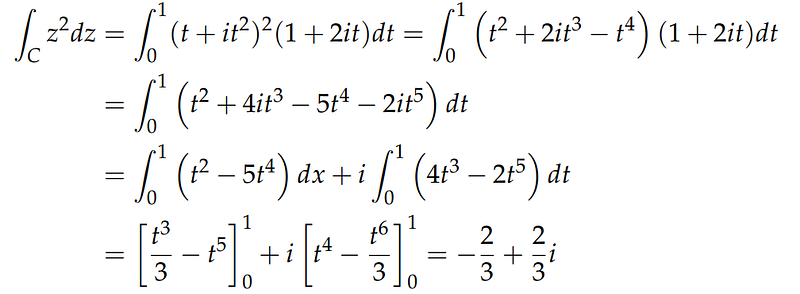
which unsurprisingly is a complex number.
Example 2
Given the contour C: |z| = 1, where |z| is the modulus of z = x + iy and which denotes a circle of radius 1 centred at the origin of the complex plane; evaluate:
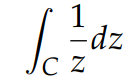
Here we think carefully about how to parametrize x and y in terms of t. Firstly, since C is a unit circle, it makes sense to use polar coordinates and let t denote the angle of rotation with respect to the positive Real axis:
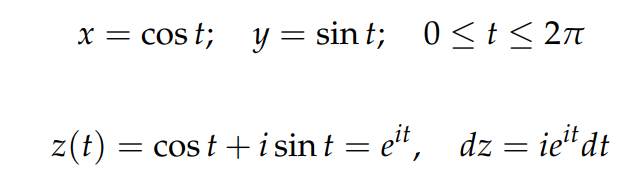
Then, applying Equation 1 we get:

Example 3
For the contour

evaluate the integral
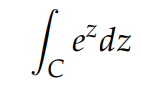
within the interval [0, π].
In this example, we are already given C and the parametrization of x and y, which corresponds to a straight line. Thus we write z(t) as

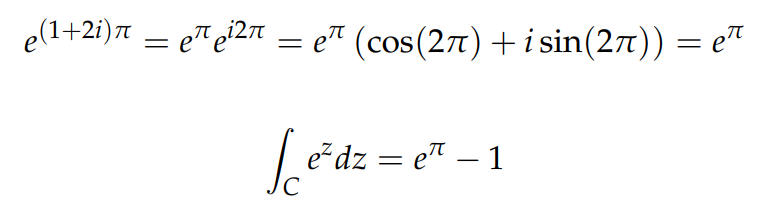
Then, we evaluate the integral as

Finally, using Euler’s formula, we find that
Hopefully these 3 simple examples have illustrated how contour integration is done in the complex plane. There are more advanced techniques which are required for more complicated cases, such as Cauchy’s integral formula, which I shall cover in a later article.