
TRAVEL — MEMOIR
Catalonia, Canvas and Cava
Exploring Barcelona through architecture, art and food
“You have brains in your head. You have feet in your shoes. You can steer yourself any direction you choose. You’re on your own. And you know what you know. And YOU are the one who’ll decide where to go…”
― Dr. Seuss, Oh, the Places You’ll Go!
The train pulled into Barcelona Sants station after a five and half-hour journey from Seville. I prefer train travel in Europe unless I’m in a rush. Watching the countryside roll by from my window while listening to my favorite tune can be enchanting. This route mainly had rugged and dry terrain, but the occasional vineyards and sloping hills were the saviors to my spirits.
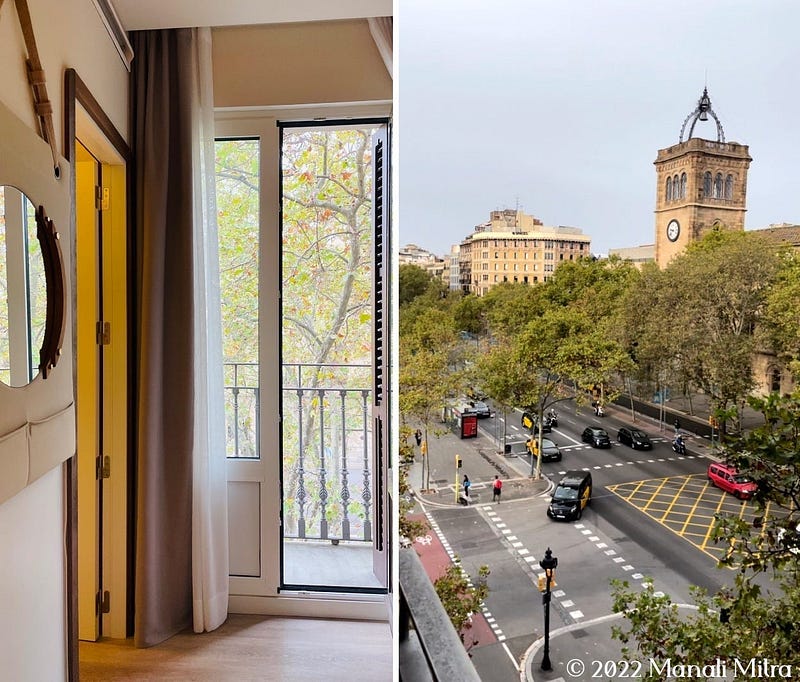
I stepped out of the taxi in the center of Barcelona — Placa de la Universit, and gazed up at the elegant facade of the ‘Sonder Casa Luz’ — my abode for a week. My room was on the 4th floor with a snug balcony. A lush green tree before the balcony was a serene escape surrounded by foliage amidst stunning city views.
It was already afternoon, and I was ravenous. The hotel has a rooftop restaurant. I headed to the open-air terrace; the warmth of the sunlight and the panoramic vista of the bustling city were inviting enough to grab a glass of cava and enjoy the sun and the breathtaking view. Having just arrived from Seville, my head was filled with vivid images of Moorish mosques and palaces. I became more excited about exploring the Catalan capital with every passing moment.
“The straight line belongs to Man. The curved line belongs to God.” — Antoni Gaudi
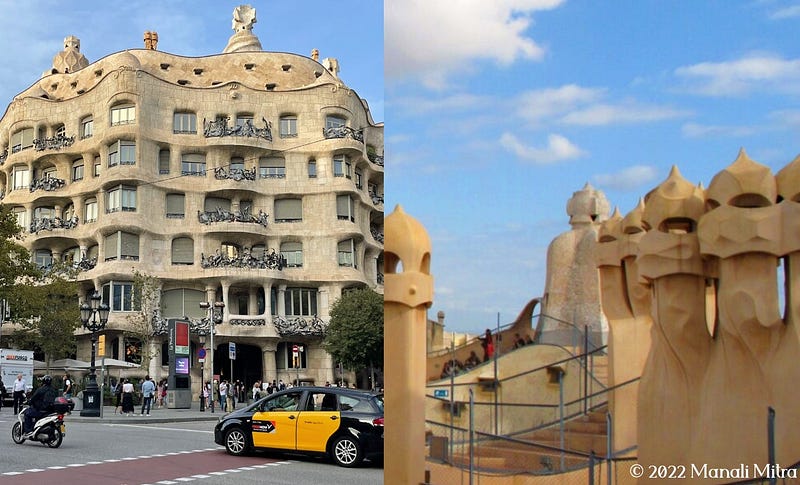
I walked towards Passeig de Gràcia. Life moves at a breathtaking pace in this city — pedestrians hurriedly walk past, cars zoom by, yet, in this urban setting emerge the celestial architectural marvels defying the ordinary! ‘Modernisme’ or Catalan Art Nouveau profoundly impacted the city, and the marvelous architectures are a tribute to the ingenuity of the movement’s pioneers. In the mid-19th century, Catalonia gained substantial power and economic boom due to the growing industrialization and was the most favorable backdrop for a renaissance in the arts and architecture — ‘Modernisme.’ This period saw a rapid urban expansion pioneered by some exceptional talents — Lluís Domènech I Montaner, his student Antoni Gaudi and Josep Puig i Cadafalch. I felt the grand buildings by Domènech i Montaner and Puig I Cadafalch failed to evoke curiosity beyond their overt showcases of wealth, like Gaudí’s Casa Batlló. Casa Batlló has an otherworldly allure. Commissioned by the affluent bourgeoisie, this masterpiece exudes a sense of irresistible wonder! I couldn’t wait to explore the secrets hidden within its walls the following day.
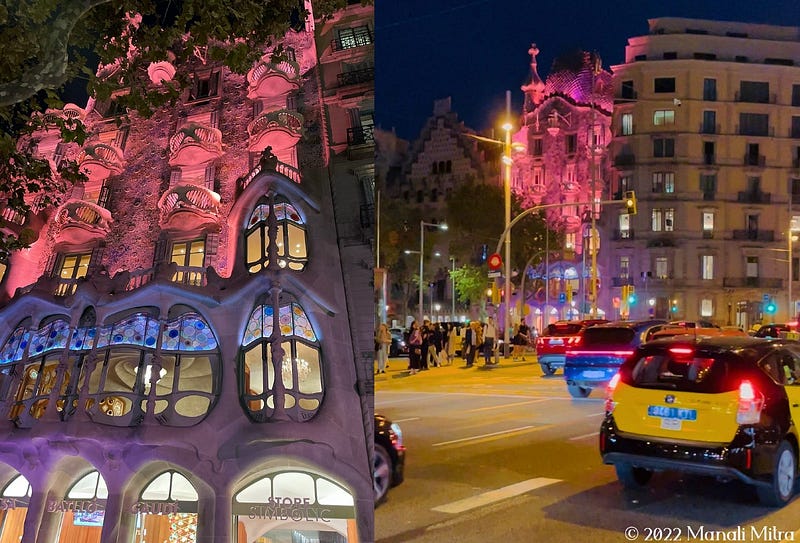
The next morning, I ventured inside Casa Batlló, also called the “house of bones” due to the striking resemblance of its columns to femurs and the balconies to skulls. I got the gold ticket that gave me access to the terrace, private residence, and audio guide.
The majestic crown atop the facade resembles a dragon’s dorsal ridge, accompanied by the four-armed cross symbolizing a sword’s hilt — this has led to interpretations related to the legend of Saint George, Catalonia’s revered patron saint. According to the tale, Saint George valiantly slew the menacing dragon with his sword, saving both the princess and the people from the creature’s wrath. This narrative has led to an intriguing interpretation of the roof’s design, portraying a sword deeply embedded within the dragon’s body while the bone-shaped columns and skull-shaped balconies commemorate its victims. Casa Batlló is also called the “house of the dragon.”
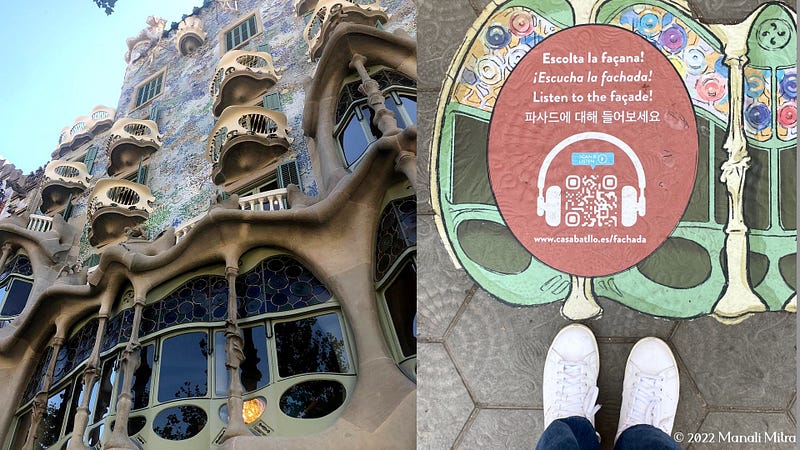
Another interpretation suggests an aquatic theme, drawing inspiration from Monet’s “The Water Lilies” series due to the colorful ceramic glaze and glass fragments on the facade. Salvador Dali supported this interpretation, “Gaudí derived inspiration for the house from the forms found in the sea, reminiscent of serene waves. It is a true sculpture capturing the reflection of twilight clouds upon the water, depicting vast expanses of water, tranquil stillness, shimmering reflections, and rippling currents caused by the wind.”
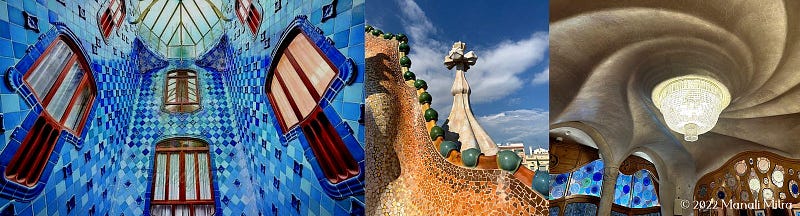
The noble floor of Casa Batlló invited me to experience the splendor of modernist living. The interplay of light and shadows accentuates the unique contours of the ceilings and the walls, casting an ethereal glow throughout the space. The undulating, wavy ceiling resembles the mighty sea — who knew the ocean’s strength could be captured in such an unexpectedly undulating way! In the shaft, the tiles transition from a pristine, snow-white hue to a gentle blue, culminating in a vibrant azure color, creating a visually stunning effect. Gaudi filled the residence with enigmatic symbols and fantastical imagery — a canvas weaving an almost indecipherable narrative together. Interestingly, Gaudí himself never explicitly explained his work, allowing our imagination to complete the story behind the symbols and imagery found in the house!
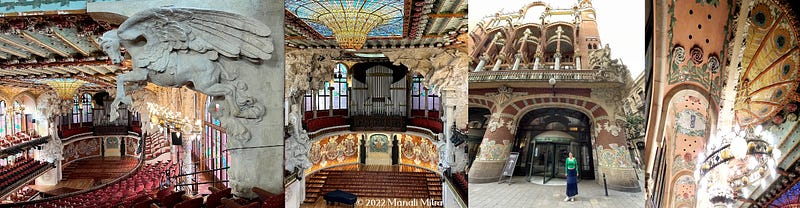
Another notable creation is Lluís Domènech i Montaner’s stunning concert hall, the Palau de la Música Catalana. During the late 19th century, the “Orfeó Català,” an amateur music society, gained immense popularity in Barcelona. With a vision to create a distinctive venue for their performances, they sought the support of generous donations from affluent merchants and industrialists. The renowned architect, Domènech i Montaner, was hired for this task. According to Domènech i Montaner, the Palau de la Música Catalana was intended to be a “garden for music.”
As I stepped in, a mesmerizing display of mosaics showcasing intricate patterns of flowers, fruits, and peacock tails caught my attention. Notably, Pegasus, the winged horse, takes flight from the second balcony, adding a touch of mythical charm. Dominating the scene is a monumental organ boasting an impressive array of 3,700 pipes.
In the evening, I went back to see the mesmerizing performance of the “Barcelona Guitar Trio,” purely to bask in the immersive ambiance of Catalan modernist architecture. Both the performance and acoustics were incredible!
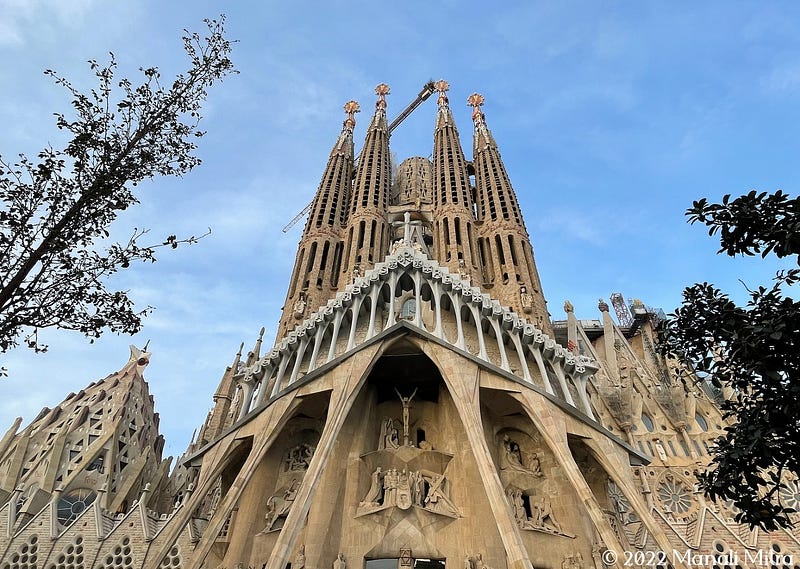
“For the first time since I had been in Barcelona I went to have a look at the cathedral — a modern cathedral, and one of the most hideous buildings in the world. It has four crenellated spires exactly the shape of hock bottles. Unlike most of the churches in Barcelona it was not damaged during the revolution — it was spared because of its ‘artistic value’, people said. I think the Anarchists showed bad taste in not blowing it up..” — George Orwell, Homage to Catalonia
I must confess my sentiments aligned with George Orwell’s when I first glanced at the Sagrada Familia from a distance. The facade is a steampunk architect’s wild creation from Jules Verne’s book.
The Sagrada Familia showcases three perspectives devoted to a different chapter of Jesus’ life. The Nativity Facade, on the eastern side, is the oldest of the three and celebrates the birth of Jesus. Facing west, the Passion Facade portrays the story of Christ’s death and resurrection. Lastly, the south-facing Glory Facade embodies the eternal glory of Jesus even beyond his earthly life and is incomplete.
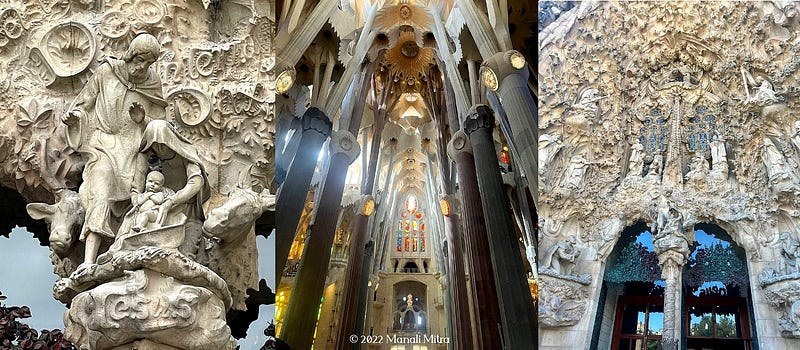
As I stepped onto the nativity façade, all my reservations dissipated. The scale and vibrancy of the interior are absolutely breathtaking! Columns, resembling the trees, ascended towards the ceiling, branching out like a majestic forest. The grand geometric stars were punctuated by open hyperboloids that absorbed and diffused light, creating an ethereal canopy reminiscent of the celestial realm. Sunlight filtered through stained-glass windows, painting the stone surfaces with a stunning palette of greens, blues, yellows, and reds, casting ever-shifting patterns and illuming intricate carvings.
“Do you want to know where I found my model? An upright tree; it bears its branches, and these, in turn, their twigs, and these, in turn, the leaves. And every individual part has been growing harmoniously, magnificently, ever since God the artist created it.” — Antoni Gaudi.
The construction is still underway and is expected to take another 20–30 years. The cranes and scaffolding have become an integral part of Sagrada Familia.
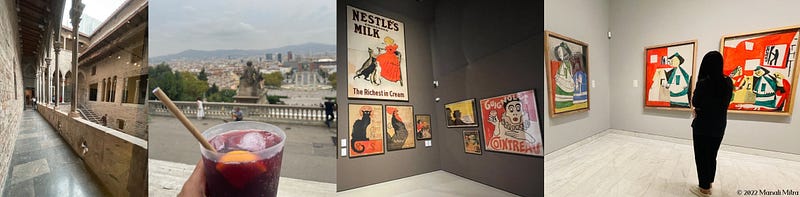
One of the many things that I enjoyed most about Barcelona was the abundance of public art found throughout the city and the art museums. I got the pass that gave me access to six museums.
The Picasso Museum, located inside adjoining five medieval palaces built in the Catalan Gothic style, offers a comprehensive view of his oeuvre of over 4,000 pieces, including paintings, sculptures, and drawings. The majority of the displayed artworks belong to the period 1890 to 1917 — from Picasso’s childhood and school years like “Man with Beret,” “Waiting” (1901,) his time in Paris, and works from the Blue Period and the Rose Period. I was particularly interested in his exceptional “Las Meninas” series from 1957. This series comprises 58 paintings that analyze Diego Velázquez’s masterpiece. An absolutely fascinating series.
“If someone wants to copy Las Meninas, entirely in good faith, for example, upon reaching a certain point, and if that one was me, I would say...what if you put them a little more to the right or left? I’ll try to do it my way, forgetting about Velázquez. The test would surely bring me to modify or change the light because of having changed the position of a character. So, little by little, that would be a detestable Meninas for a traditional painter, but would be my Meninas.” — Pablo Picasso, 1950.
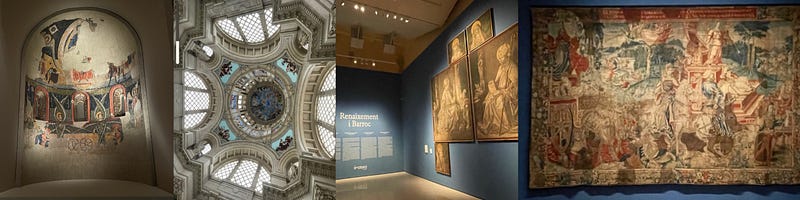
Museu Nacional d’Art de Catalunya houses the world’s finest collection of Romanesque murals. During the middle ages, Catalonia, particularly the Spanish Pyrenees, was a prominent center for art, with many small churches with colorful murals. To protect and make these artworks more accessible, they were transferred to the museum — an absolute must-visit destination for art enthusiasts.
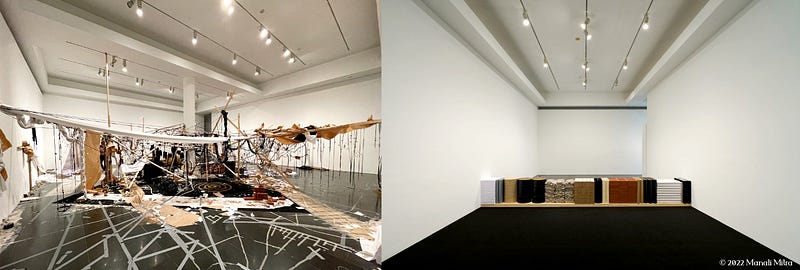
MACBA, Museu d’Art Contemporani de Barcelona, is a museum dedicated to modern art. The museum fosters critical discussions surrounding art and culture with regularly rotating exhibitions. I was lucky to catch Brazilian artist Cinthia Marcelle’s exhibition — A Conjunction of Factors. “The Family in Disorder” installation was notably striking. On entering, going to the right I encountered a dead end: a black-carpeted room divided by a neatly stacked barricade made of bulk quantities of the materials. Turning to the left, I found a large open area, an installation made from the same materials by a group of workers invited to occupy the space in Marcelle’s absence. Marcelle’s art aims to disrupt hierarchies and binaries in our daily lives.
I was thrilled to see The Brain(s) exhibition at CCCB aimed to explore the complexity of the human brain and its relation to creativity, emotion, perception, and consciousness. The interactive installations, multimedia artworks, scientific experiments, and philosophical reflections all focused on exploring the mysteries of the brain — a must-see exhibition for a cognitive science enthusiast like me!
Last and not least, Fundació Joan Miró was a breathtaking experience, and I have dedicated a separate post to share the story.

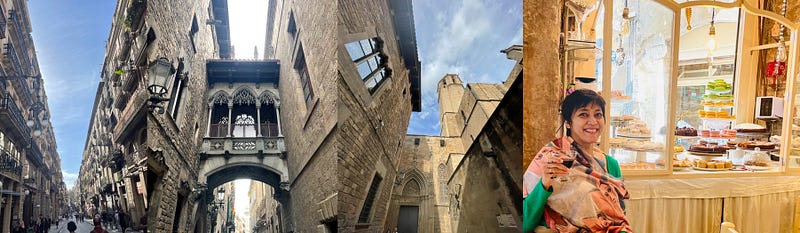
To culminate my trip, I enthusiastically joined a food journey led by the local food guide, Atair. We were a small and diverse group of four travelers. With Atair’s expert guidance, we ventured into hidden gems I would have never discovered. One highlight was a visit to a bodega, where we had the privilege of meeting the passionate winemaker behind the exquisite wine we were having. Each bodega had its unique story to tell. Another charming experience was visiting this cozy bar owned by a warm elderly couple who spoke only Spanish. We listened to their stories while Atair graciously translated. Atair’s thoughtful curation of the tapas menu, wine and cava, and his ability to share the stories behind each dish gave us great insight into Barcelona’s bodega and tapas culture.
As I sat in the taxi later that night, watching the illuminated roads pass by, my thoughts meandered to the 13 hours flight that awaited me the following morning. With deep gratitude, I whispered, “Gracias, Spain.”
From the architectural marvels of Barcelona to the passionate rhythms of flamenco in Andalusian towns, my journey was an unforgettable emotional crescendo that would forever linger in my memories.
“We crossed spacious streets, with building resembling palaces, in La Rambla promenade; the shops were well illuminated and there was movement and life… I did not decide to go to sleep, even though I wished to, so I could rise early and contemplate, in daylight, this city, unknown to me: Barcelona, capital of Catalonia.” — Hans Christian Andersen.
More of my stories set in Spain:


