
PERSONAL ESSAY
Evoking Lorca’s Duende in Andalusia
A memorable evening to experience Duende, “the mysterious force” that the Spanish poet and playwright Federico Garcia Lorca felt, “has to be roused from the furthest habitations of the blood.”
“The duende loves the edge, the wound, and draws close to places where forms fuse in a yearning beyond visible expression.”
— Federico Garcia Lorca, Theory and Play Of The Duende
Wandering the labyrinth of cobblestone streets in Seville is fascinating– blooming orange trees, roadside cafes offering sangria and paella, flamenco dancers performing at the squares and alleys, and the bright ruffled gowns being sold amidst the kitsch relics and the antiques. Flamenco is as much a part of Seville’s identity as the intricate Moorish architecture. The first flamenco schools from the 18th century are in Cadiz, Jerez de la Frontera, and Seville. These cities have produced some famous flamenco artists in history.
Over several centuries, flamenco in Andulasia has perfected the art of stirring emotions through its craft. The aim is to evoke emotional impulses rather than create sounds appealing to the ear. Love, injustice, misery, and heartbreak are common themes in flamenco, and the artists alter them depending on the situation and mood. I was really looking forward to the flamenco show in the evening.
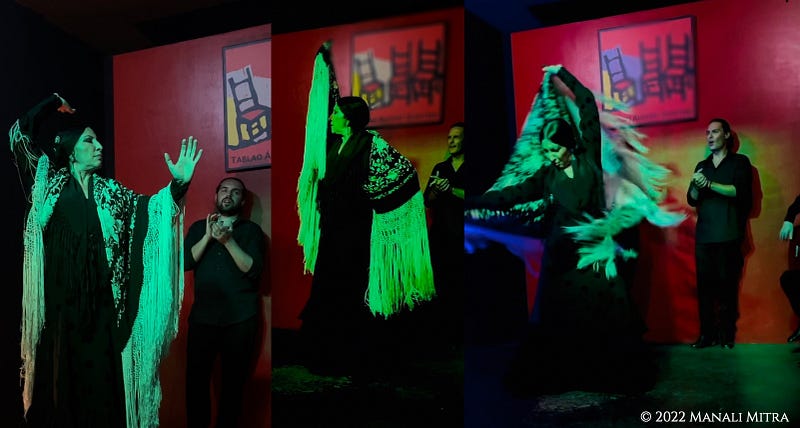
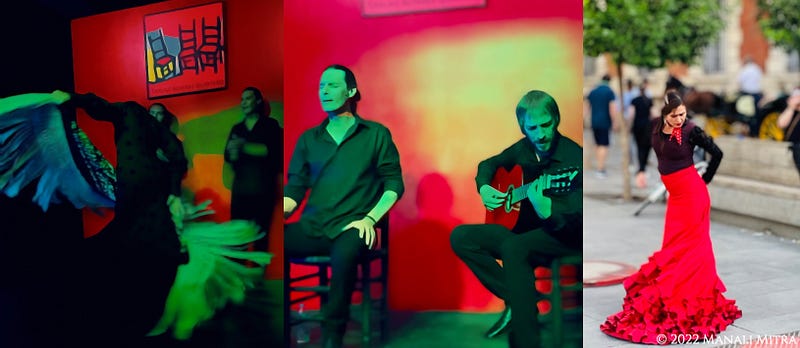
The tablao was small in an old historic building — an intimate set-up. The energy shared among the four performers was electric. Sometimes the dancer was accompanied by the cantaor or the guitarist, and sometimes by both. Though I didn’t understand the language — many of these songs seemed anecdotal, lamenting over a tragic life experience. The guitarist played out the chords with eyes closed, immersed in his craft. The cantaor in his mysterious voice sang the Cante Jondo (Deep Song) with sorrowful modulation that was haunting — like a long, woven cry. Lorca explains in ‘Poem of the Deep Song,’ it is “deep, truly deep, more so than any well, more so than all the seas that bathe the world, deeper than the present spirit that creates it or the voice that sings it, because it is well-nigh infinite. It arises from remote people, traversing the graveyard of the years, and the fronds of parched winds. It comes from the first cry and the first kiss.”
“It is a song without landscape, concentrated in itself and terrible in the shadows, shooting its golden arrows that pierce the heart. It is like a formidable archer of azure whose quiver is never emptied.”
— Federico Garcia Lorca, Poem of the Deep Song
The pathos in the shrill voice of the cantaor was soul-stirring. While singing, his face often contorted into expressions of suffering. The dancer swirled and stomped on a hardwood floor even faster while clapping her hands and snapping her fingers. Her fingers curved in graceful pain. Her body rhythm expressed a moving story. Her moves exuded rebellious grace. Her expressions evinced heartache. Her aggressive stomping manifested revolt. I clenched my jaw, in attempt to fight back my tears in vain. There was a feeling of ecstasy, grief, emptiness, loneliness, and joy all at once! The waves of emotions were inexpressible. Could I be experiencing duende?
“The arrival of the duende presupposes a radical change to all the old kinds of form, brings totally unknown and fresh sensations, with the qualities of a newly created rose, miraculous, generating an almost religious enthusiasm.”
— Federico Garcia Lorca
What is Duende? The Spanish poet and playwright, Federico García Lorca does not give a simple explanation but exalts its force by providing many powerful references. Lorca quotes Johann Wolfgang von Goethe providing a vague definition — duende is a “mysterious force that everyone feels, and no philosopher has explained.”
During his famous lecture at Buenos Aires in 1933, ‘Theory and Play of the Duende,’ he says,“The duende is a power, not a work. It is a struggle, not a thought. I have heard an old maestro of the guitar say, ‘The duende is not in the throat; the duende climbs up inside you, from the soles of the feet.’ Meaning this: it is not a question of ability, but of true, living style, of blood, of the most ancient culture, of spontaneous creation.”
I understand duende as the spirit of summoning, kindling and motivation; it is a spirit which graces an artist during their performance, composition or any creative craft — “Each art, as is natural, has a distinct mode and form of duende.” It can also be felt by the audience when they experience a performance or listen to a melody or even while reading a book. Duende is a shared experience between the artist and the audience — “….she managed to tear down the scaffolding of the song, but allow through a furious, burning duende, friend to those winds heavy with sand, that make listeners tear at their clothes with the same rhythm..” Duende cannot be predicted or stipulated — “Seeking the duende, there is neither map nor discipline.”
After the hypnotizing and emotionally uninhibited experience, the lights came on. I looked around; the rest of the audience was also in tears, but an enraptured, fulfilling smile on their faces.
“The great artists of Southern Spain, Gypsy or flamenco, singers dancers, musicians, know that emotion is impossible without the arrival of the duende”
— Federico Garcia Lorca, Theory and Play Of The Duende
Does one need to visit Andalusia to experience duende? No.
“Every art and every country is capable of duende…All the arts are capable of duende, but where it naturally creates most space, as in music, dance and spoken poetry, the living flesh is needed to interpret them, since they have forms that are born and die, perpetually, and raise their contours above the precise present.”
— Federico Garcia Lorca, Theory and Play Of The Duende


