
Casey’s Reviews
Cards Against Humanity
A review of a party game for horrible people
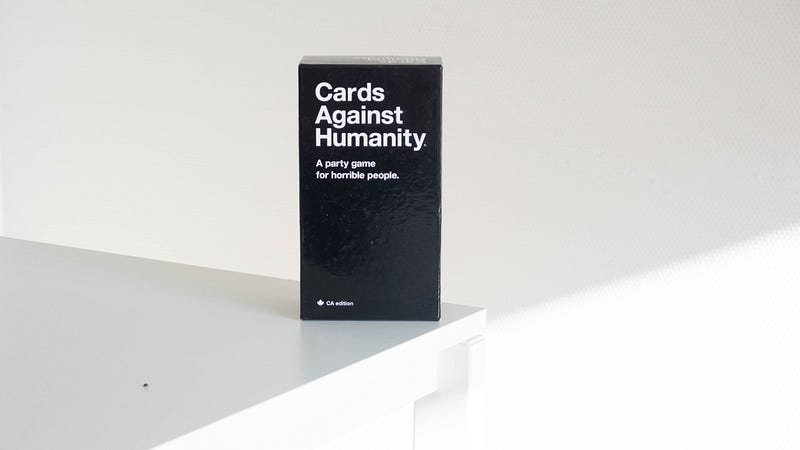
Cards Against Humanity is grown-up Apples to Apples. Using a white answer-card from your hand to fill in the blank on a black prompt-card, the object of the game is to get the judge, or “Card Czar” to laugh — by any means necessary.
Warning: this review contains potentially offensive content.
Marketed as a “party game for horrible people” because of its deliberately offensive material, Cards Against Humanity is not for squeamish players or for children. Many of the cards are raunchy, dark, sacrilegious, political, and even racist or homophobic, which might throw some people off. In a game of Cards Against Humanity, shock value is King.
Here’s an example round:
“This is the prime of my life. I’m young, hot, and full of _____.”
- Hope.
- Crippling Debt.
- Viagra®.
- White power.
- A man on the brink of orgasm.
Now, the winner of this round is going to depend a lot on the Czar’s sense of humour. Each round is judged by a different person, so you have to tailor your responses.
If the Czar is a student, “Crippling debt” might make them snort. A good sex joke, like “Viagra” or “A man on the brink of orgasm” is a pretty good bet to make most people laugh. Playing something like “White power” can be a risk if you don’t know someone’s sense of humour. “Hope” is only the funniest answer if the Czar is a very literal player, or the other answers don’t make sense.
Recently, I played this game with a group of my husband’s colleagues at an office mixer. It’s a great game to play in a big group, and there can be a good bit of background chatting without too much disruption to the game.
All the participants were graduate students or postdocs, so the age range of players was 25–35, and many of the players spoke English as a second language. Sometimes we had to throw back cards that didn’t make sense to this particular audience, since the references can be pretty American-centric (or in the case of the Canuck expansion, Canadian-centric), but for the most part, it worked as an accessible intro game with simple rules.
One drawback to the game is that, because it is deliberately offensive, people from different backgrounds or cultures may find the game legitimately offensive. When explaining the game, you really do need to emphasize that the game contains raunchy and rude answers, and giving a sexist response, for example, doesn’t mean that speaks to your core beliefs.
In fact, quite the opposite — it’s a game of intrusive thoughts, of all the things you’d never say out loud because they’re horrible and you know they’re horrible, but that’s what makes you laugh: the incongruity.
Another example round:
“What has been making life difficult at the nudist colony?”
- Menstruation.
- Coughing into a vagina.
- A snapping turtle biting the tip of your penis.
- The primal, ball-slapping sex your parents are having right now.
- The eighth graders.
- Some douche with an acoustic guitar.
This game uses taboo subjects like pedophilia, incest, racism, and sexism to create some truly absurd combinations.
For those who are open-minded and willing to blush, face-palm, and say the words “biggest blackest dick” out loud, the game manages to be oddly charming.
But not all responses have to be offensive! Sometimes, the funniest answer is actually the cleanest one, especially when all the other answers go the dirty route. For example:
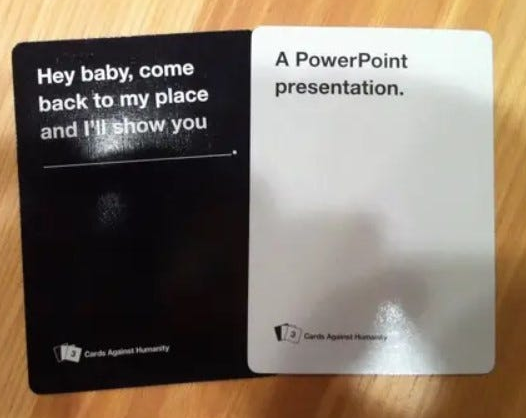
When you really know someone, it pays off to predict what sort of answer they’ll find funniest when it’s their turn to be Czar. For some people, the “biggest blackest dick” card trumps all others. For my husband, I know I can get a point if I play something about the Discovery Channel, science, or academia.
Not everyone thinks the game is fun, although I clearly do.
The Beaverton, a satirical publication (Canada’s version of The Onion) published a tweet calling Cards Against Humanities “the most annoying thing you can bring to a party.”
I’ve also seen a lot of complaints that the game is “so Millennial,” and therefore should go the way of the dodo. As a Millennial — and a cuspie at that — I don’t think it’s necessarily a bad thing to play a game designed for our demographic.
Poker was invented in the 1930s, and plenty of people still play it. There are games associated with older people — rummy, cribbage, checkers, shuffle board — and games associated with kids, like Go Fish! or Snakes and Ladders. Have we given up on those too for being old? Why can’t we have a game associated with being in our late 20s and early 30s?
Maybe I’m out of touch, but I still think Cards Against Humanity is a great ice-breaker. Perhaps it plays into Millennial nihilism and dark humour, but there’s something about making raunchy jokes (with everyone’s consent!) that clears away the stuffiness of an office party.
I think you can learn a lot about a person by playing Cards Against Humanity. But maybe I’m just a horrible person!
Reviewsday Tuesday is run by yours truly, Casey Lawrence. Running a publication is a time-consuming volunteer activity. If you enjoy my work, consider showing your support by buying me a coffee. If you sign up using my referral link to get unlimited access to all Medium stories, I receive a small commission, at no extra cost to you.
If you would like to write for Reviewsday Tuesday, check out the submission guidelines. I am eagerly accepting new writers at this time. Follow the publication here on Medium and also on Twitter.


