
Can’t Fly to Bali? Build a Virtual Beach
Filmmaking, poetry, virtual worlds
[Download my free eBook about about the film project here.]
We’re living through plague times and I pray the pandemic does not spawn a sequel to The Walking Dead.
I am exaggerating, of course, but who can fly off to their favourite destination and sprawl on a beach towel in Brazil, Bermuda or Bali? If you crave to get away, building a virtual beach could be your best go-to option, especially one with a history that existed 200 years ago and has disappeared.
Beach Road was part of the Singapore island coastline, founded for the British East India company in 1819. Looking for Mr Gelam, my short film depicts what once fronted the South China Sea and is now buried under landfill and high rise.
I felt a sense of loss. It was time to make my own private beach.
Involved in virtual communities for more than a decade as places of digital modelling, poetry performance, live music and filmmaking, I knew that crafting an online beach experience would also serve as a virtual film set.
Not being a digital builder, I partnered with Dr Scott Grant, an Australian from Monash University’s Virtually Enhanced Learning project (VEL). He was aided by expert 3D modellers — Modee Parlez, from Belgium and Ada Radius from the USA. Using our avatar forms we met in a virtual space and built our film set beach front, pixel by pixel.
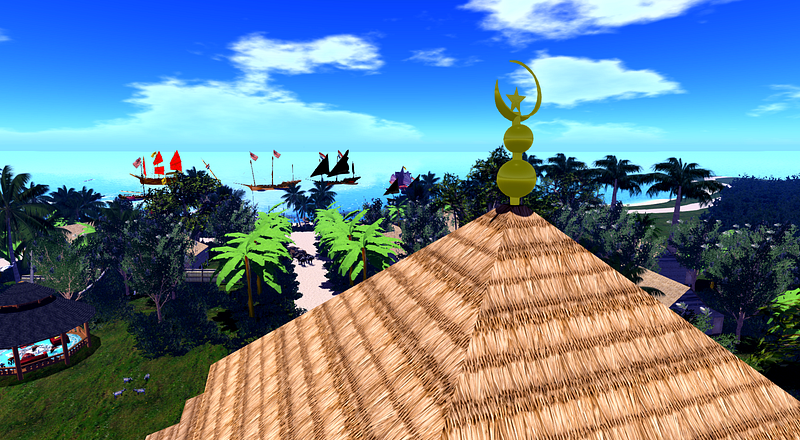
A question often comes up: how true to life is this digital world?
I had to play detective with historical records, scholarly articles, early sketches, paintings and maps. For example, the Malay precinct Sultan Mosque in the film is not the same as the present-day building in the Indo-Saracenic style. Original Malay mosques were made of wood with tiered thatch roofs reflecting a thousand years of Buddhist and Indian influences.
History is a multi-storey pagoda showing more unity between world religions and philosophies than the divided world today. Snapshots of history can be recreated. They simulate the past and inspire stories:
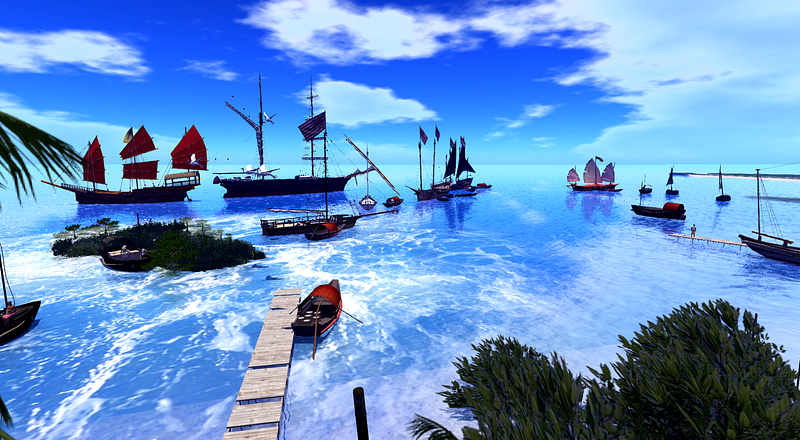
Sailing ships are moored just off the coast, so many blown from far across the earth. We came with Hussein Shah, our royal host, six hundred with him, still, since childbirth.
(from Singapore, 1825, the poem)
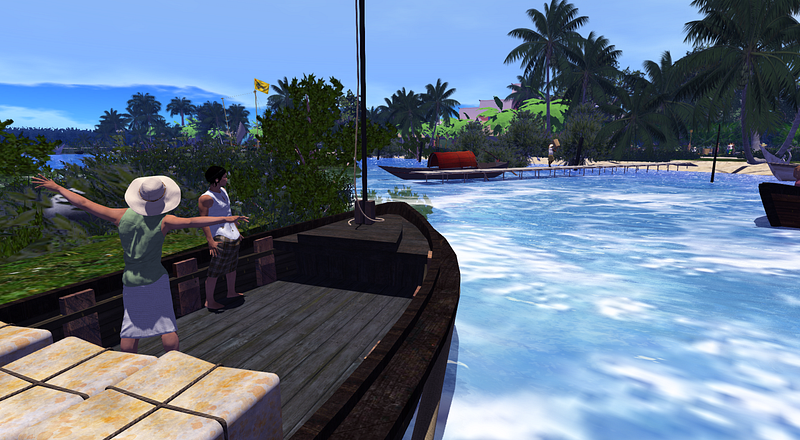
In fact, Singapore 1825, the online digital region, is also open for virtual learning journeys.
The young or the young at heart can take a boat ride and explore blue sea that mirrors the sky. A person can walk between village houses and shade-bearing banyan trees. He or she will find hibiscus and other exotic flowers, clouds of dancing butterflies and love-birds bathing in the palace fountains. You will also notice the occasional coiled serpent here in Paradise.
If your avatar gets tired you can sit in the palace grounds, listen to gamelan music and unwind just as the court did, circa 1825. Yes, unwind. A 3-D environment is immersive and can be deeply relaxing. After all, you are the world-builder, the architect. It is your story. You are the curator of your own happiness.
For a writer, this is also a great place to set the imagination free. Singapore, 1825 has already inspired a couple of short films, retold folktales and an eBook poem with virtual illustrations:
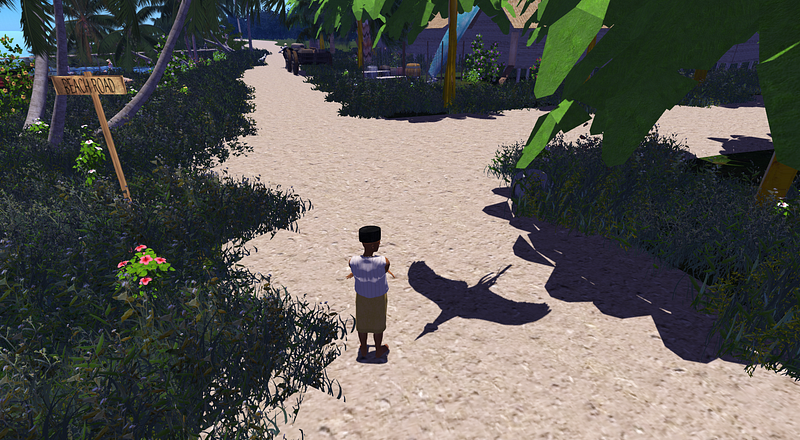
I see a heron’s shadow on the road, a pink hibiscus in the pandan creep. The fisherman is ready to unload. This port is poised to grow. No time to sleep.
(from Singapore, 1825, the poem)
What are some other advantages of virtual worlds for writing and film making? Digital sets are much cheaper to build than physical ones. In Hollywood, green or blue screen productions have become the norm. Think of Lord of the Rings, Avatar, the digital tiger in Life of Pi, and the Yukon of ice and snow depicted in The Call of the Wild starring Harrison Ford.
Large-scale or small, two images or video streams are composited or layered, one in front of the other to create scenes for character acting.
I chose to blend two kinds of cinematography to represent the past and the present Beach Road. It was an apt way to layer the rich multicultural pageantry of Malay, Chinese, Indian, Middle-Eastern and European settlement. Singapore, too, a tiny island off the tip of the Malay Peninsular only 30 km long, grew to become the largest container port in the world until Shanghai snatched that mantle a decade back. A digital world like this can be highly instructive for education.
A modestly-resourced blended reality film can visualise the past far more memorably than looking at an image in a book or online. As a filmmaking tool it was the imaginative key I needed to make Looking for Mr Gelam. I could not afford multiple location shoots and period-costume acting sequences.
Virtual film-making is on the cutting edge of cinema today, take for example, The Mandalorian where micro-LEDS are now replacing green screens. Advances in digital tech like computer game engines such as Unreal Engine and Unity hooked up to cameras with VR sensors have opened the portal to Indie filmmakers who do not have a Hollywood budget.
Ultimately, my blended reality film only dips its toes in that cinematic pool of possibilities to remind us what we have lost — in this case, the original Beach Road with its languorous coconut palms looking out at the era of tall ships and trade, replaced by today’s luxury hotels and concrete apartment blocks.
Many would say that our game-on lifestyle is sailing into storms of stress and away from the island of peace. The story of urbanisation versus heritage preservation is much the same around the world.
I hope Looking for Mr Gelam shows other indie writers, set designers and filmmakers a few ways to use virtual worlds creatively. They can remind of who we are and where we come from.
Chris Mooney-Singh’s most recent short film Looking for Mr Gelam was released in Jan 2021. Access the free eBook here:


