
Can You Imagine a World Without Water?
How privileged the few who have access to life’s gold
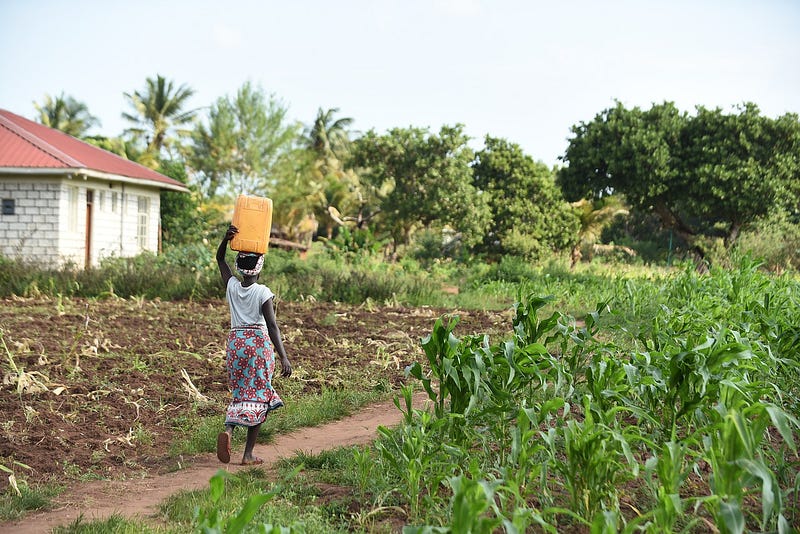
Planet Earth would be as barren of life as Mars if not for this precious commodity. No plants, no trees, no animals of the land and seas — and no us.
For this piece, I climbed aboard my soapbox to highlight the predicament of those without water, rather than espouse the beauty of Nature’s rivers, waterfalls, lakes and oceans.
Many people in developed countries are unaware of the daily struggle of billions whose lives are at risk for lack of water.
In our modern world, we open the tap, water comes out — woohoo! Turn on the hose to water the garden, fill our swimming pool, throw our laundry into a washing machine, invest in a dishwasher — until one day the taps will run dry.
My favorite lines from The Rime of the Ancient Mariner by Samuel Taylor Coleridge, that have stayed with me since my schooldays are:
Water, water, everywhere, And all the boards did shrink; Water, water, everywhere, Nor any drop to drink.
Did you know two-thirds of our body comprises water?
- Our brain is 80%
- Muscles and heart are 75%
- Blood is 83%
- Lungs are 90%
- Skin is 64%
- Our bones are 30%
I drink a glass of water before my first shot of coffee in the morning. Helps my brain wake up, ready for another day.
As I gulp the water, I pray for the millions of people across the world who do not have access to drinking water. Nor can they wash their hands, let alone their bodies, or go to the toilet in the way we interpret the term; they practice open defecation.
“Instead of comparing our lot with that of those who are more fortunate than we are, we should compare it with the lot of the great majority of our fellow men. It then appears we are among the privileged.” — Helen Keller.
Because I live in a country where the first and third-world co-exist, I am sensitive to the plight of those less fortunate. I’m grateful I can drink water as and when I need it, to stay hydrated and healthy.
Other people can’t.
Within the United Nations 2030 Sustainable Development Goals is goal #6, “ensure availability and management of water and sanitation for all.”
According to Lifewater International, as at June 2020, these are the top 10 countries without clean water:
1. Ethiopia
2. Republic of Chad
3. Uganda
4. Democratic Republic of the Congo (DRC)
5. Mozambique
6. United Republic of Tanzania
7. Somalia
8. Nigeria
9. Papua New Guinea
10. Pakistan
(Note: Eight of these are in Africa.)
A report by UNICEF/WHO Joint Monitoring Program (JMP) in June 2019, states
“Some 2.2 billion people around the world do not have safely managed drinking water services, 4.2 billion people do not have safely managed sanitation services, and 3 billion lack basic handwashing facilities.”
Further they say
“Every year, 297 000 children under 5 years die because of diarrhoea linked to inadequate WASH (acronym for Water, Sanitation and Hygiene). Poor sanitation and contaminated water are also linked to transmission of diseases such as cholera, dysentery, hepatitis A, and typhoid.”
In South Africa, six-million people do not have access to potable water.
But the ruling party is more interested in saving a failed airline. Last Friday, Parliament debated (and passed) major budget reductions to various basic and essential services to fund a further $690-million bailout of South African Airways (SAA).
“These deep cuts included slashing budgets for the building of new schools, for the construction of new water infrastructure, for the eradication of pit latrines in rural schools, for the installation of standpipes in poor communities, and a more than $44.7-million cut to the public health budget.” — Daily Maverick.
Next time you wash your hands, flush the loo, or brush your teeth, spare a thought for those denied the luxury we often take for granted.
Please include them in your prayers. (Today I signed up to the Lifewater Prayer Team.)
A special wish to my readers and fellow writers in the US for a Happy Thanksgiving.
Thank you for being here.
My first idea for this week’s prompt from 𝘋𝘪𝘢𝘯𝘢 𝘊. on Water was to write of the floods and droughts brought on by the climate crisis and how that affects communities.
But our electricity went off at 1600 on Wednesday, only returning 21 hours later. I reflected on how my writing life comes to a dead halt without power.
That incident caused me to approach this topic in a more specific way — the impact on people’s lives of being without water.


