
Do Writers Have the Power to Change Society?
And if they can, should they?
If one is to understand if writers can change society, one must first learn how society changes.
To analyze how society changes, one needs a perspective to peer beyond the veil. Whatever the method, one needs to remove the shell hiding the machinery of society, and look deep into its gears.
We can investigate social change via the lenses of communication technology.
Communication is Power
Language defines humanity. It is the capacity for language which gives humans the power to transcend the here and now.
Language gives humans a medium not only to describe what is in front of us, but also to record the past, to imagine the future, and also to lie.
But lies can become reality. Language lets us create alternative worlds, and if necessary, cooperate, convince, and coerce to make that imagined fiction a reality.
There is power in words, but the real power of language is unleashed with writing.
For what is writing but a kind of technology that allows us to create and record permanently what would cease to exist outside of time and memory? Speech decays after it is spoken, and our memories are fallible, prone to failure and suggestion.
Civilization — complex society — is impossible without writing.
There is power in words, but they need to be amplified by communication technology. Communication technology is powerful because it transmits ideas over space and time.
Historically, leaps in communication technology have been a major driver of social change.
The birth of the printing press
In ancient China, there developed a rudimentary form of the printing press — woodblock form of printing and rudimentary forms of movable type. This technology was brought to the Goryeo Kingdom — the polity we know today as Korea. There, in 1230, innovations were made to refine it into a practical working model.
Historical evidence suggests that movable type spread to Europe via the Uyghurs through the silk road, where it set off the printing revolution.
Printing never took off on a mass scale in Korea. The problem was that the Goryeo Kingdom, like other tributary states of China, was using Chinese characters. The thousands of ideograms required to write Chinese or Korean made it cumbersome and inefficient to print at scale.¹
The printing press revolutionized Europe
The printing press took off in Europe. One major reason was the simpler and more efficient Latin alphabet. The printing press printing revolution set off a few other revolutions of its own.
In Europe, the printing revolution allowed Martin Luther to disseminate his 95 theses against the Catholic Church’s issuance of “indulgences” and set in motion the Protestant Reformation.
Galileo’s publication of his text, Dialogue on the Two World Systems, argued that the Earth revolved around the sun. For his heretical claim, he was ultimately placed under house arrest.
Today, everyone knows that the Earth revolves around the sun, even if some people continue to believe that the Earth is flat.
It would not be a stretch to say that the printing press ended the monopoly of the Catholic Church over politics, society, and scientific knowledge, setting off the Scientific Revolution that would go on change the entire world.
If this sounds like a western-centric perspective, that’s because it is. History is written by the victors, and the west won. Because of the printing press.
From radio to crypto
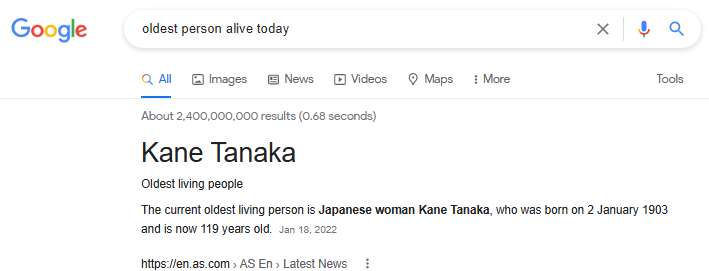
Google tells me that the oldest person alive today is a Japanese woman born in 1903. For Tanaka, she would have likely only come into contact with radios in her early adult years. It must have seemed like a magical new gadget, the pinnacle of what human ingenuity and engineering can produce.
For me, it seems magical that I can know this fact simply by Googling it.
In 1901, Marconi sent his first wireless transmission across the Atlantic Ocean. It would take another 20 to 30 years for the technology to percolate to the masses. The 1920s and 1930s became the golden age of radio.
Tanaka experiences one of the most horrible wars in recent history during her life. But she also experiences moments when technology made magic possible.
Television is invented sometime in 1927. Due to the war, Tanaka probably only gets exposed to this technology in the 1950s or 1960s.
Then, there is another breakthrough — the Internet. It was called a fad, until it wasn’t.
It seems hard to believe that Facebook (Meta) has only been around for less than two decades. Who would have imagined going from internet chatrooms to cryptocurrency in the span of 40 years?
Who could have?
If Tanaka remembers all these details, she must think that she has had a completely different life from what her grandparents would have experienced.
The Power of Writers and Marketers
There is the view that states that marketers are not writers and writers are not marketers. From a superficial point of view, this is certainly true.
From a deeper point of view, this is a false dichotomy: Writers and marketers are both in the business of telling stories.
Successful writers not only distort reality, they often create entirely new ones. Tolkien introduced a new world into our vernacular. We think of elves and orcs and dwarves. And while they don’t physically exist, they certainly “exist” in a cultural sense. Most of us “know” what elves and orcs and dwarves are.
Marketers are in the business of creating worlds as well. Advertising and marketing, if successful, create new ways of being.
Successful marketing creates new habits
The biggest power of marketing is that it creates new habits. By utilizing all kinds of media, brands and products become omnipresent to a level that writers cannot hope to match.
Advertising can be on TV, on Internet ads, on train stations, on pamphlets, on magazines, on the radio.
Everywhere.
Diamond — in reality, a piece of carbon— fetches high prices in the jewelry market. Proposing with diamond rings is seen as customary. We take this practice for granted.
Why? We are often told, as consumers, that diamonds are forever, and therefore a fitting symbol to represent marriage, which should also be equally eternal and long-lasting.
Of course, anyone familiar with marketing history will tell you that the cultural demand for diamonds was fabricated by DeBeers.
Successful marketing creates new habits and ways of being. That is not to say that marketers are mind controllers. Far from it. Marketers just exploit whatever emotions — insecurities and “pain points” — that already exist.
Writers are constrained by the textual medium
Unfortunately, while marketers seek to master all kinds of communication media, writers are, by virtue of their vocation, constrained by their medium.
For the marketer, writing is but one tool within their communication toolbox. Marketers can exploit multiple media. Visual, audio, video, physical, intangible. The list goes on.
The marketer also has a much larger budget. Large businesses can afford to hire entire teams of creative directors, copywriters, PR managers, and run ads online and offline.
Worse, it is often said that in the digital age, people have an attention span of two seconds. If that is the case, writers are at a serious disadvantage.
Given this, can writers change the world? I would suggest that it is possible, but you would need to engender a social movement like the one Karl Marx unleashed.
Karl Marx was a bit like a marketer
In his famous text, The Communist Manifesto, Karl Marx identified the “pain points” of his target, the proletariat. He also helped to paint a dream that was worth the struggle.
Let the ruling classes tremble at a Communistic revolution. The proletarians have nothing to lose but their chains. They have a world to win. — Communist Manifesto (Chapter 4)
Living in Industrial Europe — where people routinely worked 14 hour days, six days a week, in hazardous conditions, and certainly without sufficient rest — that would have been a very strong call-to-action.
And certainly, his work would not have birthed Communism without the organization of the Communists.
Marx amplified his ideology with communication technology and the power of organization. His ideas would have been consigned to the dustbin of history had he not been able to print and distribute the political pamphlet with the funds from his long-time collaborator, Engels, and inspire the Communist parties around the world to organize.
So the question of whether writers can change the world is not a difficult one to answer. History proves that writers can.
The more difficult question is this: Should writers aspire to change the world?
Should Writers Aspire to Change the World?
One need only look at the horrors of 20th-century communism that Karl Marx birthed with his ideas to wonder if writers should change the world.
At a microcosmic level, it is a truism that writing changes the world. Writing is in the world, and it is of the world. When a piece of writing is published, it ripples throughout the world, perhaps altering the electrical signals in the brain of an intelligent person reading it.
New ideas are further born from this reading, beyond the control of the writer of the text. The speaker cannot control how the receiver interprets the message.
Misunderstanding can also be a form of understanding.
Marx could not have predicted the impact he would have on 20th-century history.
Writing has an unpredictable effect in an infinitely complex world. The author has little control over how his or her ideas are understood and acted upon by others.
The Writer’s Consolation
Even if writers do not aspire to change the world, if they achieve a modicum of success, they will already have transformed the world in some way.
Perhaps it goes on to inspire a group of people that will form a social movement to topple governments. Perhaps it gets forgotten and nothing major ever comes out of it.
But one thing remains true.
Writing is permanent.
Even something published online, short of a global meltdown of the physical Internet, will likely last forever, in some mode or manner.
So, even if a writer does not manage to change the world, he or she achieves immortality through words — possibly inspiring someone fifty years later to start a social movement.
And maybe, that is the best consolation a writer can hope to have.
©Alvin T. 2022
Update: Kane Tanaka passed away on 19 April 2022, at the age of 119.
The author writes on a variety of topics. His key topics are Japan, society, culture, modern work, and cryptocurrency, with the occasional fictional story, creative piece, or reflective essay. Discover his most-read stories here.
If these topics interest you, consider subscribing to receive new stories from the author via e-mail.