
Can We Heal This Division?
Some wrongs cannot be righted — so now what?
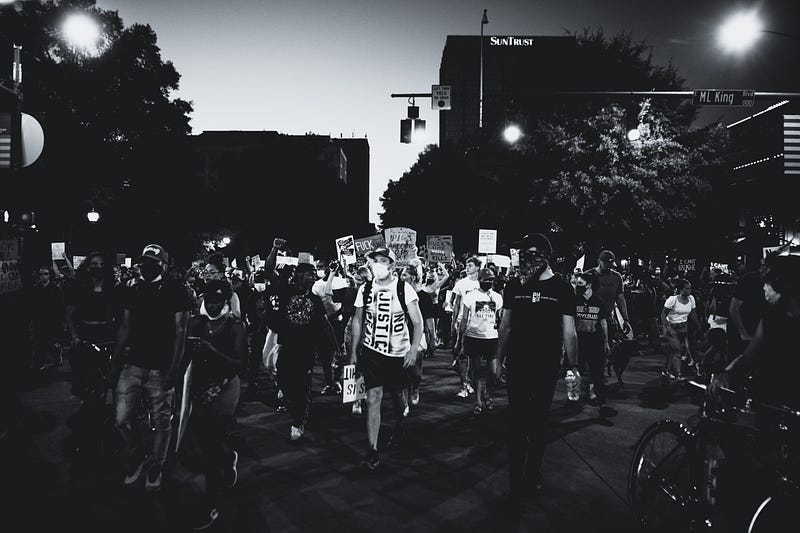
I used to think healing was inevitable. The human body always heals, right? It heals from cuts, bruises, even broken bones. It heals from viruses and infections.
There’s some comfort in that thought — that the human body always strives toward healing.
But there’s one thing I often fail to take into account when I’m not feeling well and trying to rouse my faith in my body’s inherent drive toward health. We don’t always heal. There are things that the body cannot correct.
Some things are too strong to overcome.
It’s not that the body isn’t still striving toward healing — even when death is inevitable, the body would choose life if it could. Living beings cling to their aliveness. We were made with an intrinsic drive to survive.
And yet…sometimes, despite our will, despite our ability to heal, despite our best intentions…we lose the battle.
On election night, an old friend posted a video on Facebook from The Daily Show of Jordan Klepper interviewing people at a Trump rally. She said she needed a laugh, though acknowledged that the footage was far from humorous.
I watched it and felt such a struggle with how to respond. Yes, it was funny… (Maybe not the right word?) Or rather, it would have been funny had it been a satirical TV show about a dystopian society full of people who’d just had lobotomies.
Yet as we watch videos like this one, no doubt many of us are very aware that this is real. This is actually happening. These are the genuine opinions of many, many, many Americans.
To be fair and to keep things in perspective, I think it’s important to remember that videos like these are carefully curated in order to make the biggest impact — comedic with some shock value thrown in.
And yet…living in an alt-right town, I overhear this kind of talk regularly. Not all the time. Not everyone. But curated or not, I know these are real and fairly common opinions.
In other words, the video didn’t shock me. The election night results didn’t shock me, either.
But I think about the body and its attempts to heal. I think about the fact that it cannot heal everything.
And as I look at these people who only care about white lives, people who believe that “one man’s sexual assault is another man’s flirtation,” I wonder…can this be healed?
When I first came to this platform, it didn’t take long for me to start questioning what I was doing. It seemed like a good idea in the beginning and dare I say (without sounding arrogant), I thought I could inspire change.
Very quickly, I realized how naïve I had been. Of course my writing would resonate with people who had similar perspectives — and that’s great. But the people who I hoped would hear me were the ones who would either ignore me or attack me.
Within months, when I’d write about social issues, I did it with a feeling of futility. What was the point of this when it wouldn’t matter to the people who were the most entrenched in their racism, homophobia, and misogyny?
I’ve often gotten into battles with friends and family members who think my work is pointlessly antagonizing “the other side” while failing to actually accomplish anything other than putting myself in people’s crosshairs.
Maybe they’re right.
But what’s the alternative? I argue. Silence? Don’t people like me need to contribute to this dialogue, too?
Their answer doesn’t matter to me, though, because I already hear the futility of that question. There is no dialogue.
We picked our sides. We dug our heels in. And that was that.
I’ve lived in a conservative town for a long time now. Alt-right, actually, though I didn’t know it was alt-right (or even what that term meant) until 2016.
I didn’t love how conservative it was, but I didn’t hate it, either. There are lots of things I love about conservative people. I can’t really explain what it is — maybe their love of tradition, their concern about how we spend money, their love of family.
Although, I don’t really see this as “different.” Me and my liberal friends love tradition, too (some of it), we are very concerned about how we spend money, and we are very protective of family values, too — everyone’s family values. In fact, pre-2016, I would’ve said that all these supposed divides between the political parties are largely exaggerated by the media and our own sense of tribalism.
I grew up around Republicans. Both my parents were raised in Republican households and somehow, they are the only two who ended up leaning liberal after they left home. In other words, everyone outside of my immediate family is a die-hard Republican, with the exception of a few distant cousins.
It’s true that political conversations are not always pleasant for me (I still remember my grandfather calling me in 2000 to complain that I shouldn’t be voting blue anymore unless I wanted to be responsible for the disintegration of American values, and blah blah blah), but I respected my family members and understood that it was probably a good thing that we had a balance of opinions in this country that would hopefully guide us to the middle road and ensure that we would never lean too far in one direction.
So instead of arguing about politics, I quietly lived my beliefs. I rode my bike to work. I took low-paying jobs because they gave me the opportunity to contribute to positive changes in my community. I recycled like a champion. I wrote my representatives.
I didn’t see a need to talk about it — or, more accurately, argue about it. Sure, some days I felt frustrated that everyone wasn’t doing what I was doing because surely I was right. (Ha!) But mostly, I had enough humility to admit that — shocker! — I did not know everything. Just because my beliefs were right for me didn’t mean they were right for everyone.
I came to believe people had to matter over politics — and I still believe that.
What happened that our disagreements went this far? That we are so set in our opinions, so judgmental, and so beyond discourse?
And…how are we going to heal this?
Are we supposed to have a serious discussion to find common ground with people who believe Central America is filled with rapists and murderers who are traveling to the U.S. in caravans in order to defile our women and kill our men? That is racism. That’s not a perspective we need to “come to understand” nor something we should compromise on.
Are we supposed to debate about whether or not we should leave it to individual men to define what constitutes sexual assault?
Are we supposed to have a thoughtful dialogue about why we should allow Black men to be tried and executed in the streets by any random person with a gun whether or not they have actually committed a crime?
I’m not trying to be glib or sarcastic here. I’m seriously struggling with this idea that we need to open up a dialogue and find more common ground in order to heal. In general, I believe that’s true, but in light of what is actually happening in this country, it feels like there are things that must be non-negotiable.
We’ve already had four years of the highest office in the land normalizing racism, sexism, and violence. The last thing we need to do is sit down at the conference table and further normalize this by saying, “Okay, let’s make a deal so we can start healing this divide.”
People’s lives are at stake. What is there to talk about?
In light of my utter confusion about how to respond to the state of this nation on a larger scale, there is one thing I know I can do: Clean up my own mess and be vigilant about what I put into the world.
I can always do better. I can make sure I’m questioning everything, getting my facts straight and apologizing when I screw up. I can strive to not inspire conflict or strife. I can try really hard to question what’s going on over there on “the other side” without pointing fingers or creating more division. (Notice I said “try” because I’m obviously struggling with that one right now.)
I can examine my own biases. I can be open to learning and exploring other people’s perspectives. I can work toward a higher level of emotional maturity. I can remember that everyone I encounter will be affected by my words and even my energy and strive to leave them more fortified than they were before our interaction.
I can insist that my representatives stop speaking in incendiary generalizations, like “The Republicans have blocked us again,” or “Republicans don’t care about ___.” This isn’t helping anything and is only encouraging more conflict, more us-versus-them mentality.
I can keep being an engaged citizen and looking for creative ways to use my talents to affect positive changes. I can reach out to people in my circle and make sure to keep uplifting them.
I believe all these little things matter. Maybe one day, when I die, I’ll find out it was the little things that had the greatest impact — a thousand tiny acts of love that covered the world in kindness, disrupting what looked like, in life, a tidal wave of hatred.
Maybe the only way to heal is to heal ourselves in these tiny increments, all the while knowing that there’s not much we can do in the face of certain viruses and infections. We can only count on our own will to survive and our determination to always do better.
© Yael Wolfe 2020
More on faith and hope and humanity:


