POLITICS | IMPACT
Can We Change the World by Daring and Doing?
An open letter to our government about upstream solutions. We aren’t as powerless as we think.
On September 29, 2020, I wrote an open letter to our Dutch government. To be more precise, to our minister of agriculture Carola Schouten and minister of housing Kajsa Ollongren.
Do you ever think you have no power to change anything? I definitely thought myself powerless. In the past, I was often complaining. Saying to myself and others, why don’t they understand? Why do they decide on stupid solutions?
Well, it changed rapidly these past few years.
In this story, I want to tell you about my friend, Marijn Poels, who made a very impactful film that’s shaking the world awake right now. ‘Return to Eden’ is a film about worldviews. About trying to control the world as human beings. And about choosing to create a better world within nature’s laws.
It is a film about food. And about ecosystem restoration. About laws in many countries and about how we can restore ecosystems, even in the desert. And change the weather and climate in the process.
It’s all about seeds that we plant on acupuncture points. Making an impact without using large scale industrial solutions. Designing and collaborating.
Marijn told in his TEDx talk that he was a gravedigger when he decided to change his life. He embraced his daring and became an impactful filmmaker. Well, my story is different and the same. I embraced my daring and became a changemaker of economies. Aligning them with ecology and humanness.
You can join our wave. Just be brave enough to embrace your talents and shine your light…
Upstream Solutions
First of all, I found words for the way I look at the world. It’s really simple. It’s like a river. We are downstream and our regular solutions take us further downstream.
We put a bandaid on the wound every time a problem shows its head. Instead of looking upstream and transitioning to real solutions. Long-term solutions with benefits for people and the planet.
Then I connected to many people with my worldview on LinkedIn and here on Medium. I invited people I admired for a conversation, learned so much in the process. And some others found me when I started to write my stories. My tribe grows every day now and openly connects to many other tribes.
All these people, all in their own ways with their unique expertise, find solutions the way I do. Upstream, nature-based solutions.
And then I wrote this letter to our government.
The Letter to Our Ministers
Dear Carola Schouten en Kajsa Ollongren,
Let me stop beating around the bush. I would like to invite you both for a film screening of ‘Return to Eden’, the documentary by Marijn Poels released last week.
It is a film that opens eyes and asks many questions. But the beautiful thing is, after watching this film the answers come closer. And that seems like a blessing if you are struggling with the nitrogen problems of our country.
Can I describe how I see it?
Upstream Wisdom
Problems are like rivers. They start at the source and move downstream to the sea. You are close to Rotterdam, nearly at the end of the river. But still, you are looking for solutions downstream.
It’s like a wound. You can put a bandaid on (downstream). You can also prevent the wound from occurring (upstream). And in the case of agriculture, this might have a completely different tone than the simple ‘we need fewer cattle’. Marijn’s film shows that we might need more cattle.
“The connections between Man, Animals and Nature are the only tools available to restore soil degradation, desertification and our climate cycles. [..] Methane is not a problem, it will be broken down and absorbed in healthy soil. The problem is that our soils are not healthy anymore.” — Allan Savory in Return to Eden.
Also, the changing of cattle feed is a downstream solution. I understand the thinking. Less concentrated feed, diluting the manure, fewer ammonia emissions, fewer nitrogen emissions in our nature reserves. But that’s only part of the picture.
What we can do differently, is understanding the mechanisms of nature for real. Let’s not view circular agriculture as the closing of loops here or there. Let’s view it as regenerative agriculture that contributes positively to all water and nutrient cycles.
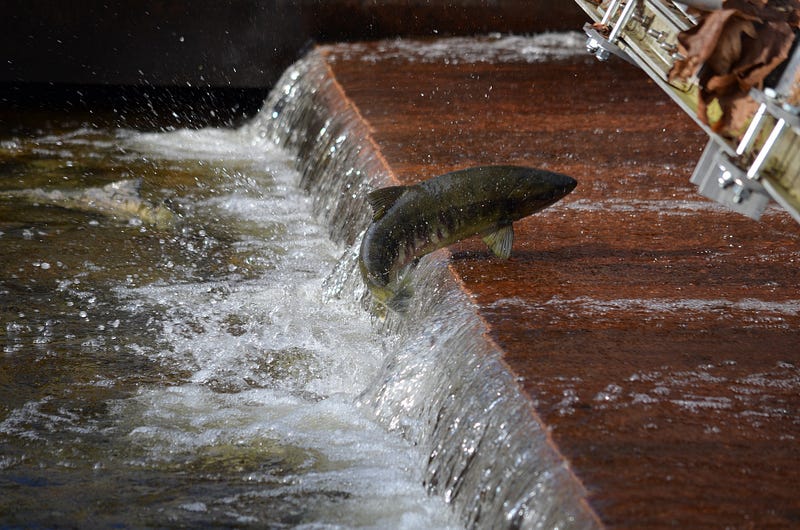
We can zoom out. We can see the connections between the various problems. And then we have to go back a bit to where the problem started. The middle. Upstream we’ll find solutions. The salmon is a symbol of wisdom after all.
And everything starts with living, healthy soil. If we would have healthy soil, give animals a respectful role in restoring our soils, and look closely at the mechanisms of our economy, nitrogen wouldn’t be a problem anymore.
Agricultural landscapes and nature reserves would merge at the edges and bring yields for people, animals, and plants, all together. They wouldn’t be fighters in a boxing ring. Both landscapes would flourish with a living, healthy soil.
It’s really simple:
- We zoom out and see the problem with all connections
- We form a radical vision of how we want to future to be
- We make a holon of minimal laws of what we don’t want. Easy to uphold
- Transition times call for radical measures
- We will show compassion for all stakeholders and communicate in a clear and strong way
Humans in Full Control or as Part of Ecosystems?
Marijn Poels describes clearly the dilemma of our times. Are we continuing on the path of full control by people? Or will we learn from nature? And take up our wise (and modest) place as the human part of ecosystems?
And don’t think this doesn’t mean technology. Technology can definitely be part of this picture. But let’s choose technology that supports life instead of destroying life.
It also doesn’t mean that a large scale is not possible. Have a look at the Caring Farmers. They aren’t small fish in the Dutch farming pond.
So why do I also invite minister Kajsa Ollongren for the film screening?
Because agriculture, housing, and the nitrogen problem are connected. In this story, I already wrote about it. But we can definitely say much more about it. Solutions emerge when we look deeply at problems and their connections.
In the case of housing, it means that we have to look smarter at what is available locally and use it to an optimum.
Buildings are just as dependent on healthy soil. And we could transition in our housing to thoughts of healthy shelters. With enough natural ventilation. Several initiatives in The Netherlands combine agriculture with housing and already find solutions.
Cross Viewers and Fresh Thinkers
After the film screening, I suggest adding some wisdom from experts in the Netherlands to nitrogen problems. Wisdom from people who know what I’m talking about when I say zoom out and think upstream.
Let’s start with Marijn Poels himself and two other people from the film, Maddie Akkermans and Ties van de Hoeven of The Weathermakers.
Marijn and me, perhaps accompanied by Maddie, a farmer, and a builder would like to open the conversation with you after the film. We would like to explain what ‘upstream wisdom’ in farming and housing would mean.
But perhaps there are more people who want to add wisdom (from a distance) to this initiative. The exact form I’ll discuss with them as soon as you take up our invitation to the film screening. I, myself, have learned so much from these people, I wish that for you as well!
For scientific wisdom, I’m thinking about the professors Pablo Tittonell (agroecology and landscapes Groningen) and Louise Vet (evolutionary ecology Wageningen). And let’s add the Rotterdam professors Jan Rotmans (transition) en Kees Klomp (purpose economy).
Of course, we ask some Caring Farmers for their wisdom. Ruud Zanders of Kipster, Annette Harberink of Keizersrande, Geert van der Veer of Herenboeren, Marcel Jacobs of People’s Farm or others.
Then we will ask wisdom from Arie Voorburg at Arcadis with his clear vision on Urban Systems, AI en VR, and his projects with the honor’s students at the Maastricht University. He already once made a plan for solving the housing problems in our cities holistically. But his vision was way ahead of the times, back then.
We will ask wisdom from Jan Jongert of the architect agency Superuse Studios. And we’ll ask for input with design eyes from Daan Roosegaarde and Klaske Postma.
Of course, the wisdom of Marjolein Jonker of Tiny House Nederland cannot miss from this list. And we’ll ask the vision of Chantal van Schaik and Sandra Nap of Holland Houtland. They have a brilliant plan to connect the business cases of farmers and builders. They put their efforts into locally growing healthy building materials, such as bamboo and industrial hemp, in order to regenerate the soil at the same time.
And to stress the importance of water, we’ll ask the Dutch Special Envoy of International Water Affairs Henk Ovink to give us water wisdom. Just like Li An Phoa, the woman who shows banks and governments that drinkable rivers can be indicators for healthy economies.
And I should not forget to mention Henk Nieboer and ‘Building with Nature’. They are finding and implementing the nature-based solutions that’ll change a lot in our world.
My partners in healthy buildings, Michel Weijers, director of the Cradle to Cradle Expolab, and Piet Eichholz, professor at Maastricht University (real Estate and Finance), will have some wisdom to share with you too, I guess.
By the way, don’t think that everybody will completely agree with each other in this group. Also, cross viewers and fresh thinkers have their hobby horses. But Marijn and I will make sure that you will get a collection of fresh, cross-connected ideas that can really make a difference.
Then, it’s up to you to weigh the wisdom wisely and make a plan. The benefit of this is that you will have met a forest full of wise trees, whom you can ask for guidance next time you have the tendency to flow down the river.
You will find out it’s not difficult at all to zoom out and to think upstream. And that the nature-based solutions will not have a political color. They will have all the colors of autumn forest soil.
The solutions, as varied as they will be, will have one thing in common. They will be grounded in healthy, living soil. With respect for humans and animals. Biodiversity will take priority. And the diversity of people will be a priority.
Do you like the small club of wise people like this?
Of course, it’s a bit difficult to find a suitable place in The Hague, now in corona times, but Marijn and I invite you to North Limburg. Upstream from The Hague, along the Meuse. We will arrange a setting, for instance in the Venlo municipality office. We will guarantee the 1.5-meter distance.
You can define the date. Marijn and me, we’ll adapt. But please, don’t wait too long. In October please, because from the beginning of November I’m needed elsewhere to share some upstream wisdom.
See you along the river.
Warm regards,
Désirée Driesenaar Blue Economy Expert (at e.g. European Commission)
And for the people who have really become curious now about Return to Eden, you can watch the film here. Free and independently. Sponsored by all political colors of the rainbow together.
What Happened Next?
And of course, now you wonder if I succeeded in getting them to Venlo? Watching the film together? Talking about upstream solutions? The answer is no. Not yet. But I have patience and will try again.
I received a reply from both of them. One is a definite no. The other still has some openings that we are pursuing.
But the film is patient. I might remind them again next year. Or invite other colleague ministers with another plea. Or I’ll screen the film in my local community to explain and discuss. The film is a document that can be used to enlighten governments, businesses, and environmentalists in so many ways. And a small flap of butterfly wings can cause hurricanes of change.
There are multiple messages in the film. And most importantly of all, the messages are triggering us all to make up our own minds. Find our own course in life. Ask questions all day long. Be curious. And then act in our own unique manner.
Apparently, the time is not ready yet for our government. But I believe strongly in planting seeds anyway. The more we make the soil fertile, the more seeds we plant, the bigger the chance that one of them will germinate.
So, I just keep planting seeds. In my own way. Zooming out often to see if I’m still going in the right direction and not trapping myself in some dead-end street. Talking with diverse people to open up my views and find innovative ways of change.
And if you want to respond. Please feel free to add comments to this open letter. We can talk on LinkedIn or contact me via my website. I’m always open to discussions.
Thank you, Mike, for adding your wise energy to my words.
© Désirée Driesenaar