avatarDark Energy Articles

Free AI web copilot to create summaries, insights and extended knowledge, download it at here

2149

Abstract

ific Reports</a>,” scientists from UT Southwestern Medical Center kept a pig’s brain alive outside the body for five hours. They achieved this with a newly developed system that allows the brain to be isolated from the rest of the body using a super-intelligent artificial pump. This tool ensures blood flow to the brain outside the organism.</p><p id="cc3f">The pump can mimic real circulation and modify the blood composition, adjusting its flow to various variables. How does it work? In this situation, the real brain of the operation is the algorithm, which monitors blood pressure, flow, oxygenation, and other factors.</p><p id="eb61">After isolating the pig’s brain from its body (sounds like science fiction, doesn’t it?), its activity was monitored using special electrodes. Interestingly, there were no changes in the organ’s activity observed during the five-hour period.</p><blockquote id="3a7c"><p>“This innovative method enables studies focusing on the brain independent of the body, allowing us to answer physiological questions in a way that was never possible before,” explained Dr. Juan Pascual, the study’s author and professor of neurology, pediatrics, and physiology at UT Southwestern.</p></blockquote><figure id="09f1"><img src="https://cdn-images-1.readmedium.com/v2/resize:fit:800/1*T63OIrvAod8x72ZBRIxBXA.jpeg"><figcaption>[Image generated by <a href="https://leonardo.ai">AI</a>]</figcaption></figure><h1 id="1ee0">This could be the future of medicine.</h1><p id="6fed">Scientists argue that the tool they used could help understand how the body affects or does not affect certain aspects of brain function in the future. In short, it’s about whether the brain can function properly… outside the body. So far, they have examined, for example, the effect of low blood sugar levels on the brain.</p><p id="f1eb">However, it is important to remember that research on brains separated from the body poses a significant challenge in terms of producing the most reliable results. The body can partially compensate for low blood sugar levels by changing metabolism, which affects brain function. But for this, a body is needed.

Options

The “disconnected” brain is somewhat left to its own devices and the machine.</p><p id="878f">This is not the end of research using the super-intelligent artificial pump. In subsequent steps, scientists want to test how their invention performs during cardiothoracic surgeries and transplants as an “artificial lung-heart.” Its task would be to maintain blood flow. Is this what the future of medicine looks like? Even if the planned studies succeed, it will take a long time before the innovative method becomes a reality.</p><div id="975e" class="link-block"> <a href="https://readmedium.com/calhouns-revelation-are-humans-heading-towards-a-rodent-hell-a7249a59db2a"> <div> <div> <h2>Calhoun’s Revelation: Are Humans Heading Towards a Rodent Hell?</h2> <div><h3>Scientists have long pondered the direction and future of humanity. The Calhoun Experiment aimed to illustrate the…</h3></div> <div><p>medium.com</p></div> </div> <div> <div style="background-image: url(https://miro.readmedium.com/v2/resize:fit:320/1*knthe1q7it_ITOyf1JmJkw.jpeg)"></div> </div> </div> </a> </div><h1 id="e6d4">Attention all readers!</h1><p id="bb38"><b><i>As content creators on Medium.com, we face minimal compensation for our hard work. If you find value in my articles, please consider supporting me on my “<a href="https://www.buymeacoffee.com/oconnel">Buy Me a Coffee</a>” page. Your small contributions can make a big difference in fueling my passion for creating quality content. Thank you for your support!</i></b></p><figure id="1057"><img src="https://cdn-images-1.readmedium.com/v2/resize:fit:800/0*Pm9TOr-5svmNuuXB.png"><figcaption><a href="https://www.buymeacoffee.com/oconnel">https://www.buymeacoffee.com/oconnel</a></figcaption></figure><figure id="71ef"><img src="https://cdn-images-1.readmedium.com/v2/resize:fit:800/0*KJc52P2X8j4VSRWK.png"><figcaption><a href="https://www.buymeacoffee.com/oconnel">https://www.buymeacoffee.com/oconnel</a></figcaption></figure></article></body>

Can the brain live without a body? This animal endured for 5 hours.

How does the brain fare outside the body? Scientists have been trying to answer this question for quite some time. The latest study on pig brains has brought new knowledge. The conclusions may surprise.

[Photo by mali maeder from Pexels]

The brain is one of the most complex and fascinating organs in the human body. Advancing science allows us to learn more and more about the center of the nervous system, not only in humans but also in animals. In one of the recent studies, scientists focused on the pig brain. Why such a choice? The researchers did not explain this in the article, but according to previous findings, pigs are considered one of the most intelligent animals. Intellectually, they are often compared to three-year-old children or dogs.

Yet, the pig is not the first animal whose brain has been separated from the body in the name of science. Earlier, the concept of isolating brains was studied in dogs and monkeys.

How does the pig brain function outside the body?

For the purposes of the study described in “Scientific Reports,” scientists from UT Southwestern Medical Center kept a pig’s brain alive outside the body for five hours. They achieved this with a newly developed system that allows the brain to be isolated from the rest of the body using a super-intelligent artificial pump. This tool ensures blood flow to the brain outside the organism.

The pump can mimic real circulation and modify the blood composition, adjusting its flow to various variables. How does it work? In this situation, the real brain of the operation is the algorithm, which monitors blood pressure, flow, oxygenation, and other factors.

After isolating the pig’s brain from its body (sounds like science fiction, doesn’t it?), its activity was monitored using special electrodes. Interestingly, there were no changes in the organ’s activity observed during the five-hour period.

“This innovative method enables studies focusing on the brain independent of the body, allowing us to answer physiological questions in a way that was never possible before,” explained Dr. Juan Pascual, the study’s author and professor of neurology, pediatrics, and physiology at UT Southwestern.
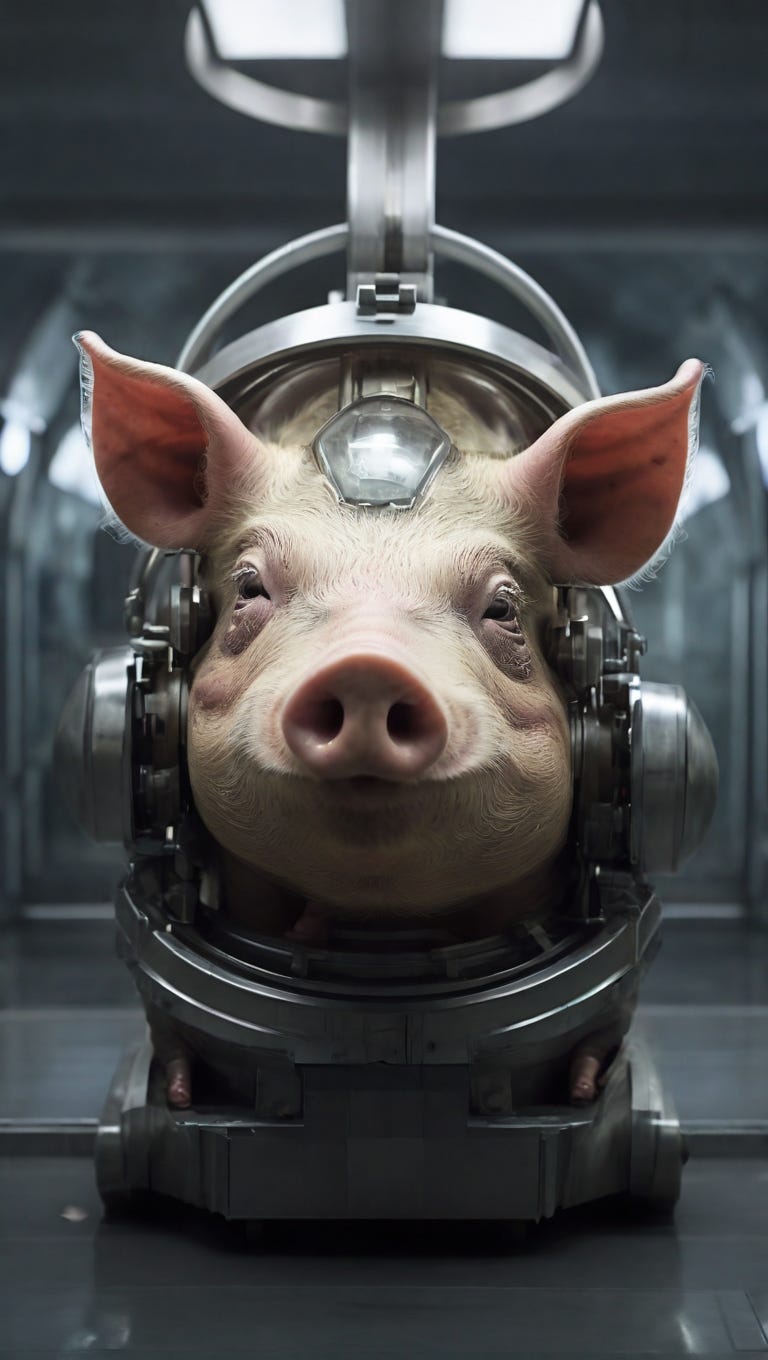
[Image generated by AI]

This could be the future of medicine.

Scientists argue that the tool they used could help understand how the body affects or does not affect certain aspects of brain function in the future. In short, it’s about whether the brain can function properly… outside the body. So far, they have examined, for example, the effect of low blood sugar levels on the brain.

However, it is important to remember that research on brains separated from the body poses a significant challenge in terms of producing the most reliable results. The body can partially compensate for low blood sugar levels by changing metabolism, which affects brain function. But for this, a body is needed. The “disconnected” brain is somewhat left to its own devices and the machine.

This is not the end of research using the super-intelligent artificial pump. In subsequent steps, scientists want to test how their invention performs during cardiothoracic surgeries and transplants as an “artificial lung-heart.” Its task would be to maintain blood flow. Is this what the future of medicine looks like? Even if the planned studies succeed, it will take a long time before the innovative method becomes a reality.

Attention all readers!

As content creators on Medium.com, we face minimal compensation for our hard work. If you find value in my articles, please consider supporting me on my “Buy Me a Coffee” page. Your small contributions can make a big difference in fueling my passion for creating quality content. Thank you for your support!

https://www.buymeacoffee.com/oconnel
Science
Health
Medicine
Life
Research
Recommended from ReadMedium