
Calhoun’s Revelation: Are Humans Heading Towards a Rodent Hell?
Scientists have long pondered the direction and future of humanity. The Calhoun Experiment aimed to illustrate the impact of overcrowding on society. The results of the experiment, dubbed the “mouse utopia,” were shocking. The study’s author sought to transpose the mechanisms governing the modern world into the “rodent universe.” It turned out that conditions of limited space, combined with the absence of threats and unlimited access to food, spelled doom for the entire population.
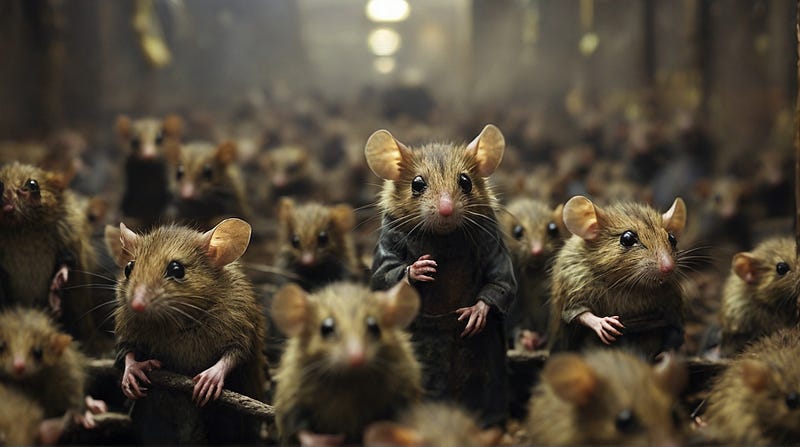
There is no doubt that complex social behaviors drive civilization and form the foundation for its continued development. What future would humanity have if this intricate system were turned upside down? Judging by the results of the controversial experiment conducted by John Calhoun, one would have to conclude that annihilation is the only possible scenario.
Who was John Calhoun, and what was the purpose of his experiments?
John B. Calhoun was an American ethologist and behavioral researcher who became famous for his studies on the impact of population density on individual reactions. During his work, he coined the term “behavioral sink” to describe the mechanism of behavioral collapse resulting from overpopulation within a population. This entire concept stemmed from experiments he conducted, using a colony of rodents as a model reflecting society.
In 1947, John Calhoun built what became known as the “mouse universe” — a ten-acre enclosure capable of holding five thousand mice. He placed five pregnant females in the enclosure, believing that the experiment would lead to a rapid population increase. However, over two years, the population stabilized at around 150 individuals and never exceeded 200. The researcher observed that the mice did not form a cohesive colony but rather split into smaller groups, each comprising about 12 individuals. Intrigued by the results, he decided to continue his experiments on rodents.

Details and results of Calhoun’s experiments
Calhoun initially conducted his mouse studies on his neighbor’s property. In 1958, he built his own laboratory in a barn adapted for this purpose. He then began a series of experiments aimed at creating “mouse utopias” — habitats designed to provide rodents with ideal conditions. The researcher ensured stable temperature, unlimited access to food and water, and an ample supply of nesting material for the animals. Furthermore, Calhoun introduced no predators into this environment, attempting to mirror the world of a developed civilization.
The culmination of Calhoun’s rodent behavior studies was an experiment he referred to as “Universe 25.” As part of this work, he created a completely controlled microcosm in the form of a square room with sides measuring 2.7 meters. The space was divided into four interconnected pens, surrounded by 16 tunnels providing access to food, water, and individual burrows, totaling 256 in number. Each burrow could accommodate up to 15 individuals, so “Universe 25” was designed for 3840 inhabitants.
The experimenter ensured that the animals experienced minimal stress by providing them with optimal living conditions, including veterinary care and construction materials for nesting. The temperature in the mouse microcosm was carefully controlled, ranging from 20 degrees Celsius in cooler months to 21–32 degrees Celsius in warmer ones. The rodents were not restricted in their movement, with the only stressor being limited space.
The experiment began on July 9, 1968, when John Calhoun introduced four breeding pairs into the habitat. It concluded in 1972, precisely on the 1588th day. Throughout the experiment, four phases emerged.
Phase I: Adaptation Period
The first stage lasted for 104 days. During this time, the mice adapted to the new conditions. Initially, they exhibited high levels of uncertainty, but gradually began to establish their territories, build nests, and interact with each other. When the first litter appeared, the initial phase of the study concluded.
Phase II: Rapid Development Period
The subsequent stage lasted from day 105 to day 314. During this period, the rodent population experienced rapid growth, accompanied by an increase in resource consumption. The population doubled at intervals of approximately 55 days. Social behaviors also developed during this time. Mice became more social, preferring to spend time together compared to the first phase. Additionally, dominant individuals began to emerge within the society, and dominance became a factor influencing the size of offspring. The most numerous litters came from the strongest individuals. Non-dominant males either had fewer offspring or none at all.
Calhoun observed that during the second phase, the mice began to change their approach to society and the space available to them. Although each box looked exactly the same, some areas became more crowded. In these parts of the habitat, which garnered more interest, rodents began to consume food, associating this activity with being in the company of others and almost completely stopped eating and drinking alone.
By the 314th day, the number of socially immature animals was three times higher than mature, dominant individuals.
Phase III: Stagnation Period
The third stage lasted from day 315 to day 559 of the experiment. The birth rate began to decline. While in the second phase, the population doubled every 55 days, in the third phase, doubling occurred every 145 days.
Some males showed a lack of interest in defending their territory and pregnant females. It seemed as though the animals were starting to lose purpose in the face of a growing population. In natural conditions, a male uninterested in defending the nest would migrate to another group. In “Universe 25,” such individuals began to gather in the center of the habitat and spent time eating, maintaining hygiene, and engaging in fights among themselves.
Dominant individuals in this group became brutal, launching attacks not only on mice from the “outcast group” but also on other individuals. Cases of rape occurred, targeting both females and males. Cannibalism also emerged.
As males lost interest in defending nests, females began to assume this role. The increase in aggression was accompanied by a rise in the frequency of brutal behaviors. Females not only attacked intruders but also their own offspring, forcing them to leave the nest before they were capable of independent life. It also happened that offspring were killed. In some boxes, the mortality rate of young rodents exceeded 90 percent.
Phase IV: Extinction Period
On day 560, the final phase of the experiment began. Reproductive capacity began to diminish, and natural growth declined to a negative level. The last live birth occurred on day 600, and the last copulation on day 920.
The number of so-called “beautiful individuals,” males interested only in sleeping, eating, and maintaining hygiene, increased. The last generation of mice, which never experienced life in a normally functioning community, consisted of individuals entirely devoid of aggression, uninterested in copulation or any other activity. Researchers referred to them as “stupid mice.”
On the 1588th day, the last mouse died, marking the end of “Universe 25.”
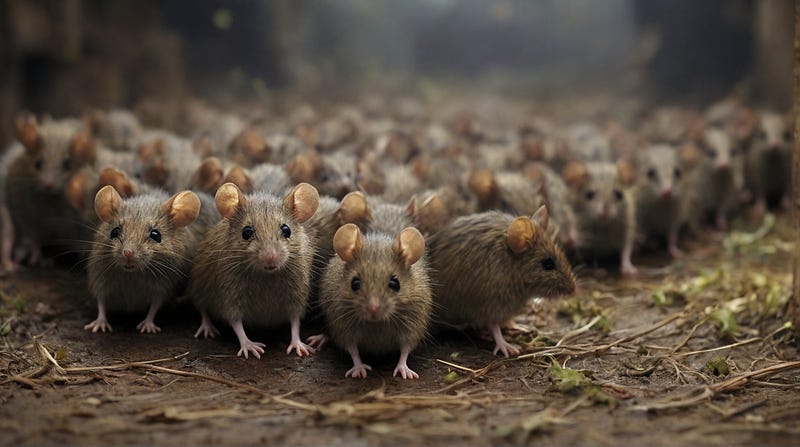
The Mouse Utopia and Human Society
In the utopian world of mice, John Calhoun sought analogies to contemporary society, where there are no natural enemies threatening it, where food is readily available (unlike the struggles of its ancestors), and where shelter is not a concern. While the real world falls short of utopia, it’s undeniable that it offers all possible conveniences, more accessible now than ever before. Does this mean that if humanity continues to focus on its own needs and desires without addressing the issue of overpopulation, it faces doom?
It’s difficult to conclusively equate Calhoun’s experiment results with a prophecy of our species’ future. However, some point out that compared to less developed areas plagued by numerous issues, birth rates are significantly lower in Western countries, and the role of men in society is beginning to change. Much like in the utopian world of mice.
Criticism and Controversies Surrounding the Calhoun Experiment
From the outset, there have been critics of Calhoun’s research methodology. The morality, validity, and purpose of the experiment remain subjects of numerous discussions in scientific circles and beyond. Opponents argue that the world created by the researcher did not reflect natural conditions. This affected the functioning of the studied subjects, and thus, it cannot be assumed that the result would be the same in an environment other than the laboratory. Some also argue that humans, as representatives of the most developed species, can draw conclusions, react, and prevent, so the vision of doom cannot materialize.
The author of the experiment himself agreed from the outset that rodents are not perfect models of humans. However, it is worth mentioning that Calhoun expressed the belief that the catastrophe that occurred in “Universe 25” was so staggering that humanity cannot wait for proof confirming the conclusions drawn from each of the four phases.
Attention all readers!
As content creators on Medium.com, we face minimal compensation for our hard work. If you find value in my articles, please consider supporting me on my “Buy Me a Coffee” page. Your small contributions can make a big difference in fueling my passion for creating quality content. Thank you for your support!


