
Can Narcissists Feel Empathy?
Many people believe that narcissists are incapable of experiencing empathy but research suggests this may not be true.

One of the biggest problems that other people have with narcissists is what they believe to be a lack empathy. This characteristic creates problems for the individual themselves, those in their life and their entire community. But new research indicates that narcissists may actually experience empathy. They may just be unwilling or unable to properly express it.
Experiments on Empathy in Narcissists
A common question that many ask about narcissists involves whether they can feel empathy. Those who have come into contact with narcissists would argue they do not. Yet recent research suggests that this may not be accurate.
Researchers at the University of Surrey and the University of Southampton examined whether an individuals with narcissistic tendencies could feel other people’s distress. They also studied whether someone with narcissistic qualities who does not display empathy could change. These studies focused on those with subclinical narcissism as defined by the DSM as opposed to the more problematic narcissistic personality disorder (NPD). Participants were divided into those who displayed greater empathy than average and those displaying less empathy than average (Hepper, Hart & Sedikides, 2014).
In the first study, participants read a case about someone who had suffered a recent break up. The scenario was altered in terms of the severity of the person’s reaction. Regardless of the severity of the scenario, those high in narcissistic qualities failed to display empathy. This was the case even when the person described in the scenario was said to suffer from extreme, overwhelming depression and hopelessness. The outcome also showed that this lack of empathy was related to the participants characteristics of entitlement, explosiveness, and exhibitionism, features associated with narcissism.
The next experiment investigated whether narcissists were able to show empathy when directed to take the perspective of the target person. Female participants were shown a 10-minute documentary which detailed a woman’s experience with domestic abuse. They were instructed to imagine how the person felt as they watched the video. Results indicated that participants who were high in narcissistic qualities were able to alter their point of view. They displayed a far greater degree of empathy compared to those in the first study.
The final study examined whether the shift in empathy triggered by suggestions to take another’s perspective could be seen not only emotionally but also physiologically. Previous research has indicated that increases in heart rate are a strong indicator of an empathetic response to another person’s suffering. Initially, those high in narcissistic tendencies showed lower physiological arousal when shown other people’s distress than their counterparts. When instructed to take someone else’s perspective however, their physiological arousal increased to the level shown by those low in narcissistic qualities.
Implications of the Research
The findings from these studies suggest that those with narcissist characteristics are able to empathize with other people’s distress under certain circumstances. The results also indicate that they also can alter their ability to do so. However, it is important to note that these studies did not examine those with actual Narcissistic Personality Disorder. Also, the perspective taking studies only included women as subjects so it might be concluded that males and those with more severe narcissism might not respond in the same way.
These studies also did not examine whether a narcissist could empathize with another’s positive emotions. This might be more difficult for narcissist since negative emotions. This is because negative emotions may not elicit envy in the narcissist as often occurs when they see someone who is happy due to receiving good news or other positive circumstances.
In the case of positive emotions, a narcissist may actually feel that someone else should not have positive experiences that they themselves are not experiencing. This is especially the case when the cause of another’s positive emotions is something valued by society such as marriage or receiving a promotion. The narcissist is generally not consciously aware of this envy, nor will they easily admit to it when it is suggested as a possibility in therapy.
Narcissism According to the DSM 5
It is important to remember that narcissists frequently are successful in establishing relationships even if they later go wrong. One of the classic features of narcissism is acting in a manner that is superficially charming to the point that, at least in the initial stages of a relationship, it appears that they know what it takes to meet social expectations and have developed behaviors that allow them to do so.
Yet the characteristics of NPD, would suggest otherwise.
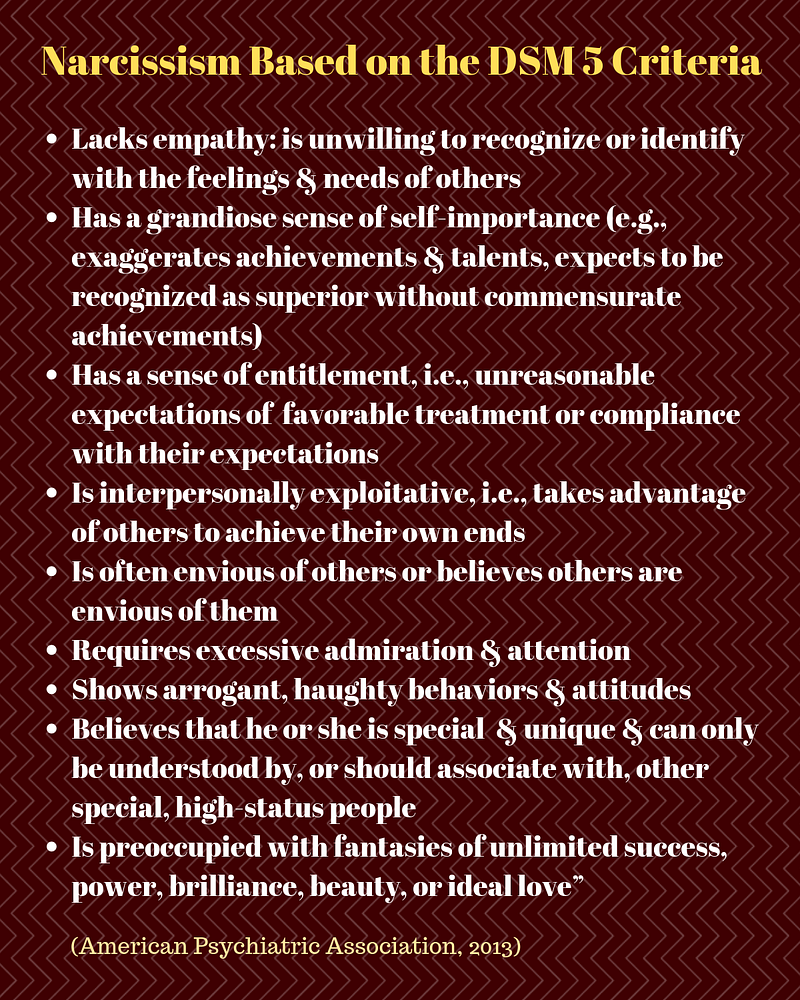
These are not characteristics that would attract most of us nor would we likely want to establish a relationship with, or indeed even be around, someone who displays these features. Yet many of those with Narcissistic Personality Disorder do marry, obtain jobs and maintain a way to meet their physical, emotional and practical needs.
This illustrates the fact that those with NPD know what to do and what is socially acceptable and desirable to form interpersonal relationships. So if they are aware of what is necessary in order to form real relationships and to have others genuinely care and respect them, why wouldn’t they simply act accordingly?
Why Aren’t Narcissists Empathic?
This question has not been completely answered to date but a large part of the solution is likely found in the narcissist’s negative self-concept that they fervently defend against breaking through to their consciousness. Underneath the narcissist’s problematic characteristics is a significant lack of self-esteem and perceived self-worth.
People develop different ways of coping with such deficits in how they view themselves and, while some may self-sabotage to avoid cognitive dissonance, the narcissist banishes conscious awareness of self-doubt replacing it with a false sense of self. The clear degree of overcompensation for the lack of self-esteem is seen in their need to not just feel accomplished but to feel superior to everyone with whom they come into contact.
Summary and Conclusions
The results of the studies reviewed here, while interesting, are not likely to provide the first step in helping narcissists experience and express empathy. In order to do this, their defenses against understanding the underlying causes of their perceptions and behavior must be exposed. To do this, the individual must be capable of handling the resulting emotions. They must then be given the tools to evaluate themselves accurately and helped to set goals to address any real weaknesses or problems they may truly have.
Additionally, the resulting inability of the narcissist to understand why others respond to them in a way that is different from what they expect and believe they deserve must be explored. Finally, the person should be helped to rectify their interpersonal problems that resulted from their narcissistic characteristics to the degree they can.
Until the person is able to understand their actual self-perceptions and replace it with a different set of perceptions they will always need to be completely focused on establishing, at least in their own mind, that they are superior in every way to those around them. Failing to do so, even for a short period of time, would result in the awareness that they may not always be deserving of rewards, the most popular person in a group or the best at a skill or talent.
In turn, this awareness which well-adjusted individuals take in stride as a fact of life, could open the door to the narcissists true self-perception. This would be a problem in that without therapeutic intervention they would be unable to accept this outcome and this could overwhelm their ability to cope.
Only by slowly exposing their true view of themselves, can a narcissist reach the point that they can begin to accept their difficulties. Processing what led to these negative self-perceptions and replacing faulty perceptions with a realistic understanding of their true abilities and faults will help a narcissist accept guidance. It is this process of giving the individual an accurate understanding of who they are and how others perceive them that will enable the narcissist to stop focusing exclusively on themselves and develop the ability to focus on the emotional needs of others.
References
American Psychiatric Association (2013). Diagnostic and statistical manual of mental disorders (DSM-5®). American Psychiatric Pub.
Brunell, A. B., Tumblin, L., & Buelow, M. T. (2014). Narcissism and the motivation to engage in volunteerism. Current Psychology, 33(3), 365–376.
Hepper, E. G., Hart, C. M., & Sedikides, C. (2014). Moving Narcissus: Can Narcissists Be Empathic? Personality and Social Psychology Bulletin, 0146167214535812.
Natalie Frank has a Ph.D. in Clinical Psychology. She specializes in Pediatrics and Behavioral Medicine.

If you enjoyed reading this article, you might also enjoy these:
You can find links to my other work on Medium and follow me here. Thanks for reading!