
Feeling What Others Feel: What is Intuitive Empathy?
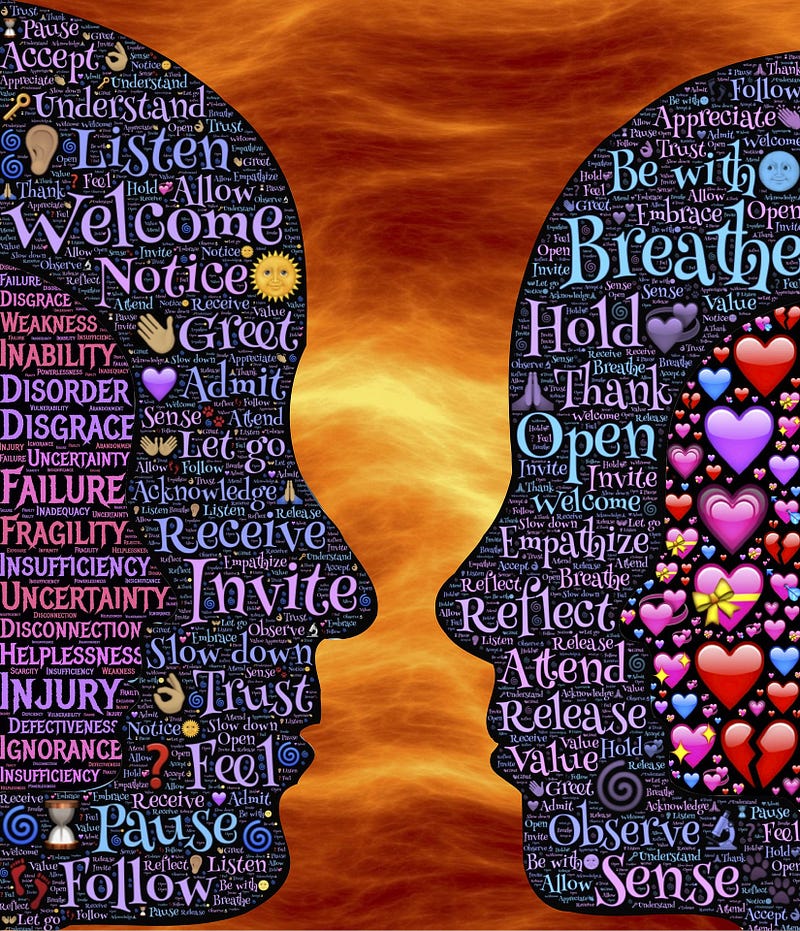
There are those who seem to feel more deeply for others, to the point of experiencing other people’s’ emotions or sensations. This article presents several theories regarding intuitive empathy.
In a commencement speech at Xavier University, President Barack Obama talked about how important it was “to see the world through the eyes of those who are different from us — the child who’s hungry, the steelworker who’s been laid off, the family who lost the entire life they built together when a storm came to town.” He went on to say, “When you think like this — when you choose to broaden your ambit of concern and empathize with the plight of others, whether they are close friends or distant strangers — it becomes harder not to act, harder not to help.”
Some have called the current era an “affective revolution.” This refers to the increased interest in emotions, moral thought and responsible actions that have been observed in recent times. At the forefront of this movement is a greater focus on empathy.
What is Empathy and Why is it Important?
Probably the most common type of naturally occurring ability to sense things related to others is intuitive empathy, also known as psychic empathy. While some are uncomfortable with the word psychic, it is simply used to refer to information that is hidden from what we consider our “normal” senses. Yet often, intuitive empathy could be considered a normal sense in itself. This is when an individual experiences the same emotions or sensations, such as pain, sadness or distress, that another individual is feeling.
Empathy is different from sympathy. Sympathy involves a sense of condolence, the feeling of feeling pity for someone else. However, sympathy doesn’t include being able to understand what the person is going through or feeling similar emotions to what they are feeling. With sympathy, a person doesn’t grasp how someone else is experiencing the world.
There are some people who we are naturally more in tune with and more likely to feel empathy for. Obviously, we are more likely to show intuitive empathy with those we care about, those who come from similar backgrounds and have similar experiences to us, and even those who look more similar to us. Research suggests that we are hard wired both to feel empathy for others but also to feel empathy for specific others. At the same time, it has been suggested that only 50 percent of empathic ability is accounted for by genetics. The environment in the form of early experiences, trauma, early role models, caretaking history, chronic illness, experiencing numerous losses, among numerous other influences can increase our ability to feel empathy or make it more likely that empathy will displayed.
There are some, however, who seem to automatically display empathy in practically every situation in which they find themselves. These individuals seem to be extremely sensitive to the emotions of those around them and at times may appear to take on the stress of the world. This automatic experience of empathy even for those we make not know or who we don’t share a common background or experiences with is intuitive empathy.
Sympathy Pains
People often make fun of the husband who has sympathy pains. According to the Telegraph, father’s to be often experience, “cramps, back pain, mood swings, food cravings, morning sickness, extreme tiredness, depression, irritability, fainting and toothaches,” according to research . Some even begin to notice their stomachs swelling until they almost appear pregnant as well.
While the medical world has given it a formal diagnostic name, Couvade Syndrome, they admit to finding no medical cause for it. Some have called it psychosomatic in nature, not to mean these men aren’t actually experiencing these symptoms, only that there is no known medical cause or explanation for it despite the fact they are suffering from very real pregnancy signs, (Kiefer).
It appears that the most likely explanation is one that is often said in jest — “I feel your pain.” Only in such cases as these, people truly do feel another’s pain. When they share a close bond and truly care for one another, the one not hurting would rather take on the pain if it meant relieving the one they love and while they can’t accomplish that, they do in fact experience similar symptoms. This is probably the most familiar case of intuitive empathy.
Mirror Neurons
One explanation for why we seem experience the same emotions or feel the same sensations as others, was developed through the use of MRI techniques that discovered certain neurons that appear to account for some of these experiences referred to as mirror neurons. New research has shown that when we observe another doing something we have done or feel something we have felt, these neurons fire and they experience what we are.
These researchers use examples of why we wince when watching someone getting tackled in a football game or grimace when seeing someone carrying heavy boxes down the street. Our mirror neurons recognize the action and translate it as our own. They purport that this ability is behind what allows us to develop empathy for others — the ability to view the world from another’s perspective. This makes it possible to actually feel sad for another’s loss or happy for another’s success when we see it on T.V. despite that we’ve never met them.
These types of responses have been attributed to our mirror neurons firing which is triggered by our observations of others emotions. When in the company of another person our mirror neurons allow us to relate to them, tune into what they’re feeling and form connections based on shared affect. Essentially, we observe what others are feeling and doing and mirror or imitate them which makes them feel understood (Nova Science Now, 2005). When we sense that others understand we feel we have things in common with them which establishes a sense of connection forming the beginning of a relationship bond.
However, this fails to explain several things about empathy. When we experience true empathy we aren’t merely imitating another person’s feelings or sensations, we are actually experiencing them. A father to be can’t imitate his wife’s growing waistline and actually gain weight in the same area himself. Something else must account for this.
In addition, it doesn’t explain why mothers or children experience the sensation that something’s wrong with the other or feel joy and know the other has had something good happen in their life, even when long distances apart. Others have reported that a wife can experience joy at home when her husband learns he’s received a bonus at work. Even though she doesn’t know the exact cause of her happiness, she does know it is related to her husband, (Navas, Albea, & García-Parajuá, 2017)). Yet, in cases such as these, there is nothing to observe, nothing to imitate.
Emotional Types and Empaths
While there’s no absolute answer to how these experiences occur, some have suggested that there are those who are are what is termed emotional “empaths”. While almost everyone has empathy to some degree, someone who is considered to be an “empath” is extremely sensitive to others emotions and physical states. These individuals do more than mirror or imitate, they actually experience others emotions and physiological distress in a way much the same as the person themselves.
Empaths can be more or less sensitive to the emotions and physical states of those around them such that each empath is affected differently. Some may experience physical symptoms of another despite not actually having the illness itself and without being excessively affected by the emotions. Others may experience the emotion of a loved one thousands of miles away but not their physical status (Orloff, 2010).
While many say everyone has experiences like these at some point in their lives, such as the expectant father, others refer to it as one of four “emotional types” (Orloff, 2010). Orloff defines these types as the filter through which you see the world and which determines how you relate to others. Each person is characterized by features which fall into one of the four types.
Orloff defines the empathic style as referring to those who are “highly sensitive, loving, and supportive. They are highly tuned instruments when it comes to emotions and tend to feel everything, sometimes to an extreme” (Orloff, 2011). Empaths are also referred to as “emotional sponges,” because they soak up the emotions of both those around them as well as sometimes those who are far away or who they only hear about through the media.
In addition to the empath, the emotional types include the intellectual, the rock and the gusher. The intellectual thinks everything through and analyzes the world, relating to others through rational thought, instead of focusing on others emotions. While intellectuals keep their cool, they also have difficulty engaging in anything lighthearted and don’t trust their gut, only believing what they have data to prove.
The rock is the person who others consider steady, stable and reliable who they can express their emotions to and trust that they won’t be judged. This person stays calm, cool and collected. At the same time those characterized as rocks often have difficulty expressing their own emotions and significant others are often trying to get this person to open up to them.
The gusher is someone who is very attuned to their own emotions and loves to share them with others. Oftentimes however, this person may share too much, leaving others feeling burned out after interacting with them. Because of this, gushers may be avoided.
A person’s emotional style is the filter through which they see the world. It can be though of as the default setting of someone’s personality that they revert to, especially during stress. It represents their basic tendencies. While people are characterized by one of these types, they can build on their natural tendencies by utilizing their best traits and adopting traits from the other types that appeal to them.
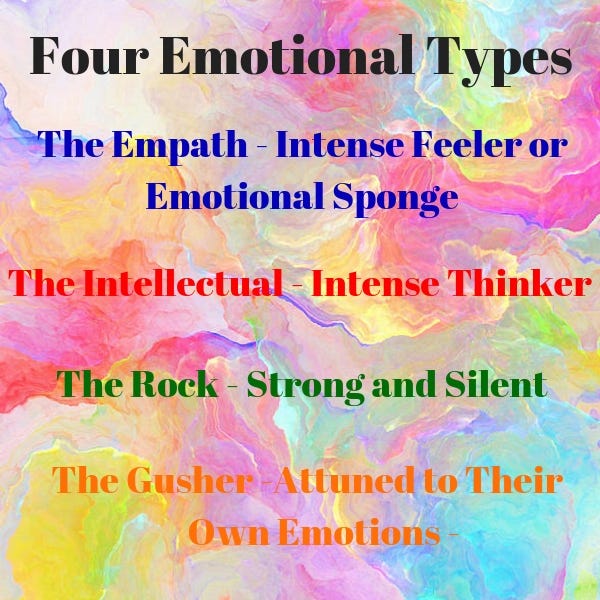
The Empath: The Emotional Sponge Empaths are highly sensitive, loving, and supportive. They are finely tuned instruments when it comes to emotions and tend to feel everything, sometimes to an extreme.
Are You An Empath? Have you been called “too emotional” or “overly sensitive”? If a friend is upset do you start feeling it too? Do you replenish your energy by being alone and tend to get exhausted in crowds? Are you sensitive to noise, smells, and excessive talking?
If so, try this: * Take calming mini-breaks throughout the day. Go outside for a walk, meditate in your room alone. Focus on exhaling pent up emotions such as anxiety or fear so they don’t lodge in your body. * Protect your sensitivities. Make a list of your top five most emotionally rattling situations, then formulate a plan for handling them so you don’t get caught in a panic. For instance, take your own car places so you don’t get trapped in social situations.
Taken from: Emotional Freedom - Liberate Yourself from Negative Emotions and Transform Your Life
Summary and Conclusions
The basic quality of empathy, viewed as the ability to see things from another’s perspective, is a human characteristic that develops as children grow older and can see things through others eyes. It is this very quality of perspective taking that allows human relationships to be established and strong bonds and connections to form between people.
While almost everyone has some degree of empathy, there are those whose emotional style is characterized by this quality. These empaths are able to truly experience others emotions and sometimes their physical sensations as well. As this is a style that characterizes their state all the time, they can become overwhelmed by their nature needing to take a break from interacting with others to recharge their batteries and dispel some of the emotional stress they have built up.
This style isn’t a conscious choice but something that is likely innate and thus, like the other three styles, the intuitive empath must learn to manage their emotions and how to distinguish their own emotions from those of others. As is the nature of personality, there are positives and negatives that go along with all the characteristic ways humans have of seeing the world and interacting with and relating to others. Learning to utilize the positive traits to help others without it becoming overwhelming is the task of the intuitive empath. In that way they will be able to help other feel truly heard and understood while allowing themselves to appreciate the closeness of the emotional bond that forms as a result.