
Can Infrastructure Neglect cause Revolutions?
America’s crumbling infrastructure could lead to civil unrest, political upheaval, and revolution. There is evidence that infrastructure can cause revolts.
The number of revolts in China grew from around 1.35 a year to 10.55 a year when the Imperial government stopped maintaining the Empire’s most important transportation infrastructure, the Grand Canal in the 19th century.
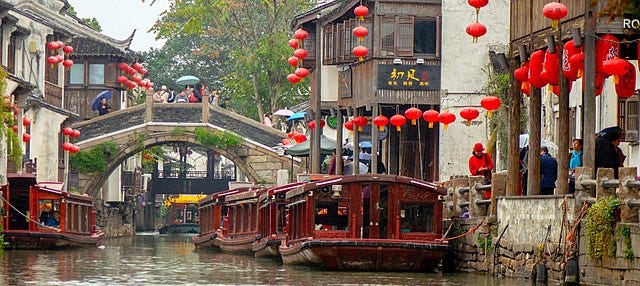
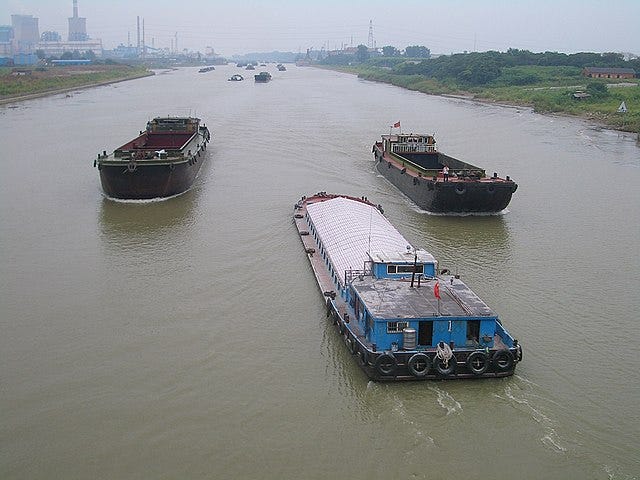
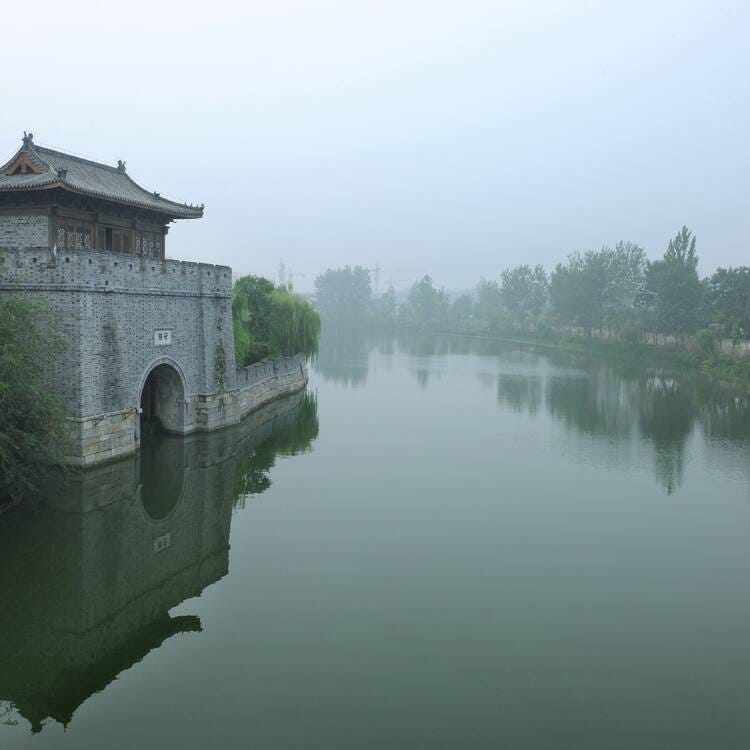
The Grand Canal is the world’s oldest, largest, and most successful artificial waterway. Historians think they built the earliest portions of the Grand Canal in the 4th century BCE. They constructed most of the Grand Canal between the Seventh and 17th centuries AD.
The Canal that Made China
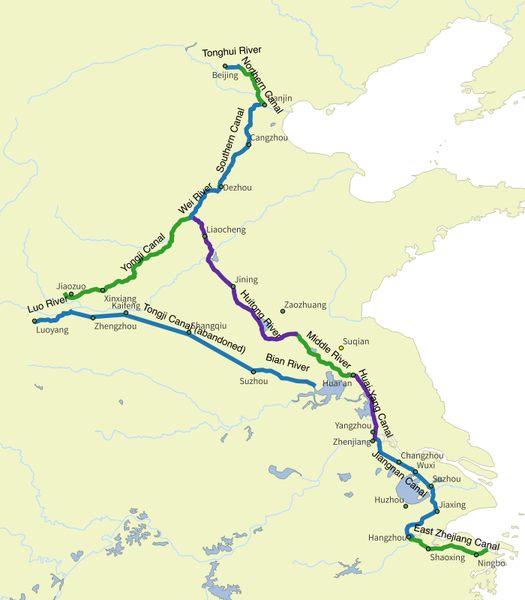
The 1,776 kilometer (1,104) mile long Jing-Hang Grand Canal connects China’s most important waterways, the Yellow and Yangtze, rivers and the historic capitals of Nanjing and Beijing. In contrast, America’s Erie Canal is 338 miles (543.96 kilometers) long.
During its heyday, the Grand Canal was the world’s most important transportation artery. Records show over 8,000 barges hauled 240,000 to 360,000 metric tons of grain on the Grand Canal. Hence, the Grand Canal was the basis of China’s economy. Several important Chinese cities, including Beijing, Nanjing, Tianjin, Linqing, Jining, Huai’an, Yangzhou, and Hangzhou, grew up along or near the canal.
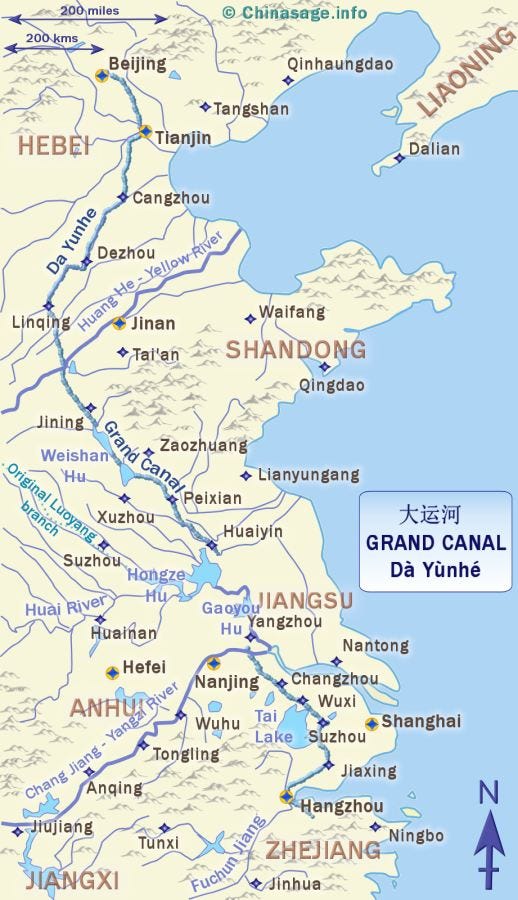
The canal served important military purposes. For example, armies and food to feed armies could move along the canal. Moreover, the canal provided China with a transportation system foreign navies and pirates could not disrupt.
By connecting North and South, the Grand Canal unified China. Hence, the Grand Canal was the backbone and lifeline of the Chinese Empire. Predictably, the canal’s neglect and decline, led to the fall of the Chinese Empire.
The Canal’s Neglect causes Revolt
In 1825, flooding caused a catastrophic break closing the Grand Canal. The canal’s closing marked the beginning of 125 years of unrest and civil war that destroyed the Chinese Empire, the Qin Dynasty, and China’s first republic.
Scholars Yiming Cao and Shuo Chen estimate unrest grew by 117% in counties along the canal after the closure. Cao and Chen write “According to historians, unemployed workers who lost their livelihoods following the closure — especially those directly involved in grain transportation and commercial services — often joined the groups of gangsters and rebels.”*
One reason for the unemployment was that Chinese merchants and government became increasingly reliant on foreign shippers as trade moved to the South China Sea. This redirection made China vulnerable to its deadliest enemy, the British East India Company. China was vulnerable because the Royal Navy was operating in the South China Sea by 1830.
Moreover, Chinese forces were incapable of stopping British and Indian troops during the First Opium War. During the Second Opium War, or Arrow War, British and Indian troops attacked Beijing itself and burned an imperial palace.
Notably, the bloody Taiping Rebellion, a civil war that caused the deaths of 20 million people, broke out in 1850. Pointedly, the Taiping Rebellion was centered in the city of Nanjing near the Grand Canal. Interestingly, the unrest got worse as the canal declined. Cao and Chen estimates the number of rebellions in China peaked at 66 in 1861.*
Canal Closes Empire Falls
Notably, the Grand Canal shut down in 1901. Just 10 years later, on 10 October 1911, the First Chinese Revolution overthrew China’s last emperor.
Vast areas of China fell under the control of warlords, gangsters, bandits, rebels, and foreign colonialists. By 1927, all-out civil war between Communists and Nationalists had broken out.
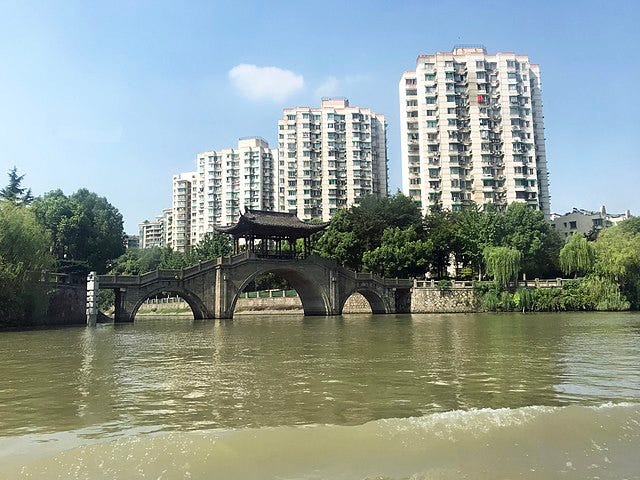
In 1934, Nationalist dictator Chiang Kai-Sek began rebuilding the Grand Canal. Rebuilding ended with the Japanese invasion of China that led to World War II.
After 1949, after winning the Civil War, one of Communist dictator Mao Zedong’s first acts was to order the reconstruction of the Grand Canal. Since their victory, the Communist Party has extensive improvements to the Grand Canal. Those improvements include the South-North Water Transfer Project. Today, barges and ships move over 100 million tons of cargo on the Li Canal portion of the Grand Canal.
Infrastructure and Empire
Since 1949, the Communist Party has spent enormous amounts of money on China’s infrastructure. For example, Bloomberg estimates the Chinese government is budgeting $1.8 trillion for infrastructure construction in 2023.
Chinese infrastructure includes the world’s largest high-speed rail network 40,000 kilometers (25,000 miles) of track. There are plans to extend this network to 50,000 kilometers by 2025 and 200,000 kilometers by 2035, The South China Morning Post reports.
China’s Ministry of Transport plans to build 461,000 kilometers of highways by 2035, The Global Times reports. Around 162,000 kilometers of those highways will be expressways (super highways). They hope to connect all Chinese cities with populations over 100,000 to the new system.
China’s cities feature new airports and mass transit systems. The government also spends heavily on dams and water infrastructure. Moreover, the Chinese government is spending heavily on next generation transportation technologies such as Hyperloop and Maglev.
Beyond China’s borders, the Chinese government plans a massive network or rail lines, highways, and ports they call the Belt and Road Initiative. President Xi Jinping hopes the Belt and Road Initiative will connect Chinese factories to markets in Europe, Asia, and Africa.
Cynics note the Belt and Road Imitative will make other nations dependent on China. Belt and Road projects are already leaving some governments deeply in debt to Chinese banks. Hence, Xi is trying to recreate the British Empire but base it in Beijing.
The Communist Party’s infrastructure program resembles historic Chinese emperors who launched new dynasties by constructing portions of the Grand Canal. One reason the Communist Party spends so much on infrastructure is that its leaders grasp the connection between infrastructure and empire. They understand that empires collapse without effective infrastructure to support their economies.
America Neglects Infrastructure
Frighteningly, America’s “leaders” are ignorant of infrastructure’s importance. For example, the American Society of Civil Engineers (ASCE) estimates the United States had an infrastructure gap of $2.588 trillion in 2021.*
To explain, the ASCE estimates Congress will need to budget $5.947 trillion to meet America’s infrastructure needs. Conversely, Congress and other governments budgeted $3.350 billion for infrastructure work in 2021.*

This neglect will harm America’s economy and ordinary Americans, the ASCE predicts. A 2021 ASCE study Failure to Act: Economic Impacts of Status Quo Investment Across Infrastructure Systems claims neglect of infrastructure will reduce the US gross domestic product (GDP) by $10 trillion by 2049.
Furthermore, infrastructure neglect will cost the United States three million jobs by 2039, the study claims. US exports could fall by $2.24 trillion by 2041 if infrastructure neglect continues, the ASCE predicts.
Ordinary Americans this neglect every day. Bridges are collapsing, trains are running off the track, and interstate highways are full of potholes. Notably, cleaning up the damage from one train derailment in East Palestine, Ohio, will cost $1 billion, CNN claims.
Once gleaming examples of US infrastructure, such as La Guardia Airport, the New York Subway System, the Interstate Highways, and the Washington Metro are national disgraces. For example, Business Insider describes La Guardia Airport, serving America’s largest city, New York as “cramped, poorly lit, and dirty” and an “eyesore.”
Moreover, 33% of all US flights, around 31,850, experienced delays between 24 June and 27 June, The Street reports. Hence, once third of US air passengers experienced delays. Plus, air travel delays rose by 25% since 2022 and 374% since. On 19 July 2023, several passengers passed out on a Delta Airlines flight that was stuck on the tarmac at Harry Reid International Airport in Las Vegas for several hours.*
One reason for the delays is that America does not have enough airports. Another is a lack of alternative means of travel. For example, the US has no high-speed rail while gridlock blocks highways. Thus, a Los Angeles resident who wants to fly to New York cannot take the train to Las Vegas, or San Diego, and catch a flight in that city.
The LA resident can drive to Vegas or San Diego, but he is likely to get stuck in a traffic jam on the I-15, or the I-5. Hence, Americans have to fly if they want to go anywhere, but the air travel system cannot serve all the passengers.
Dramatically, such infrastructure collapse coincides with the worst civil unrest in America in over a century. For example, the 6 January 2021 US Capitol Riot, riots at state capitols, and the 2020 George Floyd Riots in which mobs pillaged US cities and attacked government buildings and the police.
There have also been reports of mobs and gangs looting retail stores and YouTube is full of ugly scenes of brawls between rival gangs of protesters and protesters and police. Some of the worst violence occurs in West Coast cities such as Portland, Oregon, and Los Angeles, which have notoriously deficient transportation infrastructure.
This unrest coincides with America’s refusal to invest in infrastructure. Disgustingly, some balanced budget fanatics in the Republican Party tried to shut down the government to prevent additional infrastructure spending. If America’s empire falls, and the US becomes a Chinese resource colony. Such idiots will share part of the blame.
History shows infrastructure neglect can lead to civil unrest and imperial collapse. Future historians may list 21st century America as a textbook example of such neglect.
*https://en.wikipedia.org/wiki/Grand_Canal_(China)
*https://www.britannica.com/topic/Grand-Canal-China
*https://whc.unesco.org/en/list/1443/
https://www.chinasage.info/grand-canal.htm
*Cao, Yiming, and Shuo Chen. 2022. “Rebel on the Canal: Disrupted Trade Access and Social Conflict in China, 1650–1911.” American Economic Review, 112 (5): 1555–90.
*https://www.aeaweb.org/research/charts/disrupted-trade-conflict-china
*https://www.history.com/topics/asian-history/taiping-rebellion
*https://www.bloomberg.com/news/articles/2023-04-10/china-bets-1-8-trillion-of-construction-will-boost-economy
*https://multimedia.scmp.com/infographics/news/china/article/3200811/high-speed-railway/index.html
https://www.globaltimes.cn/page/202207/1270363.shtml
https://www.chinadaily.com.cn/a/202304/25/WS64479e1ba310b6054facfb7f.html
https://interestingengineering.com/innovation/worlds-fastest-281-mph-cr450-chinese-maglev-train
*https://infrastructurereportcard.org/resources/investment-gap-2020-2029/#:~:text=Assessing%20America’s%20Infrastructure%20Gap&text=We’re%20still%20just%20paying,10%20years%20to%20%242.59%20trillion.
https://www.cnn.com/2023/07/27/investing/norfolk-southern-east-palestine-derailment-costs/index.html
*https://www.thestreet.com/travel/airlines-delays-are-up-here-are-4-rights-you-have-when-youre-stuck-on-the-tarmac


