
Can a Man and Woman Actually Stay Platonic Friends?
Breaking down the assumptions of this absurd question

There are a lot of TV tropes depicted in shows but one that consistently irks me is the depiction of a male and female protagonist in a “will they, won’t they?” tug-of-war that insinuates that they will end up together.
I’m more forgiving when it comes up on TV for two reasons.
First, sometimes, it’s embedded in the show’s genre as a romantic comedy or a kdrama — in that case, I signed right up for this narrative line. I’m okay with that.
Second, on-screen stories are limited to the cast and characters they have to work with, and you’re viewing the story through a scoped lens. Of course the protagonists are going to get together.
When this question comes up in real life though, it hits a genuine nerve:
Can a man and woman genuinely stay platonic friends?
While life can be a romantic comedy sometimes, I’m grateful to say that my life is not limited to this genre and I live horror, comedy, and adventure plotlines as fractions of my life too. Also, I might just as likely be a non-playable character (NPC) in this video game of life as the main character.
Beyond that, there are several layers of assumptions that this question has to jump through to impose a certain narrative on my life when it’s asked.
Level 1: Questioning the Assumption of Heterosexuality
I’m not heterosexual so this question always surprises me. When you ask the question “Can A Woman and Man Actually Stay Platonic Friends?”, it has the natural assumption that the two people in question have sexualities that incorporate the other person.
That’s not always the case.
If you don’t hear the automatic assumption, here’s another version of these questions. Think about how ridiculous the following question sounds through a heterosexual lens:
- Can two women actually stay platonic friends?
- Can a non-binary person and a man actually stay platonic friends?
Someone’s gender does not automatically equate to a certain sexual orientation.
And maybe that’s the reason we need more representation on-screen to debunk this assumption that heterosexuality is the norm. That way, cross-sex friendships aren’t always assumed to be a foundation for cross-sex relationships.
Level 2: Questioning the Assumption of 100% Attraction Rate
Okay, okay, let’s say we stepped through that first hoop of assumptions. Hypothetically, let’s say that the man-in-question's sexuality includes women (gynephilic) and the woman-in-question's sexuality includes men (androphilic).
Our next challenge question:
Who in the world has a 100% attraction rate?
There is a distinct gap between “my sexual orientation includes the person of this gender” and “I am attracted to this person”.
Let’s take fictional examples for a second. You’re watching movies, TV shows, etc. Are you attracted to 100% of the protagonists that fit into your sexual orientation? Depending on their personality, plotline, visual appearance, etc. you likely aren’t.
So why is there an assumption that real-life interactions are?
That’s what this question does. It assumes that if you match in sexual orientation, that you necessarily cannot remain platonic friends because there is only one (1) outcome: romance and/or sex.
Level 3: Questioning the Assumption of Romance as a Conclusion of Friendship
Mixed into this question is the assumption that cross-sex friendships is this plotline of friendship to romance.
Let’s split this into a 2 x 2 diagram, shall we?
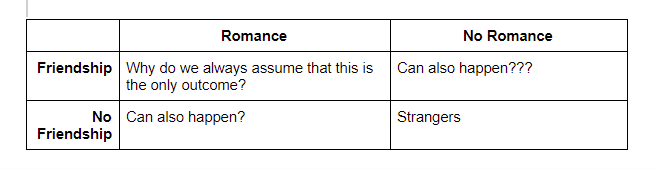
For some reason, this question assumes that only one combinational outcome can occur, which is that friendship can only lead to romance. Which is absurd.
While friendship is often a good foundation for a romance, sometimes people fall into romantic / sexual relationships without precursor friendship. Also, can we take a moment and entertain that you can have friendship with no resulting romantic / sexual outcome?
I feel like sitting in the upper left quadrant reeks of the problematic “I won’t be friends with you unless there’s a possibility we’ll fuck” syndrome, the basis of friendzone, a term that refers to “being jailed” as friend with no promise of sex. As if the base assumption is friendship → sex/ relationship.
Friendship and romance/ sexual relationships can be distinct things despite having some overlap. It’s not necessarily an A → B trajectory.
TL;DR
This question remains absurd to me because it assumes heterosexuality, that everyone is always attracted to anyone who might fall within their sexual orientation, and that every friendship input necessarily pops out a poop that is romance / sex.
Thank you so much to Dayon Cotton for inspiring this long, wild rant with his piece:


