
Can a Black Person Be Racist?
Trump’s ad hominem attack on Fani Willis dredges up an old question.
(N.B. — Do yourself a favor and don’t be one of those who succumb to their own bigotry and refuse to read beyond the headline. Read the whole article and consider the very important issues it discusses.)
“They say there’s a young woman, a young racist in Atlanta. She’s a racist.” That’s what Donald Trump said about Fani Willis, the district attorney for Fulton County, Georgia. He made the same ad hominem attack on NY attorney general Letitia James.
Now, if I said that Trump was corrupt and childish and should be prosecuted, he’d insult me too (c’mon, hit me, big boy). It’s his self-serving way of lashing out, which is significant in itself. But the larger philosophical issue is with his ad hominem attack on these people as “racist.” What is a racist, and who can properly be called one?
Trump is hardly a reliable judge of human character. Nor can we place much weight on the angry comments made by a criminal defendant against his prosecutor. But let’s consider the idea that a Black person can be a racist.
First, there are two issues here
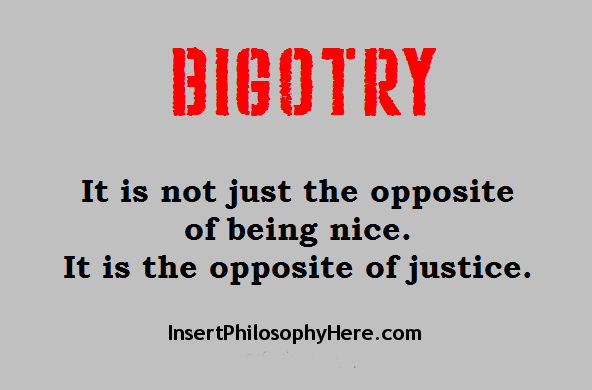
There is bigotry, and there is social power to act. The distinction is crucial.
Bigotry is a weakness. Bigotry is a symptom of giving in to the fear of those who are different and choosing to hide behind false views of other people rather than face the reality of how others actually are.
We all have a natural fear of the Other. How we deal with that fear is the difference between maturity and immaturity. A person has bigoted thoughts and feelings because they’ve given in to that fear of the Other. It takes a certain degree of courage to accept people for who they are and how they are. It’s easier to deal with and accept people who are similar to oneself. Differences cause tensions, and not everyone has the wherewithal to deal maturely with those tensions. Bigoted actions, including racism, are fearful reactions to others: People hate because they can’t cope with differences.
To cover up our fears and justify our fearful reactions, we make up stories about others. Actually, we usually don’t need to. We can adapt the stories that were made up before us. We use the stories to convince ourselves that we’re right to fear and hate others.
Our stories tell us that those who are different from us are inferior to us. They are immoral. Stupid. Deviant. Dangerous. We invent names to dehumanize them and brand them with these labels that become profanities and insults. Bigoted labels become weapons energized by fear to harm others and deny them human rights. Labels unite individual fearful reactions into institutional structures like racism.
That’s where power comes into the equation. To be afraid of others so much that you are bigoted against them is one thing, but to be able to act on your bigotry is another. For example, someone can be bigoted against Jewish people and desire to kill many Jews. This bigotry and desire are undeniably reprehensible, but only if one has the political power to act on that desire will one be able to commit genocide. True, an individual can exercise their free will to commit violence against other individuals, but that is not racism. That distinction illustrates the importance of how political power is structured and how widely it is circulated.
The difference between personal bigotry and racism
Can a Black person be racist? That is an interesting question — much more interesting and revealing than most people realize.
The answer is no, a Black American can’t be racist. That goes against our first impulse to say that of course anyone can be racist, but that is a misunderstanding of what racism is. Racism is rooted in bigotry, but they are not the same. There is a difference between personal thoughts and feelings and macrosocial structures.
Anyone can have bigoted opinions because anyone can be ignorant and fearful. But not everyone has the social power to act on their bigoted opinions. Police and politicians can believe that all Black people are inferior and they have the social power to act on that belief. A Black person could believe that other people are inferior but have no social power to act on that belief. An individual can be bigoted, but it takes the power of social institutions to be racist. That’s why institutions like segregation and apartheid can exist far more easily than can movements to oppose institutional racism.
Racism is a social structure
Racism’s structure is composed of a network of social institutions and semantic resources that establish social norms delineating a superior race from inferior races. From birth, everyone is taught norms that delineate who in society deserves recognition and who doesn’t. Misrecognition of racial minorities is embedded in the social fabric, upheld by social institutions, and enforced structurally on all.
Racism is a structure of social institutions that condone and even encourage individuals to be bigoted. The pppression of racially minoritized individuals is a central part of institutional racism. The social norms of racism are enforced by the legal system and spread far and wide by the media. Society teaches false views of minorities to individuals who receive social recognition when they repeat those lies.
For “white”* Europeans and Americans, false views about “non-whites” are so ingrained they are invisible. “Whites” can rationalize their fear of the Other as truth, and, if they act on their fear, they are supported. “Whites” can choose easily to hide behind bigoted views knowing they have little obligation to deal with minorities as equals or challenge the lies told about minorities. Racism empowers the weakness of bigotry.
Racism provides the structure in which fear can flourish. An individual can feel and act in a bigoted manner toward others but will only benefit if others support these feelings and actions. If people disapprove of bigoted words or actions, individuals will stop. But if others cheer them on and join into the bigoted words or actions, then individuals are encouraged to repeat them.
Back to the question of whether Black people can be racist: Again, the answer is no. A Black person can hold false bigoted views about others, and can act in destructive ways, but because society’s structures do not empower their fears or bigotries, they lack the social power to act broadly on them. If whites want to accuse Blacks of being racist, they first need to dismantle current anti-Black structural racism and then see if Blacks use their power to turn bigotry into racism as whites have done.
Bigotry is a choice
No matter the strength of the social structures of racism, bigotry remains a personal choice. Most people follow the norms, but that is not a given. An individual can choose not to follow the norms. Trump chose to make bigoted ad hominem attacks on Black people he fears.
The problem is that going against the norms of structural racism is not an easy choice. The followers of Trump choose to be bigots because it is the easier path for them — easier than resisting the pressure of tradition and political power structure. Much of that pressure comes from peer pressure, but a great deal of it is because people do have a fear of the Other. It is easier to unthinkingly accept the false stories and just go along. That is not an excuse. It is always wrong to mistreat others. It is the moral responsibility of all “white” people to reject the false stories about minorities taught to them.
Is overcoming bigotry and racism possible?
Not easily. To not follow the norms, “whites” have to overcome their own fears. “Whites” who try to go beyond the racist stereotypes and treat minorities as full human beings will often find themselves shamed for doing so. That’s nothing compared to the constant shame heaped on minorities who are told continually to accept the false views society has of them, or else.
Society recognizes racist behavior by supporting “white” fear of minorities, supporting discrimination against minorities, and then refusing to recognize that minorities have legitimate grievances about the lies and injustices perpetrated against them. Social norms perpetuate racism, but we can choose to recognize truth rather than lies. Instead of recognizing the false views of bigotry, we all need to recognize the voices of minorities.
Racism is a structure built on weakness. It is powerful because its norms are embedded in our social existence, but it is based on lies. The structure is rotten and needs to be torn down, yet railing at the structure doesn’t succeed because those who have fearful reactions to the Other have a vested interest in maintaining the structure. Structural racism gives cowards cover under which to hide. We need to deal with causes, not symptoms. Until we deal with those fearful reactions to differences and the weakness surrounding them, we can’t hope to stop the cycle of hate and ignorance created by fear and weakness.
Overcoming fear and bigotry takes courage and communication among individuals. Overcoming racism requires a widespread, sustained effort from many individuals. There are no easy solutions. It will take much more than courage, but it begins there.
- “White” and “non-white” are social constructions tied to value judgments — in other words, tied to racism — and who is assigned which category has changed over time. The highly dubious stance of racialism declares that humans can be divided into biologically distinct races. The upshot of racialism is that individuals are determined by biology. For example, the idea that Africans are inferior to Europeans and so on. Racialism is a total fabrication, but because the false views of racialism are supported by social institutions, it has been widely accepted and used to build structural racism. Racialism is a concept held even by scientists who falsify science to justify their personal bigotry. See “scientific racism.”


