
Camden Town: Subcultures and Aesthetics in Architecture
The effect alternative subcultures have on architectural development
Alternative subcultures refer to specific cultures that exist outside the mainstream.
They can be described as ‘…a collective solution to, or resolution of, problems arising from the blocked aspirations of members, or their ambiguous position in the wider society’¹ and normally arise from the development of new views that involve the rejection of traditional norms and social codes. This can often accompany a visual style and a musical genre that members of the subculture identify with. The focus on subcultures is an uncommon theme to be studied as a part of architectural history, however, it allows us to rethink social relations and how they affect the architectural space.
Camden became a centre for alternative fashion around 1980; this was ‘’post punk…’’²
London has a huge community of alternative subcultures which have influenced Camden Town’s development over the years and contributed to it being known as a place for the celebration of alternative lifestyles.
The City of London plays a significant part in the establishment of places that are known for alternative lifestyles. Not only does the city have an extensive community of sub-cultured people, but it also has a historical background that has an effect on its architectural space. The city has many conservation areas. The preserved buildings are generally adapted to modern society and their functions are changed in most cases.
For instance, the parts of Camden Town that are conserved have a high number of 19th-century buildings some of which are listed to protect the overall characteristics of the area. To ensure this, the process of getting planning permission is made tricky. The proposed building design has to match the historical and architectural characteristics of the area. This quality of London has an effect on important areas like Camden Town. It is very hard to get approved for a building design there and a lot of the shops are built on the front gardens of terraces fronting Camden High Street, which have existed since the street was a residential area.
Initially, Camden Town was a quiet, middle-class suburb, however, from the arrival of the railways in the 1830s, it started attracting working-class people, who made a living out of these railways as well as canal-associated activities. This had a fundamental effect on the development of Camden, resulting in a different social mix than what it was before. Many moved there because of the convenience of its location as well as the availability of affordable housing. Up until the later part of the 20th century, this remained to be the case. Once Camden Market was opened and started attracting many visitors, it became a touristic space well known for its association with alternative cultures.
At first Camden Market was a temporary market housing a total of 16 stalls.
It was basically a small arts and crafts fair in the backyard of Dingwalls (a well-known music venue in Camden which was a warehouse at the time) but now, is home to hundreds of small businesses today, making it the largest market in London. The market also had an influence on fashion ever since it was opened, drawing inspiration from music rather than catwalks. This gave many designers the opportunity to start their businesses and many well-known British designers have indeed started out in Camden, usually with nothing but a single stall. As Caitlin Davies explained in his book, Camden Lock and the Market; ‘Camden Town was soon known as a place to source trendy clothes’² Today, Camden Town is still the place to go for subcultures that are defined by music due to its eccentric atmosphere.
The way Camden Town is structured and its history, tells a lot about how alternative subcultures affected its architectural development. Looking back at old maps, especially the area around Camden High Street, we can see little change in regard to the construction of new buildings. Most buildings were preserved rather than being demolished to make way for newer and more modern buildings. This relates to the characteristics of London as a city, as well as Camden. The built structures have transformed their functions over the years whilst maintaining their original forms, linking the past with the present. This shows that architecture cannot be separated from the society. Aldo Rossi, an Italian architect, preferred to look at the city as something that was constructed over time to explain this. He argued:
…the city is something that persists through its transformation, and that complex or simple transformations that it gradually undergoes are moments in the reality of its structure.⁴
The urban artifacts give the city its character.
Rossi’s argument moves onto the rejection of functionalism as these urban artifacts defy the rules of function. They incorporate new functions to adapt to modern needs. Camden Town is an interesting example of change in function rather than form. This process started in Dingwalls, which was a timber yard that was transformed into a market to create workshop spaces for artists and designers. The market eventually grew due to popularity becoming Camden Market as we know it today. The run-down packaging warehouse near the market was transformed into Dingwalls Dance Hall, which is used as a music venue having had many famous alternative bands performing their first gigs there. Similarly, the houses that used to face the high street are now being used as shops, restaurants, and tattoo studios. Camden Town preserves its 19th-century architectural and historical character whilst being the fourth-most popular visitor attraction in London.
The sub-cultured people also contribute to Camden Town as a space, which is important in regards to explaining its development. From the moment Camden Market opened up, it attracted artists who drew inspiration from alternative music. This, as a result, brought along an alternative crowd. Eric Reynolds, the previous manager of Camden Lock explained that ‘if anyone goes to London, they will go to the Tower, they will go to the Palace and they will go here’.² Camden has become such an important spot that, many travel there all over the UK. This gives the architecture of the space a new meaning. It changes the definition of architecture from being the space itself to a way of looking at space.
Social relations come into play whilst looking at Camden’s architecture.
Iain Borden’s approach in his book titled Skateboarding, Space and the City focuses on the skating culture and how that can define the architecture of the city. He talks about structural forms used by skateboarders for different purposes from the one they were built for.
This is one of skate-boarding’s central features, adapting and exploiting a given physical terrain in order to present skaters with new and distinctive uses other than the original function of that terrain.³
In his book, Borden explains how skaters change the function of a space. We can make similar arguments for Camden Town. The alternative people, who come to visit, give the space its meaning. Without these people, Camden is a place no different than any other — they give Camden its identity. The place is defined by the alternative people’s engagement with it just as skateboarders define spaces in the city by engaging with them. The subcultural groups contribute to the expansion of Camden Town’s already rich culture. They change the way buildings are presented in the city.
Despite the fact that the alteration of buildings is not permitted, decorating them is allowed.
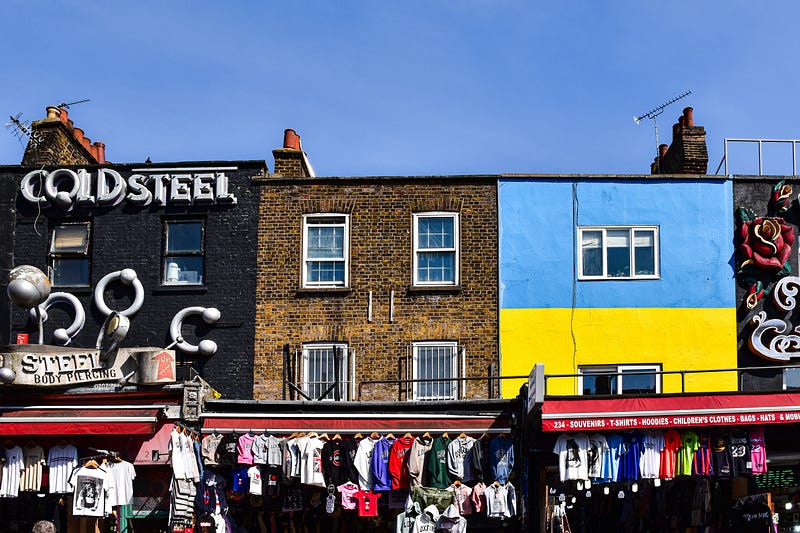
A unique feature of Camden High Street is the transformation of residential houses, not just by turning them into shops and venues, but also by painting over them and hanging sculptures to reflect the alternative culture of the district. As a result, we have a mix of preserved 19th-century characteristics combined with a modern interpretation of the area expressed through artistic means. This demonstrates how subcultures engage with the architectural character of the space.
A very important concept Borden talks about is zero-degree architecture. This can be defined as ‘…the urban having lost the characteristics of the creative oeuvre and of appropriation’.³ What Borden means by this is that a piece of structure that was designed for a specific purpose is turned into zero-degree architecture when it’s used for something that has nothing to do with the original purpose. As an example, he once again uses skateboarders who go around the city finding things they can perform tricks on such as handrails. Handrails are designed for safety purposes but by skating on them the skateboarders change the purpose entirely. Something that was meant to increase safety is now used for risky activities. The handrail hence becomes zero-degree architecture.
This concept can be applied to Camden Town by once again mentioning the change in function rather than form.
If we take a look at its well-known music venues, we can see that they are all converted buildings that were put to new use. An example of this is Dingwalls, which was one of the many Victorian buildings that were converted into something different in the 20th century. The name comes from the owner and is painted outside the building which was common practice in the 19th century. This represents the old nature of the building making a reference to its past. By being used for a different function it keeps the past alive and gives the place character. Another example that we can use is the Electric Ballroom, which was partly destroyed and rebuilt during WWII.
This building is one of the rare new ones in Camden and a very well-known music venue, yet still makes use of transforming its function to take full advantage of its location. While it is used as a nightclub and performance space at night, during the day it is converted into an indoor market. These two functions are completely unrelated and the building was designed to be a performance space with full concert facilities on the ground floor. The concept of zero-degree architecture can be applied here in regards to the place being used for something completely different than what it was initially designed for.
The market space is demonstrably the most significant aspect of Camden Town.
It made the place an alternative haven it is considered by many today by attracting customers and observers (tourists) who are interested in these alternative subcultures. The market’s popularity resulted in the economic advancement of the area making it a more commercial space rather than a residential one it had initially been. The market also gives small businesses a chance to succeed. It isn’t well-known brands one finds there but rather vintage, alternative, and second-hand clothing, stuff designed by stall owners, alternative jewelry, books, and crafts.
Participants adopt modes of heightened and stereotyped role-playing, appropriate for a ceremonial occasion, and the obligatory ‘dressing up’ is an aspect of this.⁵
This shows the ceremonial components of markets. In Camden Town, going to the market is almost ritualistic. The person is aware of the fact that there will be tourists and other visitors there so they will dress to impress and show them what they came to see: the subculture. This aspect of Camden Town is emphasized by places such as The Dev (The Hobgoblin), a pub that only accepts people who are dressed up according to the dress code, which is alternative-only making it somewhat of a safe space for the sub-cultured.
All these demonstrate how alternative subcultures can have an effect on a space and its development.
They show the importance of these groups and give us a new way of defining architecture. By analyzing the space in terms of its social relations, we can understand the character of the place more accurately. Without the alternative people, Camden Town is just a district with 19th-century buildings. The place is turned into something else when subculture is added to its identity. Through analysis of Camden’s social presence, we can create a different kind of architectural history which, in Borden’s words, ‘does not focus on things, effects, production, authorship or exchange but upon process, possibilities, reproduction, performance, and use.’³
References:
[1]: Scott, J. Marshall, G. (2009) A Dictionary of Sociology. Oxford
[2]: Davies, C. (2013) Camden Lock and the Market. Quarto Publishing Plc.
[3]: Borden, I. (2001) Skateboarding, Space and the City. Oxford
[4]: Rossi, A. (1966) The Architecture of the City. Padova
[5]: Gell, A. (1999) The Art of Anthropology. London
If you enjoyed this post and would like to read more, you can subscribe here — https://medium.com/subscribe/@ella_harris to get an email whenever I publish a story. You can also buy me ☕ via — https://ko-fi.com/ella_harris
This post contains affiliate links. If you use these links to buy something I will earn a commission. Thanks.


