
Calculating Medium Partner Program Earnings
A change from Monday 28 October 2019

Source:
The Medium Partner Program allows writers to earn money for the content they publish on Medium based on engagement from Medium members.
I always thought that a complete read of an article or Medium Story was a true reflection of interest, i.e. enough interest for a reader to read the whole Story.
As Medium members spend more time reading your story (“member reading time”), you will earn more.
The framework or basis for payment calculation is monthly reading time of your Stories, on a proportional basis. Medium states:
By calculating a share of member reading time, we support authors who write about unique topics and connect with loyal readers.
For example, if last month a member spent 10% of their monthly reading time on your story, you will receive 10% of their share (a portion of their subscription fee).
and:
How do you technically calculate reading time?
We calculate reading time based on the amount of time that a viewer spends actively reading on the page. We consider the viewer’s scrolling and activity, and then determine how long the viewer spent reading the story. We take care to differentiate between gaps in scroll activity versus long periods of time during which the viewer stepped away for a coffee break.
This describes “Reading Time” of one Story.
The goal is to determine if a reader has completely read the Story, word for word.
This would obviously be based on the estimated Story Duration.
The FAQs before the new payment calculation method stated:
How do my stories earn money? (this is about pre 28 Oct 2019)
Currently, Partner Program writers are paid every month based on how members engage with stories. Some factors include reading time (how long members spend reading a story) and applause (how much members clap).
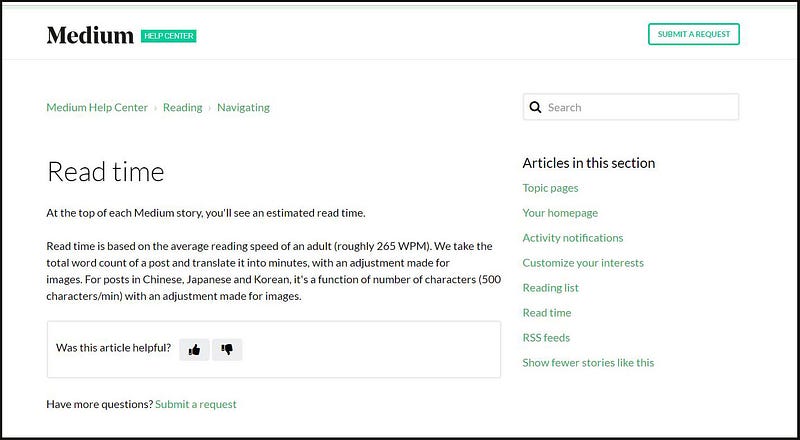
There is a difference between Reading Time and Read Time. It is logical to assume that the new payment system measures whether the Reading Time by a reader is equal to the estimated Read Time of the Story.
At the time of writing this article, Medium does not state this though.
My curated Story “Which Came First, the Chicken or the Egg?” is put up by Medium as a 5 minute read. The number of words (including references) is 905.
If you multiply 265 x 3 you get 795 and 265 x 4 equals 1060, meaning the estimated 5 minute read is on the generous side (remember read time allows for taking in images and is based on 265 words per minute).
265 words (per minute) x 5 minutes = 1325 words. Maybe you can read it in 4 minutes, but the algorithm adds on some time for slower reading or for absorbing or digesting the words (as people are human beings not robotic).
A question for Medium.
Does this mean that a complete read of this Story is only recognised if a reader spends 5 minutes on it, as it has a “5 min Read” time?
But does this really matter? The “chicken or the egg” question is:
Under the new model, is Reading Time measured against Read Time at all?
How we calculate story earnings — from the Medium help page
Partner Program writers are paid monthly based on how much time Medium members spend reading their stories. We’re always working to improve our model as we learn. Initially, we will calculate earnings based on two components:
How long members spend reading your story
How much of their monthly reading time members spend on your story
Let’s say a paying member reads 10 Medium Stories in one calendar month, and one of these Stories is YOUR Story.
Whether their Reading Time equals the Story’s estimated Read Time or not, it is the proportion of their monthly reading time that affects payment.
Let’s say the reader spent 100 minutes during the month reading these 10 Stories and spent 10 minutes on your Story.
If they spent 10 percent of their time on reading your Story, the guideline from Medium below indicates that the writer will receive 10% of their monthly $5.00 payment.
For example, if last month a member spent 10% of their monthly reading time on your story, you will receive 10% of their share (a portion of their subscription fee).
It’s possible that a reader could spend 100 minutes in a month reading 4 Stories each of reading time 20 minutes (80 minutes), and spend 5 minutes reading time each on 2 stories (10 minutes), and 10 minutes reading time on one story.
A 20 minute read of the first Story would result in a 20% share of their monthly fee toward the writer. The 5 minutes reading time on the 5 min Story would result in 5/100 or a 5% pay-out to the writer of this Story.
Medium states under “How will shorter pieces perform in this new model?”
In addition, half of the earnings model is based on a proportional share. If you write a short piece that is read by people who predominantly read other short pieces (e.g., an audience who reads mostly poetry), then your story will receive a meaningful portion of share earnings. The outcome will be similar to if you’d written a long piece read by people who predominantly read other long pieces.
My interpretation of this is that the distribution in the example above really only applies to half of a member’s fees, so $2.50 will be proportioned out based upon percentage of reading time on a writer’s Stories over a month, out of total reading time.
A proportional share means that Medium will factor in relativity.
They will look at the discrete or separate Reading Times of the readers of a writer’s story and if, on the whole, they are equal to the Read Duration of the writer’s story, the writer will be paid more than if the readers did not favour the writer’s story durations.
Example:
A Medium writer, let’s call her Lady MaMa, writes a 2 minute poem. This is read by 100 readers, and the discrete or unique Stories that they mostly read are 2 to 3 minutes duration.
A reader spends 5% of her time a month reading this writer’s short poems.
The reader spends 20% of her time a month reading other writer’s longer Stories. She spends 75% of her monthly reading time on other short poems, or a total of 80% on poems of 2 or 3 minutes duration.
She spends 5% of her time reading Lady MaMa’s poem.
The Medium algorithm will weigh this up by a formula such as by a factor of 8, as the reader used 80% of her time on short articles. The 5% reading time will be up scaled say by 0.8 hypothetically 5 x 0.8 = 4 so perhaps 4 will be added onto the 5 percent.
The proportion of Reading Time has been weighted up from 5 to 9%.
The above is conjecture (an opinion based on incomplete information) wholly made by me, using my knowledge and interest in statistics, to make concrete the principle of equalness that Medium is trying to achieve for shorter Stories.
The Medium information page encourages mid-length articles/Stories, but does not stipulate what read duration they mean by “mid-length”.
My research of Medium Publication requirements indicates that “mid-length” means 7 minutes. (By “Medium Publication” I mean publications run by private individuals, NOT publications run by the Medium company.)
I find the part below from Medium very interesting, under “How we calculate Story earnings.” It depends upon 2 components: how long members spend reading your Story”, and-
How much of their monthly reading time members spend on your story
Imagine an author writes about fly fishing. She finds an audience of fly fishing enthusiasts who subscribe to Medium primarily to read her stories, meaning she receives a strong share of reading time from each of her readers.
In contrast, an author who writes about a wide variety of topics might receive smaller shares from a broader audience of readers, who also read a variety of other authors.
While the generalist will often earn a lot through the first total reading time part, the fly fisher is well equipped to earn through this share part — even with a smaller audience.

It took me a while to figure this out. Here is my interpretation.
I write about a niche topic, being Fly fishing. Luckily, I am able to promote my Medium Story about Fly fishing to fishing groups all over the internet.
At the least (as Medium suggests) I have a circle of friends and acquaintances who avidly read every Story or most stories that I publish on Medium.
These budding fly fishers spend let’s say 20% of their monthly reading time each on reading all of my Fly fishing Stories. Hypothetically, 50 readers do this, totalling 1000% monthly reading time overall.
Next, there’s the “Generalist” who writes a huge range of Stories (averaging 7 minutes read duration). The first total reading part is, of course, the un-weighted part (remember, half of the earnings model is based on a proportional share).
The Generalist publishes 20 Stories in a month, and 80 Readers each spend 10% of their monthly reading time on all these Stories. 80 x 100 = 800% monthly reading time overall.
What this scenario is based upon is that the niche topic writer WILL reach those who are interested in and will read her / his Stories.
Of course, this applies to any and all writers on Medium, but is especially significant for the niche topic writers. In fact, one could say that the payment calculations for niche readers have always depended upon having a solid readership.
As with any content platform, writers are charged with finding out what platform is good for getting reads of their content. Writers can change what they write about or how they write, to adjust to the platform, within bounds.
I’m sorry if poets and short article writers feel that they are being “hard done by” with this new Medium Partner Program payment method, and here’s seeing you trying out the new system with Medium.
If you don’t like it, then I hope you find another outlet which will reward you in the ways that you want to be rewarded.
It has an emotional effect, of course, when things change, like some international poets on Medium disappearing from Medium because they felt that they had not been supported.
But my experience has been to have a deep acceptance of things, while of course, using your influence to change what you can change, but effortlessly.
The poets and the sports writers and other prior Medium writers, and current Medium writers, who have left or will leave Medium, on the basis of not being supported enough, can look out for other online avenues or ways to promote their works (or even start their own perhaps, or ask someone who can, to run a platform with rules that they like).
Time will tell how the new payment calculations will affect each of us, and in the meantime, let’s not compare the possible effects upon each other, in terms of “it’s not fair that they will get more than me”.
We could ask:
Do we adjust to Medium, or does Medium adjust to us?
My answer is : Medium is a business and I will be adjusting to Medium.
The greatest Story of all is our Humanity, que sera sera.


