
Which Came First, the Chicken or the Egg? A Science Lesson
There are two schools of thoughts
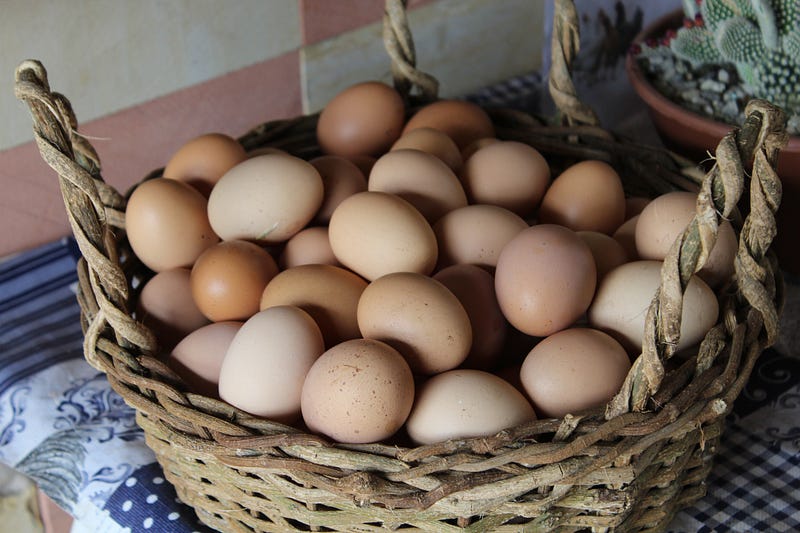
The Egg
Of course, the chicken hatched from the egg, so the egg comes first!
The Chicken
You can’t have an egg without the chicken, so the chicken came first and laid the egg.
You may be surprised at the answer, which is:
Neither came first, they began at the same time!
Complex living organisms are all made up of cells, tissues, and organs; and cells are made up of atoms, molecules, compounds, and space.
In the Beginning was Light, Sound and Heat; and we speculate, all of energy / matter packed into a dense singularity.
The Universe began with the Big Bang when the things before atoms even existed, exploded around 13.8 billion years ago, they say, and gradually formed atoms.
Atoms gave way to stars and galaxies. Cosmology is the study of how the universe began and of its development.
Earth is said by scientists, to have formed about 4.5 billion years ago, and the oldest known fossils on Earth to be around 3.5 billion years old.
Since the 19th Century, biologists have known that all living things are made of “cells”, tiny bags of living matter that come in different shapes and sizes.
Cells were first discovered in the 17th Century, when the first modern microscopes were invented, but it took well over a century for anyone to realise that they were the basis of all life.
In April 2016, scientists presented an updated version of the “tree of life”, a kind of family tree for every living species. The shape of the tree suggests that a bacterium was the common ancestor of all life.
In other words, according to the theory of evolution, every living thing — including you — is ultimately descended from a bacterium.
Biological evolution refers to the cumulative changes that occur in a population over time. These changes are produced at the genetic level as organisms’ genes mutate and/or recombine in different ways during reproduction and are passed on to future generations.
Darwin’s theory, set out in On the Origin of Species in 1859, explained how the vast diversity of life could all have arisen from a single common ancestor. The theory of evolution explains that all living things descended from a primordial organism that lived millions of years ago: the last universal common ancestor.
The Darwinian theory of evolution has withstood the test of time and thousands of scientific experiments; nothing has disproved it. It does not refute God, because “God” can be attributed as the cause of evolution.
In the 1920s some biologists, such as Alexander Oparin (USSR) and J.B.S Haldane (Great Britain), independently proposed that various chemicals could react with each other to form lots of new compounds, some of which would be more complex.
Oparin supposed that the molecules central to life, like sugars and amino acids, could all have formed in Earth’s waters. They also thought that some of the chemicals could form microscopic structures.
The idea that life formed in a primordial soup of organic chemicals became known as the Oparin-Haldane hypothesis.
In 1952, a doctoral student in the U.S.A, Stanley Miller, and Harold Urey (who helped to build the atomic bomb and fought to keep nuclear technology in civilian control) conducted an experiment which conclusively showed that amino acids, the building blocks of proteins, could be formed from a simple atmosphere, under the right conditions.
This became known as “The Origin of Life” experiment or “The Spark of Life” experiment.
Living organisms can be divided into two streams, Prokaryotes (bacteria or single-celled) organisms and Eukaryotes (multi-celled) organisms.
Prokaryotes are organisms made up of cells that lack a cell nucleus or any membrane-encased organelles, and are by far, the majority on Earth. Eukaryotes include plants, animals, fungi and simple multi-cellular organisms.
At some point in Earth’s evolutionary history only around 600 million years ago, single-celled organisms evolved into more complex multicellular life.
The evolution of multicellular life from simpler, unicellular microbes was a pivotal moment in the history of biology on Earth.
So what is the advantage to being multicellular and staying that way?”
The answer to this question is usually cooperation, as cells benefited more from working together than they would from living alone.
The processes of development of multi-cellular organism are cell proliferation, cell specialization, cell to cell interactions, and cell movement.
The hard shelled chicken’s egg starts of as an ovum, i.e. a female gamete or reproductive cell. Gametes are produced by what are called “germ cells”, in the case of females, these germ cells are called oogonia (and in males, they are called gonads).
So, after a chicken is conceived, some of the cells specialize into gametes, which become eggs.
The eggshell is deposited around the egg in the lower part of the oviduct of the hen, just before it is laid. The shell is made of calcite, a crystalline form of calcium carbonate.
Fertilized eggs will contain chicks.
When the first chicken appeared on Earth as a result of evolution, both the bird and the precursor of the egg came first.
The interesting question, really, is not which came first, the chicken or the egg, but:
.
How do chickens lay eggs?
References
https://www.universetoday.com/54756/what-is-the-big-bang-theory/
https://www.britannica.com/science/big-bang-model
https://www.nature.com/news/2011/110823/full/news.2011.498.html
https://www.microscopemaster.com/multicellular-organisms.html
https://www.enchantedlearning.com/subjects/birds/info/chicken/egg.shtml
https://www.pbs.org/wgbh/evolution/library/faq/cat01.html

Hi, if you enjoy reading my stories and you are new to Medium, please sign up from my membership page to read all stories on Medium.
A small portion of your fees will go to me, and the rest will go to the other writers whose stories you read! 😄