
Calcaneal
Don’t be such a heel!

Today’s New York Times Spelling Bee letters:

A, C, E, H, L, V, and center N (all words must include N)
Merriam-Webster says…
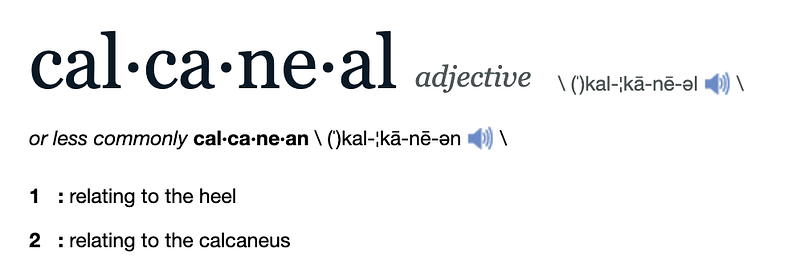
Silly little dictionary! Don’t you know that calcaneal can’t possibly be a word if The New York Times says it ain’t?
For further fascinating facts, check out the Spelling Bee Master.
What’s your favorite dord* from today’s puzzle?
My Two Cents
Ever wonder how some slang expressions came into being? No? Well, we’re going to tell you anyway.And since today’s word of the day is an adjective meaning “related to the heel”, the slang expression has to do with that rear part of the foot. Actually, there are two expression that may be intimately connected: “heeled” and “well-heeled”. Both are used in the sense of someone having a lot of money, but “heeled” was also used in the Old West to refer to someone who was armed.
According to Marshall Trimble of True West Magazine, “In the Old West, at least in theory, a person was better off carrying a firearm — and thus he (or she) was “heeled.” The term was first applied, in 1866, to gamecocks with spurs strapped to the heels, giving them advantage in a cockfight.”
The Online Etymology Dictionary explains this about “well-heeled”:
“well-off, having much money, in good circumstances;” also “well-equipped,” 1872, American English slang (originally in the “money” sense), from well (adv.) + colloquial sense of heeled. “[A]pplied to a player at cards who has a good hand, to a person who possesses plenty of money, or to a man who is well armed” [Century Dictionary]. From 1817 in a literal sense, in reference to shoes.
And regarding the colloquial sense of “heeled” mentioned above, they say this:
“provided with money,” 1880, American English Western slang, from earlier sense “furnished with a gun, armed” (1866). This is perhaps transferred from the sense “furnish (a gamecock) with a heel-like spur” (1560s), which was still in use in 19c., a special use of heel.
So which came first? The gamecock or the shoe? The slang expressions may or may not have come from nice, expensive shoes; nice, expensive heel-spurs; or nice, expensive guns. What do you think?
There’s another sense to the word heel:
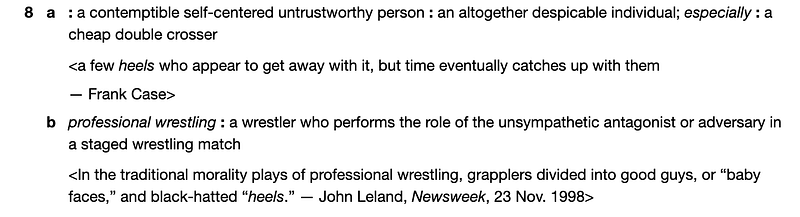
I remember the phrase “I’ve been such a heel” (or similar ones) being uttered by characters in old movies. And by old movies, kids, I mean one that were made 7 and 8 decades ago, not 7 or 8 years ago.
As for the wrestling term, the “heel” is the baddy who gets most of the boos from the crowd. At least that seems to be the way to measure heel-ness in the ring of professional fake fights. In the U.S., heels typically have been portrayed as foreigners (The Iron Shiek, Ivan Koloff, Yokozuna) despite some of them being American. Wrestling heels usually fight dirty, attack other wrestlers backstage, interfere in matches, insult fans, and generally act like they’re the best thing since sliced bread. In contrast, the hero wrestlers are known as the “faces” (Hulk Hogan probably being the best example).
Playing footsie
The calcaneus is commonly called the “heel bone”… which is connected to the ankle bone, which is connected to the knee bone, and so on and so forth, as Herman Munster once taught us. And our friends at Merriam-Webster tell us the word calcaneus comes from the Late Latin, meaning “heel”, an alteration of the Latin calcaneum.
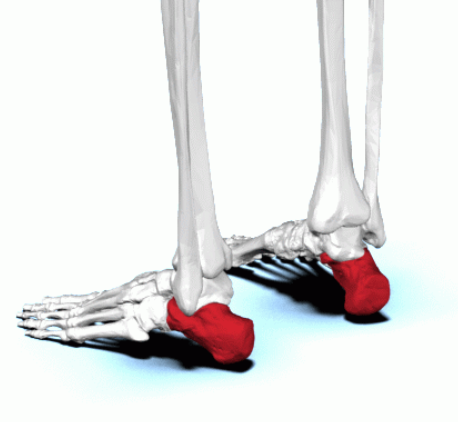
In the above image, the calcanei (plural of calcaneus) appear in red. But don’t worry, unless you’ve rubbed your heels down to the bone, your calcanei are probably not that color.
The calcaneum form part of the tarsus, a group of seven mostly short, angular bones that make up the ankle in humans. The other six are the cuboid, medial cuneiform, intermediate cuneiform, lateral cuneiform, navicular, and talus.
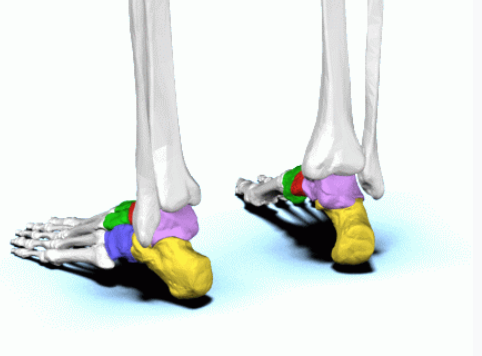
Oh, look! We’ve added more colors, and now the heel bone has turned yellow!
In animals that walk on their toes (like dogs or cats) or on hoofs (horses and cows), the calcaneum is actually not at the bottom part of the leg, but in the middle, in an area known as the hock.
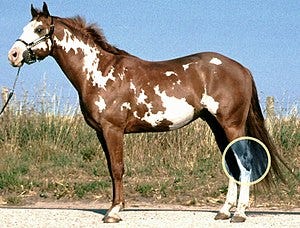
If you guessed that the circled part is the hock, well, what can I say. Bravo. Braviiiisimo! Here is what the hock looks like when you strip it of skin, muscles, and all the other yucky stuff.
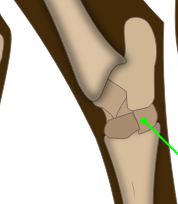
Please note that real horses do not have green pins stuck to their bones. It’s just that my screenshotter, Iva Reztok, is both lousy and lazy. A terrible combination, if you ask me. By the way, in the above image the calcaneum is the bone on the right that looks like a thumbs up.
Lovers’ leap
The calcaneum is a pretty sturdy bone, but like most bones in the human body, it is subject to suffering from fractures. This usually happens when a person falls from a big height and lands squarely on their feet or on their heels, and sometimes in certain car or motorcycle accidents. The diagnosis is made based on symptoms like pain (“Aargh! Doctor! My heel is effin’ killing me!”), bruising, trouble walking, and even deformity of the heel.
Calcaneal fractures can be confirmed via a simple X-ray or, if needed, a CAT scan or an MRI. We here at Silly Little Dictionary! don’t have the budget for the latter two, so we’ll provide you with the simple X-ray:
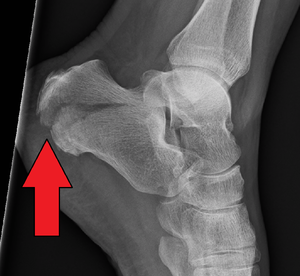
Please note that the red arrow is not what caused this person’s calcaneal fracture. At least, I don’t think so. I’ll confirm with Dr. Heilman and get back to you, though.
This type of fracture is colloquially known as “The Lover’s Fracture” or the “Don Juan Fracture”, based on the stereotypical legend of a man having to jump out the balcony or window when the wife’s husband suddenly returns home. Personally, I think the following is a much better way to deal with this situation:
Now you know. Next time you see someone limping after jumping out a window to avoid an angry spouse, ask them if they had a calcaneal fracture. Don’t be surprised if they don’t stop to answer you, though. Not because they’re in a hurry to avoid getting caught… but because the editors of the Spelling Bee decided that calcaneal is a dord*.
You can check out my previous entry on another dord* here:
*What the heck is a dord, you ask? Here’s the answer: