
Cabaret and the Death of Queer Equality
Willkommen im Fascism?
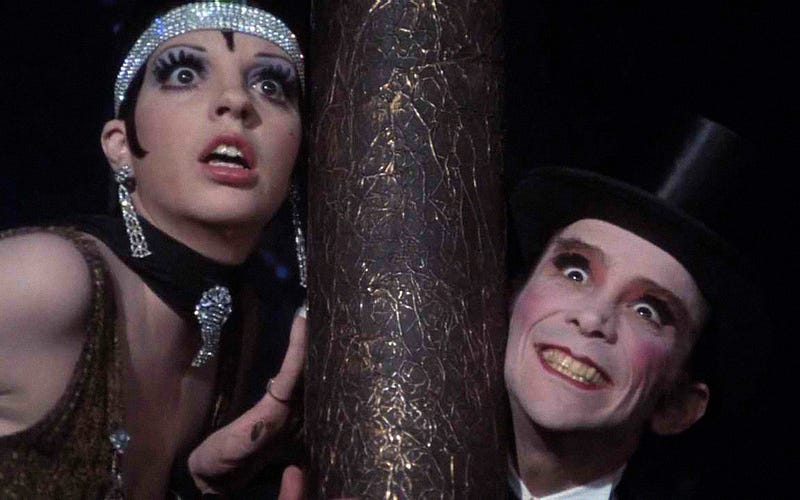
Did you know pre-Hitler Germany was an epicenter of queer equality? A liberal light to the world? The world’s first organized LGBT liberation movement was born in Berlin in the late 19th and early 20th centuries. By the early 1930s, LGBT equality had made great strides, spreading across Europe into France and Italy. The rise of fascism in Germany smashed the nascent queer movement. Is the United States facing a similar moment? Does the rise of Donald Trump threaten rights the way the rise of Hitler did during the gay golden years of the Weimar Republic?
Historian Robert Beachy calls Berlin the birthplace of modern LGBT identity in his 2014 book Gay Berlin. Writing in The New Yorker, Alex Ross agrees with Beachy that the Germans first invented gay rights more than a century ago.
By the mid-1920s, public attitudes in Germany towards lesbians, gay men, and transgender people had become relatively accepting. Laws punishing same-gender sex didn’t get changed, but police stopped enforcing them, like in much of the US in the latter half of the 20th century.
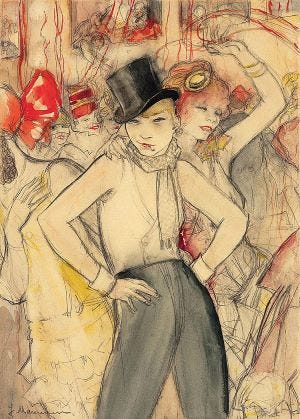
Great art was created, books written, and films produced, all celebrating and accepting members of gender and sexual minorities.
LGBT activists (to use today’s vocabulary) organized protests of offensive print and stage depictions of queer people. Media entrepreneurs catered to middle-class gay and trans clientele. Gay bars catered to all classes of people, from the working poor to the elite.
Doctors and scientists began to describe homosexuality and “transvestism” (period vocabulary encompassing transgender and gender-variant people) as a natural characteristic rather than a “derangement.”
Never doubt the evil we humans are capable of. You must always watch for the signs. You must always be ready.
LGBTQ people from all over the world came to Berlin to experience the joys of living freely. Christopher Isherwood was one of them, a young Englishman who eventually penned Goodbye to Berlin, a series of tales based on his experiences in the 1930s. His stories eventually became the germ of the Broadway musicals and Hollywood films called Cabaret.
The LGBT movement crashed with the rise of Hitler
When the Nazi Party came to full power in 1933, they did not at first persecute gay and transgender people. Ernst Röhm, who was one of Adolf Hitler’s earliest and most intimate associates, was (mostly) openly gay. He led the Sturmabteilung (the SA or Brownshirts), a quasi-military street army that helped sweep Hitler to power. But fearing Röhm as a rival, Hitler had him killed during the Night of the Long Knives in June 1934, part of a purge eliminating most SA leadership and other rivals across Germany.
While Hitler and and his senior staff had long accepted Röhm’s homosexuality, disparaging it became an important part of a propaganda effort to convince shocked Germans that the extrajudicial killings had been justified.
With the death of Röhm and the subsequent national vilification of homosexuality, the German LGBT movement came to a decisive end. During the following year alone, the Gestapo arrested more than 8,500 gay men. With the US, the UK, Canada, and the USSR harshly persecuting LGBT people at that time, LGBT liberation was dead, pretty much everywhere in the world.
Gay men love musical theatre! That may be a stereotype, but it was true for my late partner Lenny, my big bruiser of an Alphabet City lothario, husband in all but legal reality. He was a second-generation Polish Jew, a native New Yorker, built like a Sherman tank, and a huge fan of all things Judy Garland, Liza Minnelli, and Jeanette MacDonald.
His mother immigrated to New York City before Hitler’s rise to power, fearing anti-semitism in Poland. Lenny was born just a few years after Röhm’s execution and grew up in Lower East Side tenements.
He once told me he’d seen every musical that graced Broadway during his lifetime, even the ones that flopped. Starting in 1990, I was always his date. In March of 1998, we went to one of the last musicals of his life, a revival of Cabaret at the Stephen Sondheim theater on West 43rd St.
Even if you’ve never seen the musical, you’ve probably hear its signature number, Willkommen. It’s been covered by many pop artists, and Lady Gaga often performs it as an interlude in her concerts.
Willkommen! Bienvenue! Welcome! Fremder, étranger, stranger Glücklich zu sehen Je suis enchanté Happy to see you Bleibe, reste, stay Willkommen! And bienvenue! Welcome! I’m cabaret, au cabaret, to cabaret!
— Willkommen, music by John Kander, lyrics by Fred Ebb.
Besides the Broadway version, Liza Minnelli starred in a 1972 musical film blockbuster directed by Bob Fosse. Most people recognize the Willkommen number— upbeat and cheery as it seemingly celebrates diversity and common humanity. Many of us understand that as it celebrates cabaret as an art form, it celebrates the queer people who largely invented that form. But how many of us understand the musical is a tragic paean to a world of LGBTQ freedom and joy about to suffer an agonizing death?
Encoding Cabaret into queer DNA
Both the stage version of Cabaret and the film are set in 1931 Berlin as the Nazi Party begins to swell into a powerful force. Both are loosely based on characters and settings in Isherwood’s Goodbye to Berlin.
As Janet Mason writes in the Huffington Post, the Weimer Republic and Berlin’s openly gay culture should be encoded into our LGBT cultural memory. How many of us have sat around with friends listening to Liza’s beautiful singing, forgetting what the the film is really saying? How many of us have sat around pianos bellowing out the words to Willkommen, forgetting the tragic ending to Isherwood’s memoires? Forgetting the death of the “golden age.”
Watching the final scene of the 1972 film, as Nazi officers fill the Kit Kat club, how many of us think about the implications to LGBTQ people? Mason writes that in the nights after she read a book about the Weimar gay golden age, she “kept dreaming that the United States was sliding toward fascism.”
Queer consequences of German fascism
The total number of Europeans arrested for being LGBTQ under fascism is impossible to know due to the lack of reliable records. Estimates range from tens of thousands to hundred of thousands during the war period alone.
Most were sent to concentration camps, marked with a pink triangle, and singled out for abuse. They were mechanically raped, castrated, favored for medical experiments and murdered for guards’ sadistic pleasure even when not sentenced for liquidation — as survivor Heinz Heger recounts in his harrowing autobiography.
Could fascism and its related atrocities happen again?
The question that haunts Mason at night is the same one I think about sometimes. The anti-queer cancer than infected Germany during the 1930s wasn’t just a Nazi phenomenon. It wasn’t some peculiar obsession of Adolf Hitler, who as an intimate friend of Ernst Röhm didn’t seem to have much (if any) personal animosity toward LGBTQ people. Before Hitler had him killed, Röhm was one of a tiny handful of people allowed to call Hitler by his first name and even by a nickname.
Backlash against Weimar LGBTQ progress
To an LGBT person in early 20th century Europe, progress may not have spelled the definitive end of a millennium of brutal intolerance, but the 20s and early 30s must have looked promising. But the greater “out-ness” of gay and trans people provoked backlash, sometimes intense.
- One French reporter, angry about publicy open LGBTQ people, complained “the contagion … is corrupting every milieu.”
- The Berlin police complained that “obscene press materials” — magazines aimed at gay men— were becoming too common.
- In Vienna, lectures of the pro-LGBTQ scientific study groups were sometimes packed with supporters, but they were also attacked by young men hurling stink bombs.
- In 1933, a Parisian municipal politician bemoaned the “moral crisis” of gay men being seen in public. He admired the fascists for chasing gay men out of Germany and Italy.
When Hitler unleashed an anti-LGBTQ propaganda campaign to justify the killings of hundreds of his perceived enemies, he knew he was tapping into sentiment popular with conservative members of society. He used the backlash for his own political purposes.
Are queer people in the US facing a similar backlash?
21st century America isn’t 1930s Europe. Facile comparisons can only yield facile conclusions, but that doesn’t mean we should be complacent. Nobody in Weimar Germany expected the rise of authoritarianism, but it happened anyway.
With new forms of authoritarianism entrenched and expanding in Europe and the US, the fate of Europe’s openly LGBTQ people in the 1930s and 40s should serve as a timely note of caution.
In 1929, Germany came close to annulling its anti-gay law in a spirit of general tolerance and national acceptance, only to see persecutions and pogroms fire up five years later. Where will we be in five years?
The rise of Trump is cause for alarm
Donald Trump is obviously no Adolf Hitler, but he’s clearly an amoral man willing to do just about anything to gain and hold power. He’s allied himself closely with conservative elements of society who wish to see LGBTQ people disappear. He’s blatantly courting their support by using the full power of his office to suppress LGBTQ equality.
Do you think fascism couldn’t possibly take root in the US? Have a look at this rant on an official White House video in which a minister preaches, while Vice President Mike Pence sits nearby, that LGBTQ people are “demonic,” “satanic” and “of the devil.”
It’s hard to imagine any recent US administration not at least politely distancing itself from that kind of rhetoric. Trump and his people have chosen to embrace it, highlighting the video on official (taxpayer funded) White House resources.
The rise of ‘Trumpism’ may be even more worrisome
While Trump himself may present a certain danger of a slide toward fascism, his powerful Republican allies amp up concern levels. It’s hard to watch the impeachment proceedings underway in the Senate without understanding that Trump has nobody checking his worst impulses.
No bad deed by Trump and no amount of disloyalty to our republic or its constitutional principles seem enough to shake Republican senators’ loyalty. Trump is behaving like a dictator and the Senate is letting him, apparently happy about it.
Trump’s anti-LGBTQ allies press full court with ‘Project Blitz’
While Trump is delivering anti-LGBTQ measures on the federal level, his allies push ahead with “Project Blitz,” a legislative playbook designed to destroy LGBT equality on the state level. Goals include stopping LGBTQ people from fostering and adopting children, from enjoying equality in housing and employment, and from receiving medical care from professionals who object on religious grounds. Project Blitz even aims to make prescribing temporary puberty blocking drugs for transgender teenageres a felony.
Project Blitz was founded in 2016 by former U.S. Rep. Randy Forbes, as an outgrowth of the Congressional Prayer Caucus, which he also founded. The use of the word Blitz, with its Nazi-era German connotation, may or may not be a coincidence.
I never met Lenny’s Polish mother, but we did have a close friend who fled Vienna at the outset of the Nazi era. Hilda was ancient by the time I met her in Manhattan, but her memories were clear. She told me stories of personal horror and grief that I sometimes can’t bear to repeat even to myself. She lost a baby to the Nazis, and she never forgot the human capacity for brutality.
When the Bosnian War started in 1992, I was horrified. Just back from living in Berlin, I couldn’t fathom that ethnic cleansing, mass rape, indiscriminate shelling of civilians, and other atrocities were playing out so close to where I used to live.
I asked Hilda, “How can this happen? How can fascism like this return? I thought we had learned! That it would never happen again!”
She looked at me with sad eyes, then patted my shoulder. “Jimmy,” she said. “Never doubt the evil we humans are capable of. You must always watch for the signs. You must always be ready.”
Watch for the signs
I think both Cabaret and Hilda have a lot to teach us. I’m not writing to say I think a tsunami of fascism is about to wash over the US. But I am carefully watching the signs. I know what humans are capable of, and as a stigmatized minority, I know I have to be ready.
My hope lies in numbers, in trusting that if enough of us wake up, shake off complacency, and watch the signs together, we can be truly ready together. I trust we can be enough, together, to stop things before they get as bad as they did when the Night of the Long Knives killed queer equality for decades.
I trust that together we can prevent not just the death of queer equality, but freedom and equality for all Americans.
Curious about Hilda’s story? Click the link below.
James Finn is a long-time HIV/LGBTQ activist, an alumnus of Act Up NYC, an essayist occasionally published in queer news outlets, and an “agented” novelist. Send questions, comments, and story ideas to [email protected].


