
Fleeing the Nazis, Baby in Arms
Suffering and resilience intersect with queer and Jewish
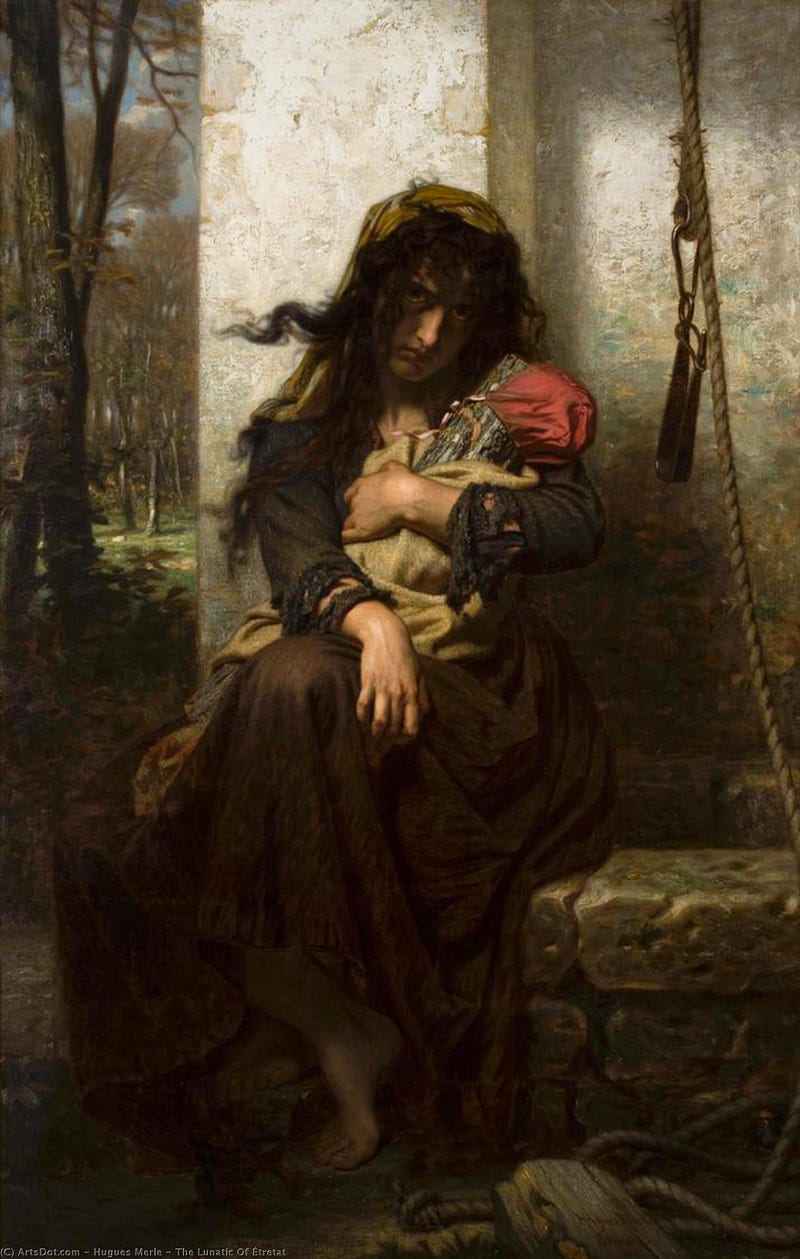
I don’t know where she lost the baby. I never dared ask —
All I know is that Hilda set out from Vienna with a infant in her arms, clasping a 3-year-old girl by the hand. All I know is that by the time she made it to Rotterdam, the baby was dead.
I think she buried it herself. I think she scratched out a shallow grave with her own bleeding fingers somewhere in rural Germany. She hinted at that much.
A friend of mine asked me a tough question —
She’d just read my piece, Tales from the Trenches, in which I talk about losing so many friends to HIV in the 1990s. “How you can recover from something like that? Can you recover?”
Living in a tight-knit gay community in Lower Manhattan in those years was traumatizing, no question. I was a young man surrounded by other young men who were dying from a terrible plague, an illness that struck people down at random and with symptoms of terrible suffering.
The Sword of Damocles dangled over our heads. Nobody knew who was next. Twenty and thirty somethings aren’t supposed to go to a funeral every week.
But as soon as my friend asked me about trauma, I thought of Hilda. I pushed back instantly in my own mind.
“People are resilient,” I told her. “We recover. It’s what we do.”
Hilda married against the wishes of her upper class, wealthy family.
She grew up a treasured daughter, surrounded by the finest art, nourished on the best music of the finest composers. Her father indulged her by letting her pursue her interests in the sciences. She worshiped Marie Curie and followed in her footsteps.
I asked her one sunny afternoon as I sat chatting with her and my beautiful friend Cooke. What pulled her to the garden and the company of queer people?
Unlike most women in prewar Vienna, Hilda went to university and studied science — chemistry. She struggled against misogyny and sexism. She fought to learn. She succeeded.
Then she fell in love with Joseph, a young shopkeeper.
“It was such a nice shop, Jimmy,” she would tell me. “My Joseph sold only the most beautiful things. Only to the best people.”
Her father disowned her when she eloped. Never spoke to her again. He was willing to put up with her being a maverick in terms of education. He tolerated her studying science. He couldn’t tolerate her marrying down.
Hilda was strong, though. She’d need to be.
She had a child, a beautiful little girl. Then three years later came a little boy. He wasn’t even six weeks old when the Nazis came, when Hitler’s forces overran Austria.
Hilda was a Jew —
Joseph was a Jew active in communist politics. His name was on all the wrong lists. The SS destroyed his shop first, shattering the plate-glass display windows while Hilda watched in hiding from around the corner, hands clasped over her children’s mouths to keep them quiet.
They threw his beautiful things out into the street, and they dragged him away, hair askew, eyes swollen almost shut, blood streaming down his face.
Hilda never saw him again. From hiding, she heard of Joseph’s friends disappearing. So, she gathered what money she could, and she left.
I don’t know all the details, but she mostly walked — all the way across Europe, through Germany, selling her body for food and transportation. She slept in barns. She slept in forests. Her plump cheeks turned hollow. Her ribs stood out.
Her milk dried up, and the baby starved to death.
Somehow, she made it to Rotterdam. Somehow she paid smugglers to bundle her and her little girl onto a boat. She ended up in England where she spent the war working as a lab technician. She raised her daughter.
She emigrated to New York City.
And you know what that woman did? That unbelievably beautiful, strong human being got herself a PhD from Columbia. She worked right through the early 1980s as a research chemist.
Just like Marie Curie.
Hilda recovered. She was resilient.
When I met her, she was hanging out in the garden of the 13th St. LGBT Community Services Center in Greenwich Village. What a magical place that was for me.
So much of my life turns on events that went down at the Center and the Garden. But why did Hilda hang out there? She wasn’t a lesbian. She wasn’t bisexual. She wasn’t trans. She’d never hung out in gay bars.
I asked her one sunny afternoon as I sat chatting with her and my beautiful friend Cooke. What pulled her to the garden and the company of queer people?
She laughed. “My apartment is just around the corner, silly boy.”
I raised an eyebrow at her.
“Maybe,” she continued, “because is better to spend time with young people, than with old, wrinkled fools like me. But not with silly young people. Not with young people who don’t know how to suffer. No, I don’t think I’d like that.”
I didn’t understand then what she meant. Now, I think I appreciate that Hilda understood resilience. I think she respected others who knew how much it hurts to be different, to suffer for it, and to just keep walking, keep fighting, keep hoping.
I’m sure Hilda never heard the word intersectionality, but I’m willing to bet that she understood the principle right down to its core.
I’m serializing a novel on Medium that features the Center, the garden, Hilda, and many more of my friends from the Plague Years of the HIV epidemic. One of the reasons I wrote the novel was to honor Hilda.