avatarChris Thompson

Free AI web copilot to create summaries, insights and extended knowledge, download it at here

3499

Abstract

<p id="7a3c">But the real issue is different.</p><p id="6887" type="7">The fundamental problem is that there is no trust in the students.</p><p id="102a">Teachers don’t trust kids. The system doesn’t trust kids.</p><p id="f3ee">And, worst of all, parents don’t trust their kids.</p><h2 id="7cce">Child in the Kitchen</h2><p id="666e">Have you ever cooked with a young child?</p><p id="b199">If it is their first time making cookies, eggs will end up on the floor, flour will be everywhere, half of the chocolate will be eaten before it gets into the cookie mix. Usually the cookies will be over- or undercooked and none of them will be uniform in size.</p><p id="ef13">A typical parent will intervene quickly to show the child how to make cookies properly. They will crack the eggs, mix the flour, distribute the chocolate chips evenly and carefully measure each spoonful of dough as it goes onto the tray. As they cookies are in the oven, the parent will watch the cookies to make sure they are cooking properly.</p><p id="44da" type="7">By this time the child has left the room to do something more interesting.</p><p id="6a17">Over the years the same parent will be frustrated that the child doesn’t like to cook or spend time in the kitchen.</p><p id="48cb">If they had just let that child make a mess the first few times when making cookies, they would love being in the kitchen and would have been cooking full meals by the time they were teens.</p><p id="08b7">But we don’t trust them and we take that experience away.</p><p id="c7b0">We strip them of their learning.</p><h2 id="4deb">Harvard</h2><p id="a2e0">The idea of utilizing more experiential learning isn’t confined to a jungle school in Bali.</p><p id="179a">Any good educator will explain the value of experiential learning.</p><p id="331d">The business school sector has gone through <a href="https://www.ft.com/content/0b1aeb22-d765-11e8-a854-33d6f82e62f8">profound changes over the past decade</a> as they found their case study model, where students look at historical business examples in the classroom, wasn’t creating well-rounded students for the workplace.</p><p id="52f7">Harvard’s business school model is built on the case study. Up until a few years ago, 70% of a student’s time was spent on case studies. The other 30% was spent in internships and real-world jobs to integrate their learning.</p><p id="5bc5" type="7">Harvard and other business schools have needed to flip this model over the years as they found students need to be spending more time in the real world having practical experiences.</p><p id="e42c">I have hired a lot of business school graduates. It takes a long time to un-train their myopic thinking as they only see the world through case studies.</p><p id="f312">They lose the ability to think and analyze.</p><h2 id="f49c">The Village</h2><p id="0306">We tend to look down on remote and indigenous societies as backwards and uneducated.</p><p id="9122">In a village the child will learn to hunt with his uncle, fish with his mother and learn history from his grandfather. They will spend time making their own tools or pottery with the neighbor. They will explore the world around them and apply their learning in the moment. They can climb trees, swim across rivers.</p><p id="9b95">By the time they are a teen they are wholly self sufficient.</p><p id="f46e">In modern society, most graduates from college aren’t self sufficient. Not only can they not cook a meal, but they don’t have the abili # Options ty to manage their own personal finances.</p><div id="5b83" class="link-block"> <a href="https://readmedium.com/my-financial-advice-to-my-kids-8564b3b594d2"> <div> <div> <h2>My Financial Advice to My Kids</h2> <div><h3>Learning about personal finance is more important than math, science and language.</h3></div> <div><p>medium.com</p></div> </div> <div> <div style="background-image: url(https://miro.readmedium.com/v2/resize:fit:320/1*lhQ8DYlMjTesg8GFoYxTyA.jpeg)"></div> </div> </div> </a> </div><p id="79f8">Yet we still look down on the villager.</p><p id="e65c">We are an odd world.</p><h2 id="3928">Let Them Be</h2><p id="126e">We have stripped our children of the ability to learn for themselves. We send them into educational processing mills where we believe they will grow, learn and be on a path of happiness.</p><p id="cacf">Nothing is further from the truth.</p><p id="0e8a">The research has been clear for over ten thousand years on the best way to learn. We imposed a new model as we moved into an industrial age.</p><p id="036c" type="7">The result is we are creating unhappy and incompetent people. If we just left them alone and encouraged them, they would be happier and more capable.</p><p id="900b">You may find it insane that a group of children were allowed to build a bridge across a river. But ask any of them how to build a bridge and they can tell you.</p><p id="d937">And it was simply because they were allowed to do it.</p><p id="61ec">Can you build a bridge?</p><p id="ab14">Think about it.</p><p id="c92e">No, don’t think about it. Just do it.</p><div id="b5e2" class="link-block"> <a href="https://readmedium.com/listening-to-leaves-d56f03b1cec9"> <div> <div> <h2>Listening to Leaves</h2> <div><h3>How one lesson transformed a child’s learning and a mother’s sense of hope</h3></div> <div><p>medium.com</p></div> </div> <div> <div style="background-image: url(https://miro.readmedium.com/v2/resize:fit:320/1*RnvbXQxOEChqVzTWbziQwQ.jpeg)"></div> </div> </div> </a> </div><div id="dbe7" class="link-block"> <a href="https://readmedium.com/spirit-disconnected-how-the-education-system-harms-our-children-e50ed9587b57"> <div> <div> <h2>Spirit Disconnected: How the Education System Harms Our Children</h2> <div><h3>And what we can do about it.</h3></div> <div><p>medium.com</p></div> </div> <div> <div style="background-image: url(https://miro.readmedium.com/v2/resize:fit:320/1*9YPjgmWhaaiVUzfRcWQw_w.jpeg)"></div> </div> </div> </a> </div><p id="cc00"><a href="https://rjchristhompson.medium.com/subscribe"><i>I write about education, parenting, life, family alcoholism, and my time around the world. If you enjoyed my story you may sign up here to receive an email for new articles. I will never ever bother you or try to sell you anything. I promise.</i></a></p><p id="4507"><a href="https://medium.com/@RJChrisThompson/membership"><i>If you would like to join Medium and support writers, please click here using my link.</i></a></p></article></body>

Building Bridges in the Jungle

Traditional education doesn’t trust the child.
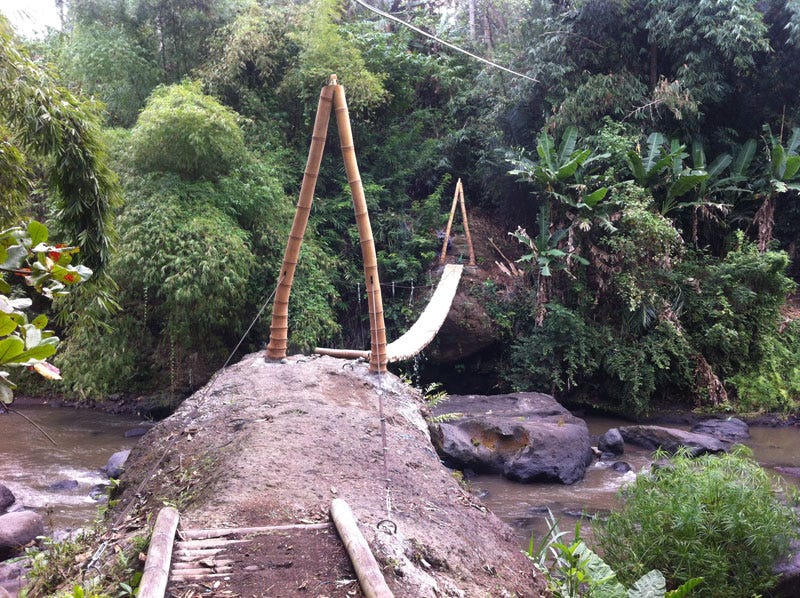
Student-built bridge at Green School Bali.

“Learning happens in the minds and souls, not in the databases of multiple-choice tests.”

— Ken Robinson

I was giving a tour to a group of architectural students at Green School in Bali. We host many architects from around the world as we have some of the most unique bamboo designs in the world.

We stood on the bamboo bridge that spans the Ayung River. It is a work of marvel and cutting edge design. They lean over the rails and point at the elaborate construction. They are excited to see a structure that isn’t square and made of cement.

I asked them if they ever took a class on bridge building.

“Yes!” the majority emphatically responded. “And what did that entail,” I ask. “We study the best bridge designs in the world and do a lot of reading. We then get into computer design and create a bridge.” “Do you build a bridge?” I ask. “Of course we do! We make a model of the bridge.” “So you don’t build an actual bridge?” I ask. “Of course not. How can we build a bridge?” they respond.

I then proceed to tell them how we learn about bridges at Green School.

Backwards Thinking

A group of Middle School students were taking a class on architectural design. As their main project they were going to build a bridge.

Just like the architectural students, they looked at examples from around the world, designed ideas on the computer and built a model.

But there was one big difference.

They actually built a bridge across the river.

And they did this first.

Was it the best bridge ever made? No. Were their adults and specialists to help? Of course. Were there mistakes? Yes. Did it look anything like the professionally designed bridge made by the School? No.

But they built the bridge as you can see from the photo above. And people could walk across it.

When I explain this story to anyone who comes from a traditional learning model, they respond with disdain. They find it ludicrous that a group of young teenagers can actually build a bridge and they question the design approach.

Standard education predicates that children need to be lectured to and inundated with information before they can take their first step.

Months of reading and research is required to accomplish anything.

This failed learning model means that there is very little time to actually get to the most important part of any learning: doing. The research is extensive on the value of experiential learning. When a child performs a task that is integrated to their subject, they learn and retain the information more effectively.

Part of the problem is that there isn’t time in the classroom because the subject-oriented model fills up the timetable leaving teachers no time to work out of the classroom.

But the real issue is different.

The fundamental problem is that there is no trust in the students.

Teachers don’t trust kids. The system doesn’t trust kids.

And, worst of all, parents don’t trust their kids.

Child in the Kitchen

Have you ever cooked with a young child?

If it is their first time making cookies, eggs will end up on the floor, flour will be everywhere, half of the chocolate will be eaten before it gets into the cookie mix. Usually the cookies will be over- or undercooked and none of them will be uniform in size.

A typical parent will intervene quickly to show the child how to make cookies properly. They will crack the eggs, mix the flour, distribute the chocolate chips evenly and carefully measure each spoonful of dough as it goes onto the tray. As they cookies are in the oven, the parent will watch the cookies to make sure they are cooking properly.

By this time the child has left the room to do something more interesting.

Over the years the same parent will be frustrated that the child doesn’t like to cook or spend time in the kitchen.

If they had just let that child make a mess the first few times when making cookies, they would love being in the kitchen and would have been cooking full meals by the time they were teens.

But we don’t trust them and we take that experience away.

We strip them of their learning.

Harvard

The idea of utilizing more experiential learning isn’t confined to a jungle school in Bali.

Any good educator will explain the value of experiential learning.

The business school sector has gone through profound changes over the past decade as they found their case study model, where students look at historical business examples in the classroom, wasn’t creating well-rounded students for the workplace.

Harvard’s business school model is built on the case study. Up until a few years ago, 70% of a student’s time was spent on case studies. The other 30% was spent in internships and real-world jobs to integrate their learning.

Harvard and other business schools have needed to flip this model over the years as they found students need to be spending more time in the real world having practical experiences.

I have hired a lot of business school graduates. It takes a long time to un-train their myopic thinking as they only see the world through case studies.

They lose the ability to think and analyze.

The Village

We tend to look down on remote and indigenous societies as backwards and uneducated.

In a village the child will learn to hunt with his uncle, fish with his mother and learn history from his grandfather. They will spend time making their own tools or pottery with the neighbor. They will explore the world around them and apply their learning in the moment. They can climb trees, swim across rivers.

By the time they are a teen they are wholly self sufficient.

In modern society, most graduates from college aren’t self sufficient. Not only can they not cook a meal, but they don’t have the ability to manage their own personal finances.

Yet we still look down on the villager.

We are an odd world.

Let Them Be

We have stripped our children of the ability to learn for themselves. We send them into educational processing mills where we believe they will grow, learn and be on a path of happiness.

Nothing is further from the truth.

The research has been clear for over ten thousand years on the best way to learn. We imposed a new model as we moved into an industrial age.

The result is we are creating unhappy and incompetent people. If we just left them alone and encouraged them, they would be happier and more capable.

You may find it insane that a group of children were allowed to build a bridge across a river. But ask any of them how to build a bridge and they can tell you.

And it was simply because they were allowed to do it.

Can you build a bridge?

Think about it.

No, don’t think about it. Just do it.

I write about education, parenting, life, family alcoholism, and my time around the world. If you enjoyed my story you may sign up here to receive an email for new articles. I will never ever bother you or try to sell you anything. I promise.

If you would like to join Medium and support writers, please click here using my link.

Parenting
Education
Harvard
Business School
Architecture
Recommended from ReadMedium