Building a Data Mesh with Azure Data Lake, Azure Synapse, & Azure Data Share
How to use the Azure Cloud as a stable and modern Data Platform

Building a Data Mesh with Azure services like Azure Data Lake, Azure Synapse Analytics, and Azure Data Share enables organizations to create a scalable, decentralized data architecture.
In the era of Big Data, organizations are continually seeking efficient ways to manage, analyze, and share their vast volumes of data. The concept of a Data Mesh has emerged as a decentralized approach for managing data infrastructure, and providing agility as well as scalability. Read more about the concept in the article linked below:
By leveraging Azure services like Azure Data Lake, Azure Synapse Analytics, and Azure Data Share, organizations can construct a robust and scalable Data Mesh. Here’s a comprehensive guide on how to set up and utilize these Azure services for building a Data Mesh:
Step 1: Azure Data Lake Storage
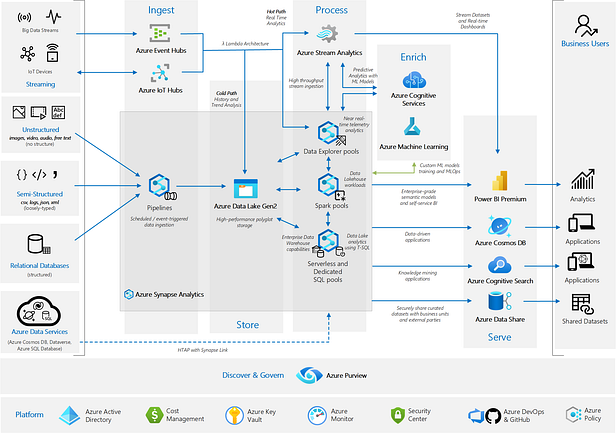
Begin by provisioning Azure Data Lake Storage Gen2, a secure and highly scalable Data Lake solution in Azure. Organize data into logical folders and hierarchies and ensure proper access controls and governance. The big benefit of Azure Data Lake Storage is that it allows to store all kinds of data from structured to unstructured data[1].
Step 2: Azure Synapse Analytics
After you create a stable Data Lake with Azure Data Lake Storage, you can then create an Azure Synapse Analytics workspace to enable seamless data integration, analytics, and querying capabilities. Utilize Synapse to perform data transformations, run analytics pipelines, and execute complex queries across structured and unstructured data stored in Data Lake Storage[2].
Step 3: Embrace the Principles of a Data Mesh Architecture
A Data Mesh approach can help with the improvement of the Data Lake as the dominant architectural paradigm. It is important to understand that the Data Mesh concept primarily creates a new organizational perspective and is less based on technical problem solving. Therefore, you should consider these four principles when building up a Data Mesh organization[3]:
- Principle 1: Domain-oriented decentralized Data Ownership and Architecture: A Data Mesh should serve the individual business units. Therefore, one or different Data Lakehouses can be created.
- Principle 2: Data as a Product: The Data Lakehouse architecture helps to manage data as a product by offering different data team members in domain-specific teams complete control over the data lifecycle.
- Principle 3: Self-serve Data Infrastructure as a Platform: Users can supply themselves with data in a self-service BI tool, while Data Scientists, for example, access the same data and develop models.
- Principle 4: Federated computational Governance: The data should be backed up and distributed with a role concept. Data catalogs, for example, are also helpful here.
Step 4: Domain Data Ownership and Mesh Governance
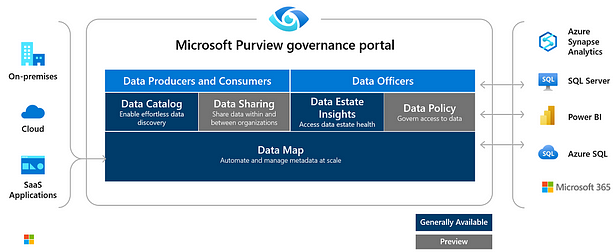
Establish domain specific data ownership and governance models. Define clear boundaries for data domains, ensuring autonomy, accountability, and responsibility for data quality, security, and life cycle management within each domain. Here, the Microsoft Governance Portal and tools like a Data Catalog can help you further.
Step 5: Data Sharing and Collaboration with Azure Data Share
Utilize Azure Data Share to securely and selectively share (big) data across domains or with external partners. Define sharing agreements, policies, and access controls to facilitate controlled data sharing while maintaining compliance and security. Adhere to compliance standards and implement robust security measures across Azure services, ensuring data privacy, encryption, and compliance with industry regulations[5].
Summary
Constructing a Data Mesh with Azure Data Lake, Azure Synapse Analytics, and Azure Data Share enables organizations to unlock the value of their data assets while fostering collaboration, agility, and scalability across diverse domains within the enterprise. Hopefully this article gave you an overall idea on what a Data Mesh is and how you can use Azure services to build such a Data Platform for your company.
Sources and Further Readings
[1] Azure, Data Lake (2023)
[2] Microsoft, What is a data mesh? (2022)
[3] Michael Armbrust, Ali Ghodsi, Bharath Gowda, Arsalan Tavakoli-Shiraji, Reynold Xin and Matei Zaharia, Frequently Asked Questions About the Data Lakehouse (2021)
[4] Microsoft, What’s available in the Microsoft Purview governance portal? (2022)
[5] Microsoft, Azure Data Share (2023)