avatarAnn Rickert Leach

Summary

The article discusses a strategy for effectively building a new bedtime habit by starting from the desired outcome of being in bed by 10 PM and working backward to schedule activities.

Abstract

The author of the article reflects on the challenge of establishing a new bedtime routine, influenced by the concept from "Atomic Habits" by James Clear. The key takeaway is to plan the routine by starting from the goal of being in bed with lights out by 10 PM and then scheduling the necessary activities leading up to that time. Recognizing that overloading the hours before bed leads to failure, the author suggests reprioritizing tasks and moving some to earlier in the day. The new approach involves focusing on a few critical activities that contribute to a successful bedtime routine, such as spending time with the author's daughter and planning for the next day. The article emphasizes the importance of building on existing successes and using tools like phone alarms to reinforce new habits.

Opinions

  • The author acknowledges the difficulty in adhering to a new bedtime routine due to an overly ambitious schedule created during a time of high energy.
  • There is a recognition that time estimation in the morning can be overly optimistic, leading to an unrealistic bedtime routine.
  • The article suggests that a successful habit is formed by consistently linking smaller successful attempts until the behavior becomes ingrained.
  • The author emphasizes the effectiveness of reverse engineering a habit by starting from the desired end result.
  • The article posits that reducing the number of tasks immediately before bed can prevent a last-minute rush and increase the likelihood of success.
  • It is recommended to attach new habits to established activities or specific times and to use reminders, such as phone alarms, to support habit formation.
  • The author shares a personal experience of reorganizing their bedtime routine to include meaningful activities with their daughter and personal planning, which has led to a sense of accomplishment.

HABITS

Build a Habit Back From the Desired Outcome

If going to bed at 9 PM is the desired outcome, build back from that rather than starting at some random time and going forward.

Image created by Ann Leach.

You need to string together enough successful attempts until the behavior is firmly embedded in your mind and you cross the Habit Line.” — Atomic Habits, James Clear

When I read this line a couple of days ago, my mind immediately jumped to the new bedtime routine I’m trying to build. (It isn’t going well.)

My intent is to get a certain grouping of activities done before I go to bed. And to be in bed with the lights out by 10 PM. So, yes, it is already complicated by having two parts.

The problem I am having is that I’ve stacked too many activities into the last 1–2 hours before going to bed.

I know that has happened because I wrote the list in the morning when I have the most energy, believe I can do it ALL, and none of it will take longer than imagined. Plus I’m looking forward into time which appears infinite. That cut-off at 10 PM isn’t solid when I look at it from this angle.

But somehow, when I read that line in the book, it flipped my perspective on planning my before-bed routine.

Looking at the plan from being in bed at 10 PM, it looks much different. To build this habit, I have to be IN bed at 10 PM first and then attach pieces of the routine to that success.

Now I am looking at the tasks and activities of the bedtime routine and reprioritizing them. Some of them can be done earlier and others don’t have to be part of the bedtime routine.
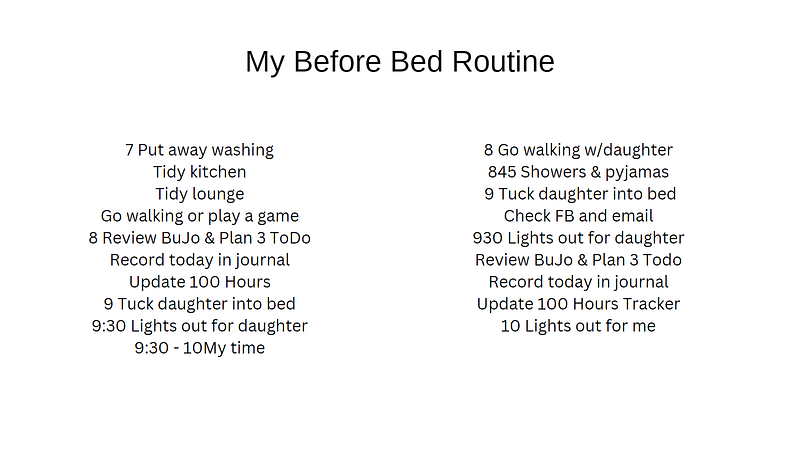
On the left is my former bedtime routine and on the right is the new one I created. The 7 PM tasks I assigned myself before have been moved to earlier in the day, immediately before or after supper. Then I filled some of the empty spaces around time with my daughter with meaningful activities to reduce “scroll” time. This way I’m not scrambling to get it ALL done at the last minute. Image created by Ann Leach.

Because this is only the second day since I had this mind shift, I’m focusing on only a few items on the list, not the whole thing. Those items are the ones with my daughter (walking, tucking, and lights out) and planning my 3 Todo for tomorrow, updating the 100 hours tracker, and my own lights out at 10 PM.

It feels good to have these successes when I go to bed.

Build your new habits on successes you already have going. Attach a new habit to an already established activity or a specific time. Use the alarm feature on your phone to remind you. (I do this regularly.)

Sometimes the best way forward is by starting at the end and reverse engineering. Best of luck!

Previous article: Learning Through TED Talks

Follow The Orange Journal so you don’t miss a post. Do you love to write about self-improvement and personal development? Learn how to be added as a writer here. 🍊

Habit Building
Routine Building
Bedtime Routine
Personal Growth
Atomic Habit
Recommended from ReadMedium