

Bronze bull — a terrible torture that was invented in antiquity. Who was killed in this way?
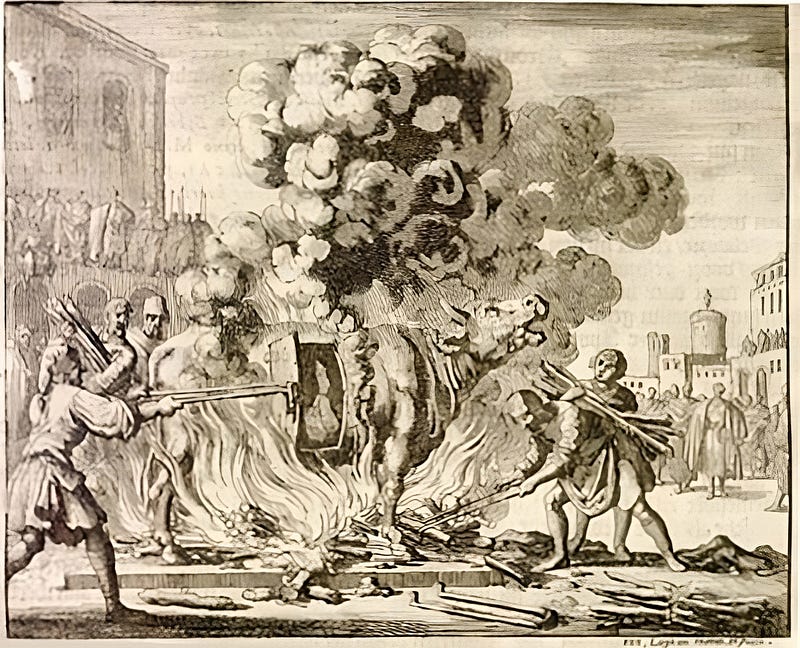
The bronze bull was one of the most horrible tortures invented in antiquity. This method of execution involved locking the condemned inside a bronze bull and then lighting a fire under the statue.

Many horrific tortures were used in ancient times. Their victims were primarily slaves, but also convicts accused of various crimes. Through torture, the death penalty was imposed.
A well-known ancient torture was crucifixion. It was used not only by the Romans, but also by the Phoenicians and Carthaginians. However, it is the Romans who are responsible for the most famous crucifixions — such as the killing by this means of six thousand insurgents of Spartacus in 71 BC. At the time, crosses with slaves were placed along the entire road from Capua to Rome.
Other tortures that were used even before our era were impalement (written into Hammurabi’s code), breaking with a wheel or throwing to be eaten by wild beasts, popular in Rome. Sawing or skinning were also part of the torture repertoire. And the bronze bull, according to ancient accounts invented in Sicily. What did the latter torture consist of?
Bronze bull, or roasting alive
The bronze bull — also known as the Sicilian bull, bronze bronze bull or Falaris bull — was an instrument of execution. It was supposed to be a life-size statue of the bull cast in bronze, which is an alloy of copper and tin. The statue should be hollow inside and have a hole at the level of the abdomen. Through this hole the person condemned to torture was put inside.
The hole was then closed, and a fire was lit under the bull. The condemned would start screaming, and his voice would pass through the bull’s head, inside which was a specially designed system of channels. It was supposed to transform the victim’s screams in such a way that they resembled the animal’s roar.

Who invented the bronze bull?
According to legends, this horrible method of torture was invented in the Sicilian city of Akragas (today Agrigento) in the sixth century BC. It happened at a time when the city was ruled by the tyrant Falaris. Falaris was originally a tax collector, who was entrusted by the citizens of Akragas to build a temple of Zeus. Falaris received the funds they collected for this purpose.
With the money he bought slaves, whom he armed. He also secured with a wall the area where the temple was to be built. Suitably prepared, Falaris attacked the townspeople, slaughtered most of the men and subjugated Akragas. He became a tyrant — that is, he exercised undivided rule in the city, maintained by violence.
The story of the bull Falaris was described by Diodorus of Sicily, a Greek historian who lived some five centuries later, in his work “Bibliotheca historica.” According to him, Perillus (or Perilaus), a native of Athens, came to Falaris with the idea of a new method of execution.
The first person to be tortured in a bronze bull
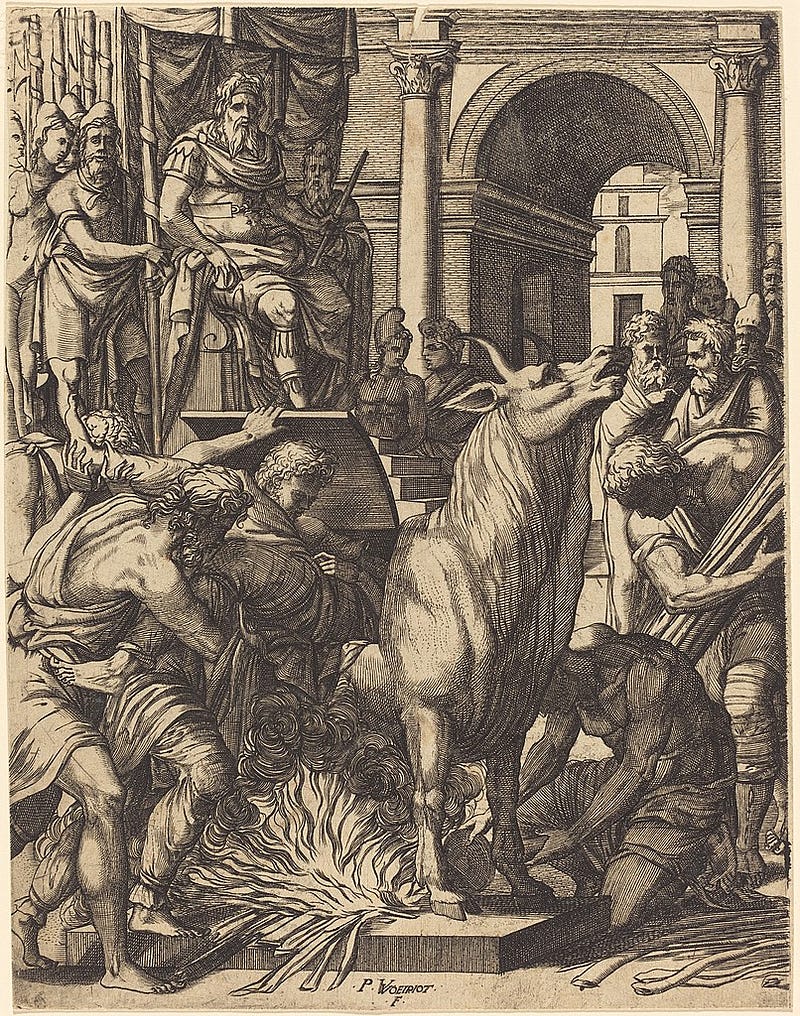
Perillus designed and built a cast bronze bull with a hole in its belly and a system of channels in its throat. It is said that when offering the bull to Falaris, he said that “the screams would come out of it like the softest, most pitiful, most melodious of roars.”
According to legends, Perillus expected a reward for his invention. However, Falaris — though a tyrant who was credited with cruelty and bloody crimes — was not thrilled with Perillus’ idea. He asked him to go inside the bull himself and demonstrate its capabilities.
Perillus was fooled and did as the tyrant ordered. At that point, Falaris locked him up and ordered a fire to be lit under the bull. In this way, the screams that first came out of the bull were the screams of Perillus.
However, the ingenious designer was not roasted alive in his own invention. Before he died, Falaris freed him. However, this did not help Perillus much. On the tyrant’s orders, he was led to the top of a hill and thrown into a precipice.

Executed in the bronze bull
Did Falaris’ bull really exist? There is no certainty about this. According to legend, the tyrant Akragas himself was killed in Perillus’ invention. In 554 BC, an uprising broke out against Falaris and the tyrant was overthrown. And then roasted alive in a bull.
According to one version of the legend, the bronze bull was then sunk in the sea. According to another, it ended up in Carthage, after which it was destroyed and returned again to Akragas.
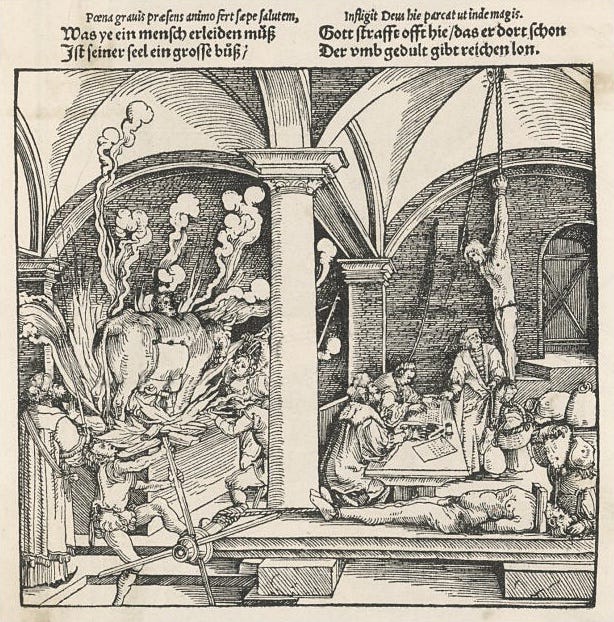
Descriptions of torture with the bronze bull appear not only in Diodorus of Sicily. Eustace of Rome, an early Christian martyr, was said to have undergone this type of execution. Sentenced to death by Emperor Hadrian, St. Eustace was to be thrown to lions. And when these did nothing to him — burned inside the bull Falaris. How much truth there is in this, however, is unknown, since the very existence of this saint is put into question.
The bronze bull was also supposed to be a torture inflicted on St. Antipas of Pergamon. This saint was supposedly sentenced to be burned inside a bull by Nero or Domitian in the first century AD. This was allegedly a punishment for casting out demons worshipped by the local population. Pelagia of Tarsus, a legendary Christian martyr executed under Diocletian, was also said to have died in the bronze bull.
Cool that you made it to the end of this article. I will be very pleased if you appreciate the effort of creating it and leave some claps here, or maybe even start following me. It would be nice if you also left a tip! Thank you!