
Breaking through the Agile Facade!
Part 3: breaching the gates.
Part 1: Trapped in the Swamp Part 2: Wading through the Swamp
It’s the Monday after the ‘post-mortem’ meeting. I’m now meeting with Kate (the VP), Jim (the PO), and Henry (the architect).

Kate wants to jump right into the action by asking me how the meeting went with the team Spaghetti. I reply, “I think I now have a pretty good understanding about what is slowing us down and how to get us back into the game. I’ll get to that.”
I grab some sticky notes from my toolkit, “This meeting is for us to develop a shared understanding of what Agile means to us. I know it’s ‘mushy wushy’ stuff.”
“No shit,” Henry snorts.
I hand each of them a large sticky and marker. Their eyes briefly scan my toolkit.
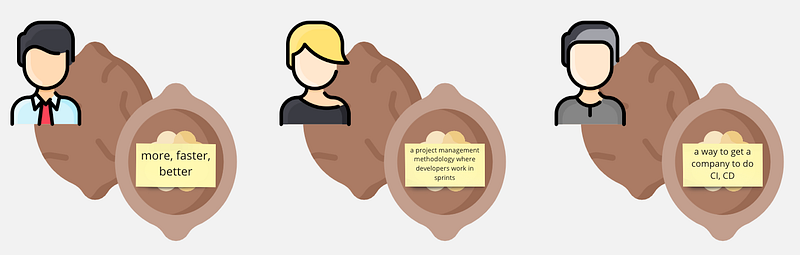
They write down, in a nutshell, what Agile means to them:
- “More, faster, better” — Jim
- “A project management methodology where developers work in Sprints” — Kate
- “A way to get a company to do CI, CD” — Henry
They chuckled reviewing each other’s stickies.
“What’s on yours?” Kate asks me. I had not yet revealed mine.
“Uncovering better ways; empowerment to self-manage; deliver continuously,” I reveal.
Kate responds to my card, “What if the team is not mature enough?”
I have to tread carefully, “Agile leadership is demonstrated, not in the ability to manage teams, but in how well the teams become able to self-manage. It’s not about maturity. You hired grown-up people. It’s really about not parenting adults to begin with.”

Kate frowns, “I disagree. Maturity for me is about them demonstrating accountability. They don’t think beyond their role. Maybe we are hiring people with the wrong mindset?”
Somehow her response bothers me, provoking a clumsy reaction from me, “Leadership can also demonstrate this mindset,” I continue, “to set a collective ambition and let the team do its thing. Judge them by what they deliver as a team, never by individual contributions; the team will take care of that part internally. Appreciate the beauty of a well-managed unmanaged team. Give them what they need, especially when you disagr —”
Ouch, Kate is breaking rapport with me. I fell into the pitfall of lecturing her. She looks out the window, turns sideways, and folds her arms.

I delegate the question to Jim, “What do you think, Jim?” Jim answers instantly, “It’s good in theory. But they aren’t delivering anything yet. That’s the problem. I agree with Kate. We first need to coach an Agile Mindset with them.”
I know Jim recently attained his Agile scaling certification by following a two-day training at a resort in Hawaii, followed by a company-sponsored retreat. This hasn’t escaped the attention of team Spaghetti.
Jim did pick up a thing or two. Jim said something important. They aren’t delivering anything yet. The PO’s primary accountability is to ‘maximize the value resulting from the team’. There is no early or continuous delivery, meaning Jim is dead in the water, and instead focuses on how the team does its work.
I invite Jim to be more specific, “What does that “Agile Mindset” mean to you? when will you know if someone shows this mindset?”
“Well,” Jim replies, frowning, “It means they must show commitment and ownership; take responsibility! be more predictable! so that we can trust them, instead of hearing excuses all the time.” Kate and Henri nod in agreement.
I invite Jim to expand on who ‘they’ are and what ‘commitment’ means.
“That’s easy,” Jim explains as he flexes his shoulders, “Spaghetti just needs to deliver and figure out a way to speed things up.”
I noticed Jim's emphasis on the word ‘deliver’ again, as his eyes turned to Henry. Henry shrugs. I realize that Jim is leaving out an important detail. Then it hits me. I think that I found ‘the gate’.

“We’re about six months in the project, right?” I ask. Jim nods. I approach the gate with a battering ram, “Six, months… and how much value is actually delivered so far?” The ram slams into the gate. “Well, none! that’s the thing!” Jim replies, throwing his arms up in the air, again directing his eyes towards Henry.
I knock the gate once more, “And what’s that like Jim, that even after six months, there is no value to work from? You’re the Product Owner; what’s going on?!”
Kate feels I am unjustly hammering Jim and tries to intervene, “It’s clear, right?! Spagh —”
I cut Kate short. I don’t like to interrupt people. That said, Kate is robbing Jim of the opportunity to speak his mind openly. I want to learn what impact this has on Jim, from Jim himself.
“I’d like to hear it from Jim, Kate. Jim, is the Product Owner, and it’s his accountability.” Kate is getting increasingly impatient with me, yet, to her credit, she allows Jim to continue.
Jim is triggered and begins to open up. Even his emotions start to shine through, “Every day I hear new excuses why we can’t release. We have eighty percent of the features ready. It just gets stuck in staging, which is just a mess. I am continuously told we cannot release yet. I want to release. We are doing it all wrong. This is not Agile at all!” Jim is visibly upset. The gate begins to shatter.
I direct my attention to Henry. “So, what’s really the deal with staging, Henry?”
Henry shrugs, “Jim’s right. It’s a mess. We cannot release. There are many conflicts. Build keeps breaking because we have issues with test data and —”
Kate cuts in, “Yes, we don’t have all the right content and data yet,” She sighs audibly, “marketing is working on it, but they are still busy reviewing and editing.”
Bzoing! So, even if the team is ready to deliver, there is simply no production-ready content and data yet.
“Right,” Henry continues, “That’s why I am automagically generating dummy text, which is causing all sorts of unexpected bugs right now.”
I redirect my attention back to Jim, “Jim. I completely agree with you. Let’s turn this ship around! This is not okay. The sooner we deliver — What do you think I’m thinking?”
What does Jim think I’m thinking? Jim looks at me and smiles. “I think… that you think… We should get together and just do it. All hands on deck!”
Jim is already familiar with my mantras. Jim and I just clicked, and, as if through some universal divine command, we both direct our gaze towards Kate.
“Do what?!” Kate asks.
Kate is about to be rewarded for her patience with me, “Kate, I talked to the team,” she sits up straight, “… if we can get them together with Mike, Rajesh, and Irene, they can deliver a working, tested(!) release to production.” Kate frowns and replies, “There is a catch? right?!”
“There is a catch, yes. We need to forget about staging and pre-staging for now. There are no users yet in production, and it’s not public, right? And we need the copy decks. Ready or not. Changing copy later will be the least of our concerns.” Kate has a world-class poker face. She knows what’s coming. So does Henry.
“Wait!” Henry exclaims, “No. No way.”
I’m about to sound the retreat. I anxiously await Kate’s reaction. She needs to be the one making the call for this to work. But I may have ruined it with my lecturing.
Both Kate and Jim look at one another and reveal a mischievous smile. That means they are ‘in’. It’s too late for Henry. The barbarians are through the gates.
“Let’s try it!” Kate concludes, “do what needs to be done; we cannot afford any more delays.”
During the day, I spend more time with Henry, listening to his concerns. Henry is not happy, yet he’s still committed. We draw in Brent and together make an actionable plan.
I talk to Mike, Rajesh, and Irene about how they feel about forming a new team together with developers. It turns out they had already discussed this amongst themselves and were happy to, as long as Jim was okay with this as Jim has tasked them to work on different projects.
Epilogue
It didn’t take long for me to pull leadership and teams together for an open conversation. The result of this event was fruitful.
- Kate literally sent the Roadmap flying out the window. Kate actually felt liberated by it, to the surprise of everyone.

- A new team formed. After some back and forth, they finally agreed to name themselves “The Michelin Stars”. Giovanna suggested this team name. Her ‘team vision’ is to cook together and serve small but perfect dishes. She made sure to add that spaghetti was not on the menu, which made everyone laugh.
- Kate challenged the team to deliver valuable increments to production with built-in quality as frequently as they could. This way, the team could let go of time-tracking. This proved challenging, yet it promoted creativity and pragmatism. It took them two weeks to figure out how to do this.
- After some back and forth, Henry ultimately agreed to simplify the deployment procedures and lower the heat to make it easier to deploy straight to production. Henry agreed that the platform was not saving any lives. A degree of instability was acceptable for now.
- Jim agreed that the Michellin Stars could use the whiteboard wall in the office instead of Jira. Jim actually shared that the two things he disliked the most were being a Jira administrator and running the Daily Scrum. It now freed him to focus on connecting with stakeholders in trying out the first increments of the product with actual users. Jim also managed to get a Content Editor and a Digital Producer from marketing to become part of the team, albeit temporarily.
- Together with Jim, The Michelin Stars used the wall to consolidate, visualize and organize the backlogs and buglog.
- Although the team abandoned Planning Poker, they internally still felt the need to size the work. They started using metaphors of different food sizes (ranging from a small ‘amuse’ to ‘the world’s biggest Pizza’). They treated the Product Backlog like a menu card that could only contain the most valuable meals. They were ‘Michelin Stars’ after all. Together, they refined the items with ‘recipes’ and ‘ingredients’.
- They treated bugs like returned meals or complaints. I encouraged them to fix these together to learn from them and find the root cause. After all, you can’t serve meals with bugs in them. They have to live up to their team name, so quality became somewhat of an obsession.
- There was some tension in the team. For Roberto, these changes came too late. He had already signed a contract elsewhere and remained pessimistic and resentful. We agreed it was best for him to adjourn the team.
- Now that they became a cross-functional, self-managing team delivering value, the Scrum events started to make sense. Scott emerged as a natural servant leader to the team, naturally assuming the accountabilities of (Scrum) Masterchef.
The real story about Fake Agile
This Story is not a real story. It is, however, based on actual events and true experiences from real human beings, including myself. This is how I can tell it safely.
The real story is your story.
What is ‘real Agile’? To some, Agile may be a mythical creature that lives on Olympus together with Zeus and Athena. There isn’t one right or real way. Agile is about finding better ways.
Even pretend play can lead to better ways. That said, it’s easier to apply the language than the actual behavior. It’s not about being nitpicky or dogmatic about language. It’s about transparency. Hacking terminology obscures and contributes to rigidity. It is a source of drama and conflict. It causes stress, and people bring that stress home with them. It hurts the operation and your colleagues’ wellbeing.
Just to be clear, when terminology facades emerge, this is not the failure of any individual. It’s also not a symptom of bad leadership. It’s a systematic problem home to complex environments.
Introducing new practices is hard. They take time, energy, and effort to master. And, naturally, calling things out for what they are is unsettling to management. Management may feel uneasy, but it can be liberating for them too.
Enjoyed this? stay tuned!
You may also enjoy this short business story:
I’m not sensitive to your environment, and I do not know your story. What’s your story?
Join me on the Road to Mastery!
