
Breaking news: ChatGPT doesn’t help my copywriting
Am I a dinosaur for maintaining my scepticism?

**This article contains three screenshots from ChatGPT chats.
On Medium Day (August 12th), I made a bold claim. ChatGPT doesn’t help my copywriting.
The 30-minute talk was mainly for entertainment purposes, and I am not an AI expert, as you will see shortly. But I largely stand by what I said. This article sums up why.
A little about me
Bit first, you should know who this opinion belongs to, so you can factor in my bias. I’m a writer and copywriter with ten years of content marketing experience.
My specialty? Taking complex ideas and translating them into something simple. Making brands likeable with language. Adding persuasion to product offerings.
I am not an AI expert, nor an engineer, or a tech-wizard. Far from it.
But I am good at one thing. Writing copy that works. Weeding out language that doesn’t.
Hot in the news
Obviously, ChatGPT (and other regenerative A.I. tools) are a hot topic. We’ve heard about ChatGPT in Hollywood, court cases, in praise and in complaints. Just a few days ago the Guardian newspaper took a definitive stance by blocking OpenAI from trawling its content. Other newspapers and content websites have done the same.
Last week, China launched Ernie, its own regenerative A.I. tool. According to the Economist, Ernie Bot is reporting that Covid-19 originated in 2019 among US vape users, before spreading to Wuhan through American lobsters.
With restraint, I will not take you down the rabbit hole of A.I. news, for it is too deep and too wide. So why am I going here in the first place?
A direct impact on a writer’s work
Because I have no choice. As a writer, regenerative A.I. has had a direct impact on my job, and I have had to confront it sooner than I’d like.
A mere couple of months after ChatGPT came out, I started getting similar questions from potential clients:
- How will you leverage regenerative A.I. in your content marketing strategy?
- How will you use regenerative A.I. to produce more copy without sacrificing quality?
- How will regenerative A.I. change the world of marketing?
And my favourite, in a video interview where a timer gave me thirty seconds to answer (I am not making this up):
What does the rise of regenerative A.I. mean for marketers engaged in content creation and SEO?
I won’t lie to you. My reaction was fierce irritation. I mean, the technology was new (it’s still new!), some of the most brilliant minds in A.I. (including its creators and OpenAI owners) were pleading with people to consider risks, and companies are looking to profit overnight and getting a writer to crack the code for you in the process.
I know I’m exaggerating, but sometimes it feels like I’m being asked to dig my own grave.
I know the answers they were looking for:
- I will use regenerative A.I. to write 10x the articles at 10x the speed! Your website’s SEO will sparkle and shine with all that great content!
- I will prompt engineer and train the program so that the text doesn’t sound like crap! And is miraculously in your tone of voice, and honours your brand principles that you think are unique, and is engaging and funny and totally original!
- The world of marketing will only change for the better thanks to regenerative A.I.! We will be able to produce more content, at scale! And it will all be correct, without errors! There will be no misinformation or bias at all! Even though those are the issues that have plagued expert A.I. scientists again and again!
- It means more money! Not for everyone, but for you and your business! Because I am the A.I. Copywriter, and I will produce lots of amazing content in 25% of the time! I have become an expert in the two months it’s been out!
I could see how desperate they were for these answers. But they’re against my nature, and I wasn’t a fan of the attitude. So I said what I consider to be the truth:
- Tools like ChatGPT are indisputably a powerful tool that can reshape some areas of marketing and can be trained to complete huge tasks at scale
- How you use it for marketing and content completely depends on your goals and the type of content you aim to produce
- I am not convinced that it personally saves me time when I write copy
- I would be very cautious of automating ChatGPT content without proper checks in place, as ChatGPT regularly makes errors, and there are reputational risks
- I am curious to observe the search engine response to A.I.-generated content is, and its effect on SEO (because so far, A.I. written or produced content doesn’t seem to rank as well — I have a few theories as to why)
- I am actively testing different regenerative A.I. programs in a learning phase, but cannot answer how it will change content marketing because there is little data available
I did not hear back.
A few months down the line, most people assume my attitude has changed.
If I don’t use ChatGPT for my role, I’m just not using it right. I’m not using the right version, or my prompts aren’t specific enough.
But here’s the thing that these people don’t understand.
A large part of my job is labouring over exact words. I spend my time looking for fresh ideas and new ways to feel unexpected with language.
I am not saying ChatGPT isn’t useful. I’m not saying it’s not impressive or helpful in my everyday life. I’m not saying I don’t use it or that it doesn’t inspire me or help marketers.
I’m saying that in its present form, for me, it doesn’t really help me to do a key part of my job, which is known for the high level of creativity it requires: copywriting. Even ChatGPT will tell you that.
Why is this opinion so fiercely controversial?
Copywriter vs. ChatGPT
Let’s say you ask me to come up with five slogans for a new food product. Of course I would never have a brief that vague, but let’s go with it for the sake of simplicity.
ChatGPT route
The first thing I want to do is reference competitors and popular campaigns to see what’s been done this year. I want to make sure I don’t develop ideas that are already used or too similar to something out there.
At the time of writing, with free ChatGPT the knowledge cutoff date is September 2021, so I run into my first hurdle. I understand that with the paid version, I can search using real-time information (perhaps this will be my September experiment?), but can’t comment on how effective this is.
Still, I ask it to act like a food marketing expert and propose ten creative marketing campaigns. I plug in my brand’s main principles, but it gets confused.
More than half of the suggested slogans take into account ‘travel restrictions’. I re-prompt it asking it for campaigns that are not related to travel restrictions or Covid-19.
The responses are campaigns that are cliché and overdone, from ‘Farm-to-table spotlight’, to ‘Flavour Fusion Fest’, to ‘Seasonal Sensations’.
If I bring any of these ideas to my clients, they would ask me if I am OK.
I wonder if I can mould them into something I can work with, but the limits of staying within a certain idea feels restrictive.
I ask it to come up with something more unique, strange and original. ChatGPT proposes something that sounds a whole lot like McDonald’s Monopoly campaign, but without using those words — so if I search for it online, the original may not even come up. Red flag.
But let’s say ChatGPT comes up with something that I can work with. I am now paranoid about the source of its inspiration, as by definition, the information came from somewhere. I would like to know where, so I am not caught off guard in a meeting.
However, my ChatGPT exercise is starting to take up a lot of time, and my results aren’t that good. I keep trying, asking questions in different formats. And then I remember that my clients want me to produce fresh ideas.
That is one of the key reasons they come to me instead of someone else.
So I try my normal route.
Copywriter route
I start by reviewing my client’s brand guidelines to have their their principles front and centre, writing down ideas as they come up. I look at their goals and review what their competitors are doing.
I research what’s been done in food marketing recently using sources like Marketing Week, The Drum, and Campaign Live. I also use Google News.
When I come up with a word or idea I like, I play around with VisuWords to see if there’s something I like more. I’m quite a visual person, so I’ll probably create a little Pinterest board with pictures that inspire me.
I find using physical paper helps me be more creative, so I scribble different ideas in a notebook.
Ideas start coming to life, so I create a first draft, then leave it for a bit.
I check the work that I’ve done for the client before, and see where I can nod to aspects that they liked. I check for words or phrases that they didn’t like and make sure those don’t come up.
I edit my draft and check it for other approved content to ensure the brand voice is strong and consistent.
I question every word, every punctuation mark. I ask whether each syllable creates rhythm or slows it down. I check if words flow or if they cause the reader to stumble.
I ask if anything is ambiguous or offensive. I check and double check lexicon, grammar, typos.
My preference is to then leave it for a day or two, and come back for final edits before delivering.
Answer me this: is it worth it trying to force ChatGPT to save me time in this process, which forces me to keep a sharp eye for the brand, develop a good understanding of what competitors are doing, and fuels my creativity?
Nuance and creativity
I realise that this is quite a nuanced example. But that’s the thing. Copywriting is all about nuance and creativity. And that’s where ChatGPT falls short in my opinion.
More often than not, it drives my creativity into corners it doesn’t like. I’m biased trying to come up with examples.
Now during my talk, I used some funny examples with loose prompts. Some viewers rightly said that I should have been more specific.
So I want to show another example. This one is made using prompts from the handbook of one of ChatGPT’s most well-known LinkedIn influencers, Ruben Hassid. I regularly try his experiments when they deal with content, and he’s an interesting guy to follow for sure.
Without further ado, let’s get in the ring with ChatGPT.
In the ring with ChatGPT
Prompt (4th September 2023, GPT-3.5):
Act like a luxury, plant-based food store. Craft a persuasive, 125-word social media ad, tailored specifically to the interests and preferences of a 35-year-old vegetarian living in London. Utilize data and insights to personalize the message and encourage this person to buy TreeCycle’s noodles on their website. The tone of voice should be playful, but not overly casual.
The result?
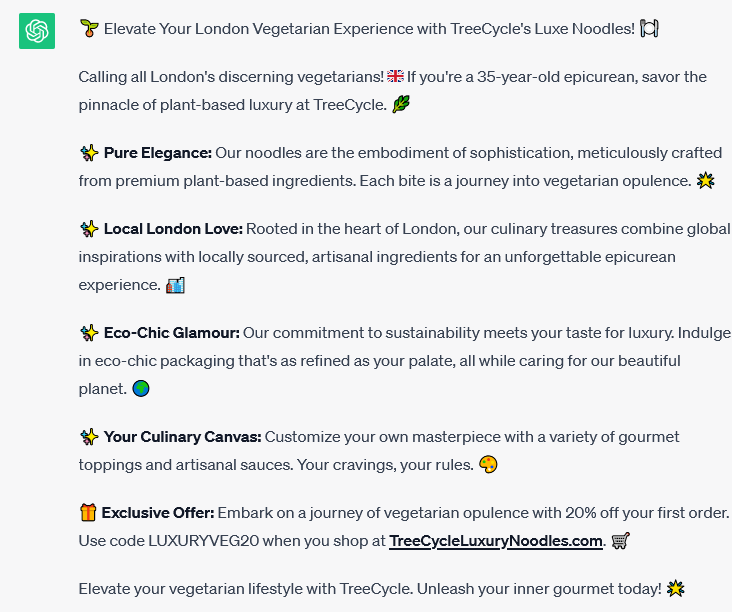
This is supposed to save me time? Really?
Don’t get me wrong: I’m impressed with what ChatGPT was able to come up in terms of the brief. But this does not save me time.
For the sake of the article, let me use another prompt from the copywriting section of the ChatGPT handbook.
Prompt (4th September 2023, GPT-3.5):
Create an attention-grabbing 100-word Instagram caption that captures the interest of a 35-year old vegetarian living in London. Use persuasive language and data to convince them to buy noodles from TreeCycle, a luxury brand specialising in plant-based foods. Include compelling evidence such as customer testimonials or data.

Culinary elite. Elevate your vegetarian lifestyle to regal heights.
Ouch.
I’m going to try this one more time. Again, I’ve adapted something from the handbook, and added lots of details.
Prompt (4th September 2023, GPT-3.5):
Differentiate plant-based noodles with a 100-word Instagram caption that showcases its unique features and benefits, such as being egg-free, containing 9 essential amino acids, and sustainable ingredients. Use persuasive language, data and insights to make a compelling case for why ABC1 vegetarians in London should make a purchase, and highlight any competitive advantages of the noodles. Do not mention an offer. Use minimalist, luxury language that is snappy and to the point.
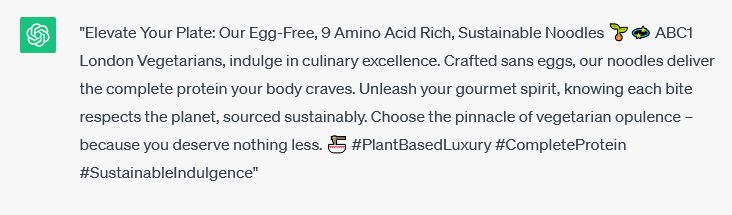
Would you choose the pinnacle of vegetarian opulence? Sans eggs?
I tried over thirty ‘expert’ ways to prompt ChatGPT into getting something I could use. Sometimes I got a word or an idea which I could maybe use, but you know what?
It would have been a lot faster if I’d done it myself.
And here is my argument: with tasks that require a high level of creativity and nuance, ChatGPT does not tend to save me time.
I don’t understand why this opinion irritates so many people. But if it does, I would genuinely love to understand why — leave me a comment!
Copy vs. content
I’d like to make an important distinction here: copy and content are very different things.
Copy is all about finding the clearest, snappiest, most persuasive way to say something. It should sound original, even though yes, there are arguments that nothing is ever really original… another rabbit hole I’m going to skip over.
Content is essentially any information communicated through media. Copy is a type of content, but not all content is copy.
As a writer, I do believe that ChatGPT absolutely can help with certain types of content. Specifically, I’ve seen some really impressive email templates that nail a good tone of voice and need little editing. A friend of mine swears by it to help with video scripts (I have yet to be convinced).
I’ve been impressed by strategy templates that I’ve requested. For some brands, I have confidence that ChatGPT could assist with a good 70% of social media captions with the right direction, massaging and editing.
I don’t personally see it helping with premium or luxury brands anytime soon, which are the majority of my clients. So I circle back to my contentious argument: ChatGPT doesn’t always help copywriters.
What I am not claiming
A lot of people misinterpret my claim (at least that’s my interpretation), so let me be clear.
On the record, this is what I am not claiming:
- that ChatGPT has no value in brainstorming, content or marketing
- that ChatGPT can’t help you become a better writer
- that ChatGPT is good or bad
- that other regenerative AI tools can’t help with copywriting
There were some great perspectives shared in the chat feature of my Medium talk on the subject, including from non-native English speakers who said ChatGPT helps them find errors and improve their English.
Jim the AI Whisperer also shared a really interesting perspective as a writer with a language disorder (aphasia). Jim uses AI to proofread his work and make suggestions on improvements and missing words.
These seem like solid, meaningful writing uses for ChatGPT.
What I am saying is that in my personal process for high-end copywriting, ChatGPT doesn’t really save me time. And I don’t understand why the response is so often defensive, especially from people who are not copywriters.
Final words
Taking it one step further, I don’t think I want ChatGPT to help me when it comes to creativity copywriting. Why?
My creativity is my greatest asset. I need to keep that knife sharp.
Call me a dinosaur. It’s very possible that my thinking will go extinct, and me with it. But you know what? For now, I am getting some of the best client feedback I have in some time.
When it comes to winning new clients, I’m not going to lie to you: it’s been much harder. It’s tough to know how much is based on the UK’s (where I’m based) terrible economic situation and how much is to do with regenerative A.I.
I wonder if this will still be the case six to twelve months down the line.
(Update from February 2024: I am now overbooked and unable to take on new clients. It’s tough to tell whether regenerative A.I. had anything to do with it, but it seems that marketing people are feeling less ambitious about how much of a writer’s work it can take over).

Discussion:
I would love to know: what does the rise of regenerative A.I mean for marketers engaged in content creation and SEO?
No, I jest! Here’s what I’d really love to know:
- Do you use ChatGPT in your daily life? How?
- Are there other tools you use instead? How have you found them?
- Emotionally, how do you feel about technology like ChatGPT on the market?
- If you work as a writer or copywriter, do you feel expectations have changed with the rise of regenerative A.I.?
- Has regenerative A.I. had an impact on your work?
If there is interest, I’ll write more about this. For now, I rest my case.