Braving the Verse Novel
Freedom in Verse and Form
[Warning: Contains material discussing poetry and the nuances of poetry and… verse novels… that may be disturbing (i.e. boring) for a general audience. In other words, run away because Anneliese and Pernoste are talking about poetry.]
Hi all. Pernoste & Dahl are back and talking about poetry again.
[Pernoste] Not again?
[Anneliese] Yes again. And nobody leaves until everybody agrees with us! Haha.
[P] There they went…. good job.
[A] (calls to the fleeing readers) Come back! I was just kidding!
[P] Well maybe we’ll just get our usual ravening horde, and not the general Medium folk, but it is what it is.
[A] OK then, ravening horde we love you in your tiny but enthusiastic numbers. Anybody wants to join the horde, the membership is free.
We are all very familiar with the traditional prose novels that dominate our lives and our libraries, and even our favorite NetFlix movies. And we are equally (perhaps) familiar with poetry, that unfortunately many avoid for both good and bad reasons. Mostly bad reasons, we’d say, as you need to take your time with poetry, and most people are too impatient these days.
[P] Verse novels are certainly a pet thing of ours, and there’s a place for them in the world…. but they are definitely NOT suitable for everything. We wanted to take this opportunity to reveal some of the inner workings of verse novels, including our own recent publication.
[A] First of all, little about verse novels/narratives is actually new. Epic poetry stories, like Gilgamesh, the Iliad, the Odyssey, and Beowulf were around long before the modern novel, mostly due to the connection with music and perhaps because it was easier to memorize poetry than prose back when people mostly couldn’t read. It was in the 19th century, however, when the verse novel began finding its own identity, first with Lord Byron’s controversial (now acclaimed) Don Juan, and later with writers like Elizabeth Barrett Browning with Aurora Leigh.
I’ll spare you most of the history, but today the verse novel is growing in popularity and recognition, proving to be an art form that is versatile and creative and unpredictable, although many look upon you with shock (and not much awe) for breaching the prose-novel tradition.
[P] Maybe they even want to wash their hands after talking to you, LOL.
So… why would anybody want to write a verse novel?
Prose forms of novels and stories are certainly quite flexible, working well in 1st or 3rd person perspectives, optimal for conveying plot movement, and action, ideal for writing with a lot of dialogue and complex character development (and/or with an omniscient narrator). And, indeed, many authors write with such skill in their prose that there is certainly a significant “poetic” beauty to their work.
OK, you can stop reading now if you’re completely convinced that prose is the best and you’re a genius and know everything. But maybe you’ll never know what you’re missing…. just saying.
[A] Yes, and (for those of you who are still reading right now) verse novels, on the other hand, are a good vehicle to use for capturing a different perspective (particularly in the 1st person), a more poetic one, on life, on the inner thinking of a character, and emotions. Selection of words is based not only on meaning but also by sound and connotation that can impact the emotions of the reader and create a different kind of atmosphere. There is a lot of attention to detail, word by word, line by line, break by break, and even the white space of the page can become a part of the story.
Fun, free, and creative.
Poetry certainly captures the heart in a way that prose sometimes does not. That’s a good thing sometimes, heart and imagination, right?
[P] Sometimes I think we have too much heart and imagination.
[A] Is that even possible? No way!!!!
Plot in verse novels can be challenging to move in a poetic manner without being a little annoying or disruptive. 1st person helps here with inner contemplation/observations serving as the narrator to move the plot.
I admit, however, that dialogue can be awkward in verse novels, so the writer often needs to find other ways to capture character interactions and character development, using very minimal dialog.
[P] Below is an example of an acclaimed verse novel that we show for the purpose of illustrating the difference between verse- and prose-novels. It’s an early chapter, not one of the later dramatic chapters … and not the chapter with 16 words that wrench your heart. We picked it because it is a fairly normal chapter.

Toss-and-Turn Night
Bone-oven hot outside, swamp-cooler cool three feet up the hallway, temperature in Dad’s claustrophobic guest room: lukewarm.
The bed was a monstrous box spring. Thin, mildewed foam, two sprays of Lysol, and one thrift-store sheet were all that lay between Bedzilla and me.
Tried my right side. Kept seeing the kitchen cockroach, the one I tried to pretend was only a Mormon cricket, Los Alamos–grown.
Tried my left side. Flashed on my bedroom at home. Pin clean, pretty in mauve, a ballet of pink butterflies on the walls, pillow-top mattress to die for.
Flopped onto my back. Found the keyhole behind my eyes, squeezed through, into sleep. Not slumber, but sleep just this side of waking, where dreams fuse with reality.
[A] Now, here’s an alternative prose styling (with some editing license to prose-ify. Forgive us Ellen for this liberty we take.):
Toss-and-Turn Night (translated to prose by A. Dahl)
It was bone-oven hot outside Dad’s house, and even with the swamp-cooler cooling just three feet up the hallway from the tiny and claustrophobic guest room, the temperature was lukewarm at best.
My bed was a monstrous box spring, but I wasn’t looking forward to it. The thin, mildewed foam on the top, two sprays of Lysol, and one thrift-store sheet were all that lay between Bedzilla and me. It would be a toss-and-turn night.
I tried sleeping on my right side, but I kept seeing the kitchen cockroach, the one I tried to pretend was only a Mormon cricket, just big because it was Los Alamos–grown. I also tried my left side, and it wasn’t any better. I flashed back to my bedroom at home, clean as a pin and all pretty in mauve. It had a ballet of pink butterflies on the walls, and I had a pillow-top mattress to die for.
I flopped onto my back and somehow found the keyhole behind my eyes. I squeezed through it, into sleep, not slumber, but sleep just on this side of waking, where my dreams fuse with reality.
[A] Perhaps you see it, perhaps you don’t. There is a beauty in the words and the brevity and conciseness of the original verse (though we are dying to change a couple of the line breaks which [we feel] disrupt the flow just a bit). Still… beautiful. Even the prose adaptation (with some license in added words to better turn it to prose) has a beauty in the language.
We see differences, though. The narrator of the verse version seems more introspective, seeing the world differently than others… felt in how you are forced to speak and how you see the page. The narrator of the prose version, in comparison, is interesting, and with a sense of humor of sorts, perhaps more sense of humor than in the verse version. However, the pacing of the words in your mind, where you break, and the feel of the story changes significantly. If it had truly been written as a prose novel, this chapter would likely have been considerably longer, with much less left unsaid and much more descriptive prose.
What do you think? Feel free to disagree with us.
[P] Just be kind. Haha.
[A] Yes, we’re both very sensitive.
Our favorite general types of free verse novels/novellas (our own simple categorizations):
1. Each chapter is a different verse, telling a different part of the story (different characters or same characters in a different scene). Not always in chronological order, but often in “emotional” order. Together the chapters paint a novel. Example: Before the Ever After by Jacqueline Woodson.
2. Enigmatic and spare: Chapters each in poem, each differing significantly in style, and so spare in the language that the story only comes fully together in the end. Novella example: The Martian’s Regress by J.O. Morgan.
3. Engrossing stories of personal development/destruction (like Crank by Ellen Hopkins)
4. Full-length verse novels, historical fiction like Alexander Pushkin’s Eugene Onegin, and especially science fiction … harder to find sci-fi, but we include our own Pernoste & Dahl’s “In the Minuses”. Generally, such longer forms have greater consistency of format and form, but not exclusively so. We haven’t read everything. Haven’t liked everything we’ve read, either… though admiring the creative effort.
In our opinion, the challenges you face with a verse novel can be outweighed by the achievement of beauty in the writing, which is deliberately spare (again, generally implying more than is directly said). There are definitely things you need to consider when you write a verse novel, though.
· How can you bring out the nuances of your character? · How can you move the plot along without deviating fully into prose? · How do you handle necessary dialog, or do without it?
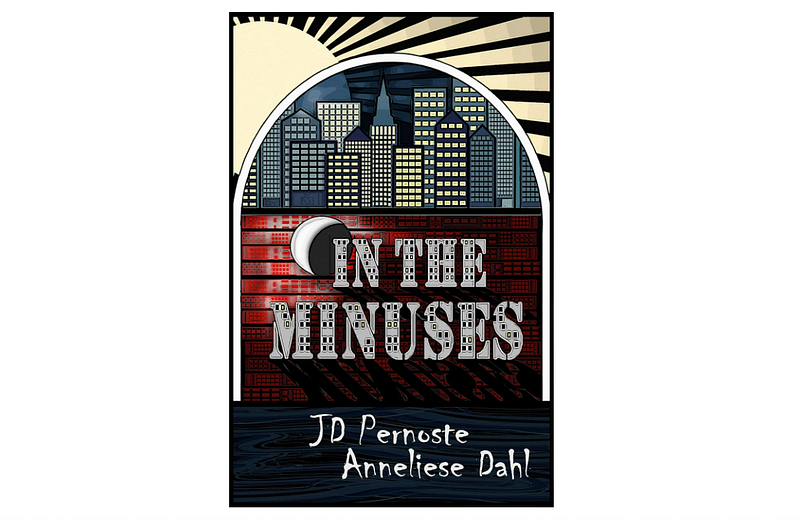
[A] Now we’re going to talk about our verse novel, IN THE MINUSES, which is a science fiction dystopian visionary novel. This is unusual in many ways, as most verse novels are introspective emotional stories about growing up, or school, or difficult childhoods. Not too many sci-fi dystopian spiritual verse novels out there.
[P] We were actually pleased that reviewers compared our verse novel favorably to prose novels such as Orwell’s “1984”, Octavia Butler’s “Parable of the Sower” and Karen Hesse’s “Out of the Dust”. At least one reviewer candidly admitted that he was intimidated to read a verse novel, but when he got past that, he loved it. A couple of people said, “yuck, it had poetry in it.”
[A] OK, IN THE MINUSES is the story of a future time in which humanity finds itself living on a desert planet, protected in a gigantic domed city. On the face of it, a pretty standard dystopian plot. In addition, also fairly standard, is the concept of the people having drifted away from the memories of their past. The government controls their lives, the vast population either living in the 3-mile deep underground portion of the city (the Minuses) or in the above-ground part of the city (the Highs) that is under the shielding dome. Beyond the standard expectations of the sci-fi dystopian story, we went in a lot of unusual directions, as well as in a unique style and tone. There are robots and laser whip fights and romance and mysteries to solve, with many of the difficult tyrannies they face being allegories of what we face in our current society. Mixed in with all this, there are scenes of romance, and family, and friendships, heartbreak, death, torture, loss, and a growing spiritual uprising in the city.
The focus of the story is the protagonist Angel “Angie” Salo who suffered a difficult childhood, orphaned at a young age and forced to mostly survive on her own. The story is told in the first person, which provides a lot of information about her character, her desires and fears.
Short excerpt one (the first two paragraphs): Cerebral in quality. The Prologue to the novel introduces an elderly woman (Aymma) traveling with a young companion across the desert to visit an abandoned domed city. This Prologue and the Epilogue are the only two chapters written in the third person. Verse is used to control the reading pace and the pauses/breaks.
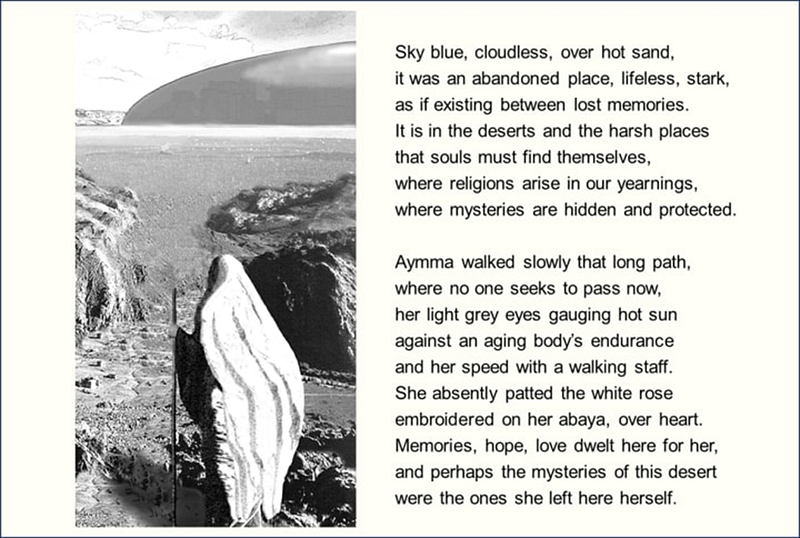
[A] This sets up a mystery, wondering what happened 500 years ago to the people in the domed city. Won’t tell you who she meets when she arrives.
Excerpt two: Emotion and action. We meet Angie and her boyfriend Daniel, running around in the city at night, avoiding the government robots and gangs. Paints a picture of the city as well as Angie’s relationship with Daniel.
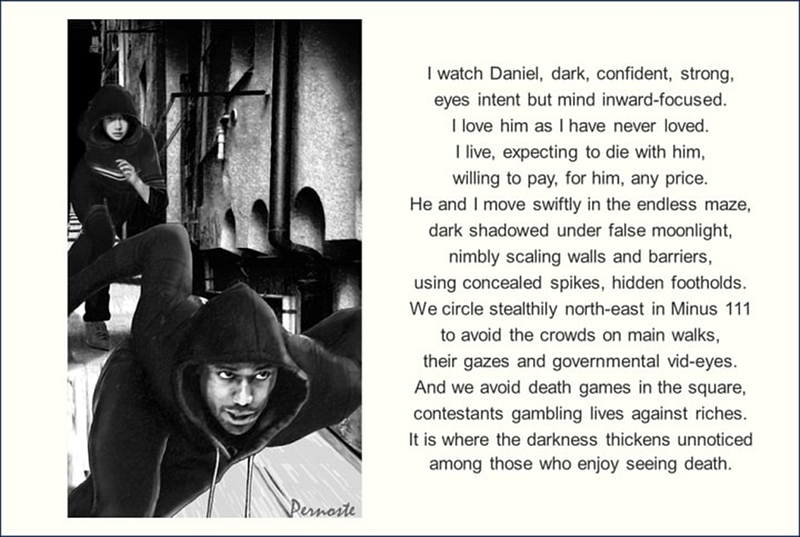
[A] A lot needed to be accomplished in this chapter, introducing the characters and the city, the good and bad. It also introduces the love story of Angie and Daniel, which permeates the novel in a rather unusual way. Don’t want to give it away.
Excerpt three: Battle scene. A robot, Mrs. Salo, fights off a vicious crowd that was manipulated by the government into attacking a group of city healers called the Versennes. The city labeled them as witches and murderers.
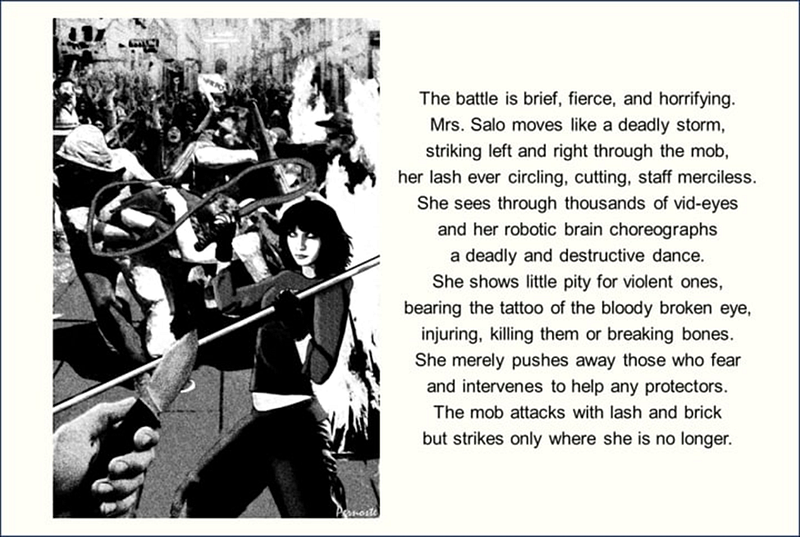
[A] We loved the laser lash battles, but we wrestled with finding the right balance of action/violence with the overall pacificist message of the story. We emphasized violence only when necessary, though there are times when the characters face the regret of killing when they didn’t walk away. There is a surprising and unique war that happens later. Again, don’t want to give it away.
Excerpt four: Spiritual scene. Angie faces enlightenment and choices. Will she pass the Angel’s test, and can she take on the challenge to save humanity from endless tyranny.
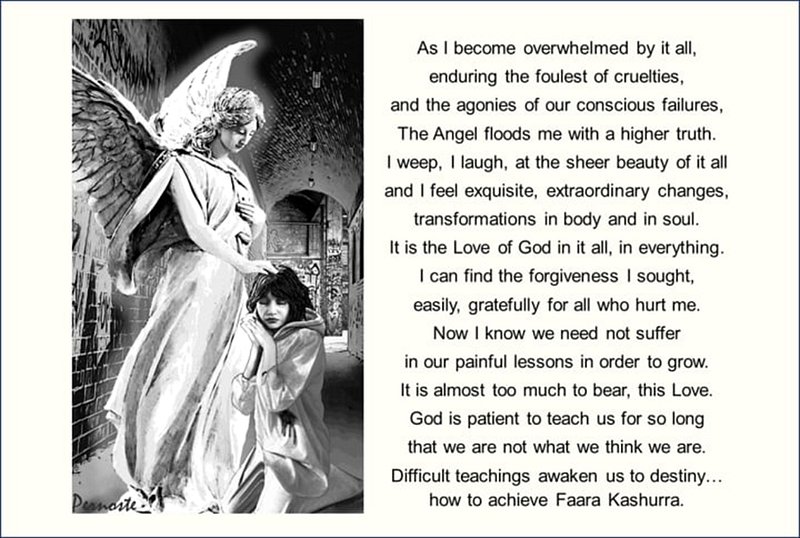
[A] Spirituality is hard to capture well in general, and certainly hard to make interesting and compelling for most readers. We wove it into our characters, expecting them to be human but to also strive to be something more. This meant some scenes of suffering passively for the greater good, and other times meant stepping up to act.
It’s a complex story, intended as a metaphor for today but also as an emotional roadmap to spiritual awakening. Angie grows from orphaned and introverted recluse, to friend, to lover, to adoptive mother, to spiritual leader… all while fighting the baggage of her past that holds her down. In the end, we (like Angie) must change our hearts, and we must see each other as we see ourselves, if there is ever to be hope for us to emerge from the world as it is.
[P] Thank you, ravening horde and others, for reading this. We could have also provided examples of how we handle dialog, but we don’t want to bore you. Nor do we want to introduce you to the ancient Sumerian words that are sprinkled throughout. There are also some inserted poems by Angie in each chapter that help to reveal her inner character. We hope at least you got a little look under the hood of a verse novel.
[A] But if you ever decide to write a verse novel, you may have to face this scenario…. A friend of Pernoste’s said to him about our verse novel…. “Wow, this was really good. Maybe you should turn it into a prose novel.”
Kinda like saying,
“I really liked your musical, except for all the singing and stuff.”
— — -
For our other writings on poetry, check out:
Is it possible to love poetry?
Welcome to the Poetry Multiverse
The cover image and an early draft of the discussion were first published at https://vocal.media .