Is it possible to love poetry?
Or have you been reading the wrong poems?
Hello, I’m Anneliese Dahl, a poet and author, and I (and my writing partner, Pernoste) want to talk to you about poetry. Not just to the poets out there in MediumLand, mind you, but to everybody… whether you’re somebody who thinks you hate poetry, are not interested in it, kind of like it, or you love it.
[Pernoste: I think I see them all running away.]
Stop it, Pernoste. They’ll come back. I’m sure. It’s gonna be fun.
Anyway…. some of you may sometimes wonder why people don’t read much poetry, and others probably wonder why anyone would read poetry at all. “It’s a joy to experience poetry” and “I can’t imagine living without poetry” are NOT very likely thoughts for most people, unless you substitute “Netflix” or “YouTube” for “poetry.”
Yet for those of us who have embraced poetry, we see an indescribable beauty in it. [We’ll mention a couple poems/poets here on Medium at the very end. Don’t peek.]
[Pernoste: They’re going to peek.]
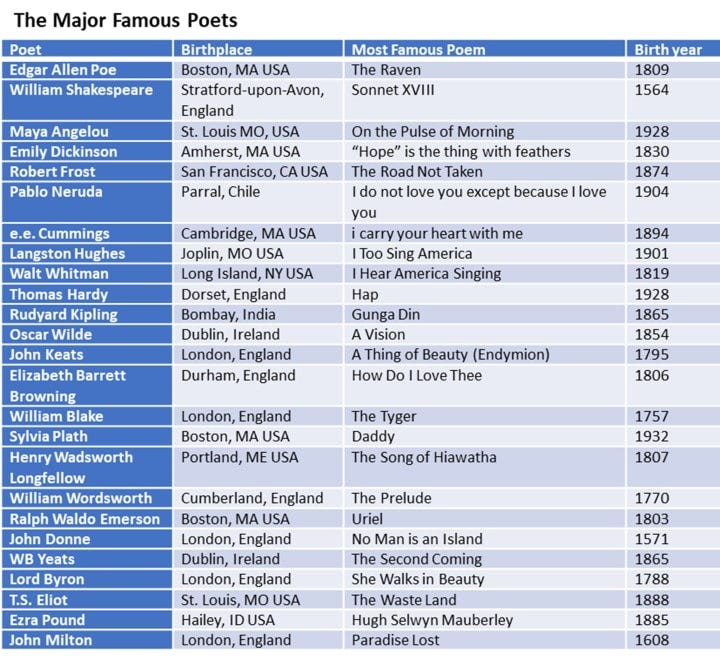
There are probably a couple of reasons why many don’t like poetry, but probably a major one is that the most famous poets were born between the 1500's and early 1900's (see the table at the end), and the language can often be obtuse and difficult, full of imagery and metaphors from Greek/Roman mythology or from the Bible. They either require translation or interpretation or both. The most famous poems often were written mostly for other poets (the majority being aristocrats) in those days long ago. Certainly if you were pushing a plow in the mid-1600s, you probably weren’t reciting Milton as you worked.
And no, Pernoste, I was joking when I said I was referring to you here.
[Pernoste: Funny, Annie. I’m not quite that old.]
Now, we don’t want to show you old poetry just to cement your dislike of poetry, rather we want you to understand poetry a little better. You don’t have to think all poetry is like what was written 400 years ago when probably less than 5% of the population could read.
So, imagine sitting in class in high school and being exposed to poetry for the first time, and you’re going to start with Milton’s Paradise Lost, written in the early 1600’s. Poor kids. As brilliant as it was in its time, it is still a challenge to find the motivation to read it. Here’s the first half of the first sentence of Paradise Lost [ yes you read me correctly… first half of the first sentence] with a modern translation (bottom):
Paradise Lost, by Milton (an excerpt)
Of Mans First Disobedience, and the Fruit Of that Forbidden Tree, whose mortal tast Brought Death into the World, and all our woe, With loss of Eden, till one greater Man Restore us, and regain the blissful Seat, Sing Heav’nly Muse, that on the secret top Of Oreb, or of Sinai, didst inspire That Shepherd, who first taught the chosen Seed, In the Beginninng how the Heav’ns and Earth Rose out of Chaos:…………
Paradise Lost (excerpt) as translated by Anneliese Dahl
It was Man’s first disobedience, eating the apple from the forbidden tree, and the taste of it that brought death to the world, brought woe, and our loss of Eden, until one great Man could restore us to our place with God, the Angels singing, there on the secret top of sacred mountains, where Moses was inspired to teach God’s chosen people in the beginning how Heaven and Earth rose from chaos…… etc…….
OK, I’m no expert on Milton, but I did my best to translate without turning it into an academic research project. Even translated to more modern terms, it is tedious (to my perception) and not very beautiful by modern conventions. Sorry, Uncle Milty…
[Pernoste: um, Uncle Milty was Milton Berle… a comedian from way before your time. Before my time, really.]
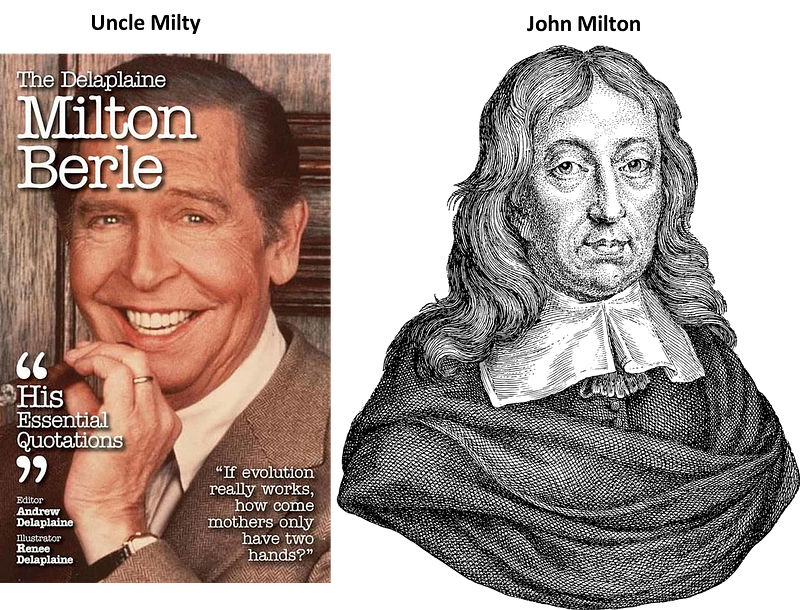
Oops. Hey, if that’s before Pernoste’s time, haha, so how does he know these things? OK, so maybe I chose the most difficult of examples.
Let’s try Oscar Wilde’s “A Vision.” He’s considered a fairly modern writer/poet and this is his most famous poem written in the late 1800s, just the first sentence. You can see that this poem doesn’t really need translation, but it does need a lot of interpretation. It is poetry for poets who love poets from back in the day, making the oh-so-moving point [ a little sarcasm, if you didn’t notice] that among the Greek playwrights of 400 BC, Euripides was so much better than Æschylos and Sophokles, but grossly under-appreciated. Despite his considerable skill with words, I think Wilde had too much time on his hands. And I’m a little disturbed by the image of “sweet long lips”.
[Pernoste: I preferred Phrynichus back then, just because of his name. And, yeah, what’s that with the lips? Read on.]
A Vision, by Oscar Wilde
Two crowned Kings, and One that stood alone With no green weight of laurels round his head, But with sad eyes as one uncomforted, And wearied with man’s never-ceasing moan For sins no bleating victim can atone, And sweet long lips with tears and kisses fed…
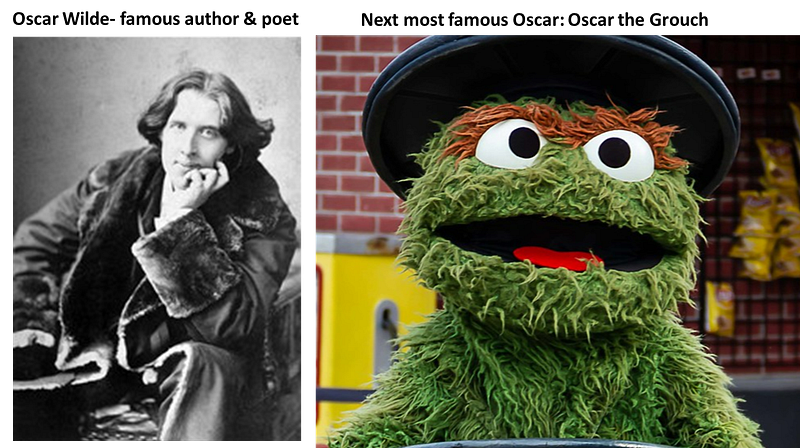
I’m not saying that Wilde was not an incredible poet, though, I just think that this particular poem of his is not the kind of poetry most people today will appreciate.
Let’s try Shakespeare’s Sonnet 18, probably his most famous poem, and it is truly lovely. Would have been nice to have a more poetic title… but that’s just me, I guess.
[Pernoste: I don’t know… 18 is an inherently lovely number. Though I would have called this Beauty Eternal.]
Sonnet XVIII by William Shakespeare
Shall I compare thee to a summer’s day? Thou art more lovely and more temperate: Rough winds do shake the darling buds of May, And summer’s lease hath all too short a date; Sometime too hot the eye of heaven shines, And often is his gold complexion dimm’d; And every fair from fair sometime declines, By chance or nature’s changing course untrimm’d; But thy eternal summer shall not fade, Nor lose possession of that fair thou ow’st; Nor shall death brag thou wander’st in his shade, When in eternal lines to time thou grow’st: So long as men can breathe or eyes can see, So long lives this, and this gives life to thee.
[Pernoste: OK, so we took a shot at translating this to modern English.]
Shakespeare’s Sonnet 18 — a modern translation by Pernoste
Shall I compare you to a summer day? You are more lovely and more pleasant. Winds in May shake beautiful buds from the trees, and summer can never last very long. Sometimes the sun is too hot in the sky, and other times its light is dimmed by clouds. Everything beautiful in time will fade, the consequence of bad luck or of nature. But the beauty of your words will grow eternal, and so long as men breathe and have eyes to see, your beauty will live and give you life.
Anyway, the original sonnet is lovely, but sadly a challenge for people today to appreciate. There are contemporary language abuses like “thee,” “hast,” “wander’st,” “grow’st,” etc … and some rather arcane phraseology. In the day it was considered to be quite beautiful and allowed one to keep to the rigid meter of the poetic form. But, honestly, it all seems a bit silly now for the uninitiated poetry reader. The quick translation does not have the power of the original, but likely with some modest work (and some deviation from the original structure) it could be beautiful in a more contemporary sort of way. Not that we should forget to admire and honor these original works . . . it’s just understandable that they don’t read well for modern readers.
[Pernoste: Did you ever think that if a man wishes to wax poetically about his lover’s/friend’s beautiful words, he could pick a better thing to compare to than a summer’s day? Maybe even a spring day would be better? And if you’re in England, why would you ever compare anything beautiful to the weather? Just asking.]
So, generally this type of poetry can be your first exposure to poetry in your youth. Imagine if our children learned how to read FIRST on such poetry. They would speak in thees and thous and say things like…
“could’st thou prepareth sustenance to break my fast, mother?”
But to be fair, you wouldn’t want to teach your child to read with the prose literature of Herman Melville, Charles Dickens or Jane Austen, either, with their long passages and archaic language, not to mention their old-fashioned perspectives.
“I’m not feeling well, daddy…it is neither the best of times nor the worst of times, though I tried to do my homework, wrestling with my age of foolishness in an effort to escape a winter’s despair for a tardy assignment.”
So what is good poetry by today’s standards? Or, at least, what might be the right poems to start with to gain an appreciation of poetry… before diving into rough waters of archaic verbiage, Greek mythology, and Christian metaphors wrapped in poetic sentences sometimes as long as your arm.
Well it’s not all like the examples above, of course. There was a modern revolution in poetry… in the early 1900’s.
[Pernoste: You probably thought Anneliese was going to say, like 1980 at least… perhaps 2010. No, the early 1900's!!]
Yes, it began in early 1900’s with Gustav Kahn and the French “counter-romanticists” and was further expanded by many poets of the day around the world and in the US, including Ezra Pound, T.S. Eliot, E.E. Cummings, Gertrude Stein, and Wallace Stevens and many others. Gone was most of the stilted language and rigid structures, falling away to “free verse,” which does not use consistent meter patterns, rhyme, or any musical pattern. It thus tends to follow more closely the rhythm of natural speech while still retaining some elements of poetic form, including the poetic line, which may vary freely; as well as poetic imagery and word choices based on sound or rhythmic cadences.
[Pernoste: Little-known made-up fact… this revolution triggered decades of all-out warfare among the poets of the world. Some thought the use of passive-aggressive metaphors and imagery would not end between the freeversers and the classicals until somebody put an eye out with a quill.]
I love your little-known made-up facts.
So, how about some “more accessible” poetry from those acclaimed by the poetry world, just three for now that Pernoste & I like (though sometimes you need the entire poem to really “get it”).
This is just the tip of the iceberg with regard to more contemporary poetry. There is a lot out there that you would probably enjoy if you can get past the whole “cringe-factor” whenever you even glimpse a poem (and you know who you are, haha). There’s also a lot of “bad” or old-fashioned or just weird contemporary poetry, too. And some of what we don’t like, you may love… so I hope we don’t discourage those who love 200 year old poetry.
Excerpt from “Daddy” by Sylvia Plath
You do not do, you do not do Any more, black shoe In which I have lived like a foot For thirty years, poor and white, Barely daring to breathe or Achoo.
Daddy, I have had to kill you. You died before I had time — - Marble-heavy, a bag full of God, Ghastly statue with one gray toe Big as a Frisco seal
And a head in the freakish Atlantic Where it pours bean green over blue In the waters off beautiful Nauset. I used to pray to recover you Ach, du.
(Continues)
— — — — — — — — — — — — — — — — — —
Thirteen Ways of Looking at a Blackbird By Wallace Stevens
I Among twenty snowy mountains, The only moving thing Was the eye of the blackbird.
II I was of three minds, Like a tree In which there are three blackbirds.
III The blackbird whirled in the autumn winds. It was a small part of the pantomime.
IV A man and a woman Are one. A man and a woman and a blackbird Are one.
(Continues)
— — — — — — — — — — — — —
“8 Count” by Charles Bukowski
from my bed I watch 3 birds on a telephone wire. one flies off. then another. one is left, then it too is gone. my typewriter is tombstone still. and I am reduced to bird watching. just thought I’d let you know, fucker.
— — — — — — — — — — — — — —
We think you may appreciate these excerpts from deceptively simple but emotionally and/or conceptually complex works of art. There is a whole world out there of incredible poets that are all at your fingertips on the internet. And you can find some terrific poets here on Medium, too.
[Pernoste: We have only just come to Medium and have a lot of reading to do to find our way around. But we came across a couple poets you may like.]
Some Medium notables (to us at least), just a sampling:
Grief Understands My Chaos by Gurpreet Dhariwal- we like this one for its simple language and honest depth of heart
My Eleventh Poem: Verse of Wanderlust by Hasnain A — this poem shares beautiful evocative imagery of nature, an illustration of the beauty of poetry itself
Blurry Mess by Dreamer’s Way — this one was inspired by a song and shows itself to be a mixture of beautiful language and an impassioned plea about being left behind when all that is wanted is a connection.
The Unsaid by Shweta Bharti — struggling to find the beautiful words to make a point, but realizing that maybe unspoken appreciation is the best way to capture the moment
Limbo by Dranéa — an enigmatic but sad poem suggesting difficulties and a need to fight together toward some end that perhaps ends badly, but there is a feeling of hope. We love poems that are not so explicit and leave some room for interpretation.
and one by us…. Sailing my heart by Pernoste & Dahl — expresses a sadness that the heart needs what it needs, though perhaps the secret love that is sought is impossible and only creates guilt and shame at how she withdraws her heart.
Please let us know about your beautiful poetry or your favorite poem.
Edited and updated from the original work published May 2023 at https://vocal.media.