
Boost your confidence, overcome shyness, and meet some great people through acting.
It’s easier to find acting roles than you might think. A chance part in a student film changed my life—and my self confidence—immeasurably for the better.

In my late 20s, my confidence took a huge plunge, and being an already-shy guy, I struggled to pick myself up. As my confidence hit rock bottom, I developed a stutter and found it difficult to speak to anyone but my closest friends.
It was a horrible time.
Ten years later, things were different. I confidently walked into a university classroom to teach acting students for the first time. It didn’t even cross my mind that taking on a class of drama students, which can get a little crazy, takes a lot of confidence to get up and do. But there I was, enjoying every second.
The reason for my change, a change for which I’ll be forever grateful, is that I’d spent that decade being an actor.
When looking to improve confidence, it’s not uncommon advice to get out of your comfort zone. It’s good advice. It works.
I thought acting might be good to get me out of my comfort zone and start to build my confidence. But it also helped me overcome my shyness, and with that came peace. I developed stage presence and even charisma when I needed it but with the confidence to be happy with not being charismatic at every moment. Part of true confidence is knowing you’re not perfect and that doesn’t matter.
Doing a bit of acting is a structured way to get out of your comfort zone. You’ll meet some really amazing people, too. You won’t believe the ways it can change you.
Getting Started
I fell into acting when a friend was desperate for an actor for her student film and needed someone who looked like me. I refused at first because it terrified me — I was in a bad place and already shy after all — but her success relied on her getting someone to act, and she was desperate. I nervously stepped in.
That was that; I’d started. I saw the road ahead and decided to go for it.
Now you can see me on major streaming channels and even buy DVDs with me on the cover. But all that means very little to me compared to how much more comfortable and happy I am in my normal day to day life.
The first time is always the most terrifying. If you’re shy, it’ll be scary. But if you keep doing it, it won’t be anymore. You’ll be less shy.
So you’ve got to start. Book something in you can’t back out of. Get a role in a student film so you can’t let them down, or book a class and pay for it in advance so you’ll go. Just get started.
If you’ve not done it before, it’ll feel weird. It’ll be uncomfortable. That’s the sign you’re out of your comfort zone and the sign you need to keep going.
Here are some good ways to find your first role.
Student films
Student films are always looking for actors. Many professional or experienced actors won’t do student films because they don’t pay, and to be brutally honest, often come out terribly.
But that’s OK. You’re not there to create a masterpiece or make money. You’re there to shed some shyness. You’re there to get out of your comfort zone. And you’ll be helping young filmmakers learn their trade, too.
I did several student films. Some came out well and some didn’t, but each time I came away a tiny bit more confident than I went in. A little bit less camera-shy, a little bit less scared, a little less weird feeling. And I met some lovely people and made some new friends.
There are also other low-level films being made by people learning the trade alone outside of university settings. These work, too. Just find someone looking for a character who fits your age, gender, and other details, and apply.
You may have to audition, which can be nerve-wracking. But these are great, too — each nervous audition leaves you walking out of the room a little less shy than when you walked in.
You can find casting calls for student films on social media and acting sites like Starnow.com. There are normally a few casting calls around with busy periods when assignments are set.
Local drama classes
These classes are often full of people just starting out, people just doing it as a hobby, or other people like you looking to build confidence. You’ll meet all sorts.
Be prepared to feel silly. Be prepared to stand in a circle and tell people your name and a tiny bit about you. That can be scary at first, but that’s why you’re there. No one is judging you. Half the people there are interested and half are worrying because their turn is coming and they’re not listening to you anyway.
You’ll do all sorts of theatre exercises, both physical and vocal. Each one will push your comfort zone out slightly in a different direction.
In my first class, I found myself being an egg and a chicken, repeatedly saying the phrase “I’m an egg” or “I’m a chicken.” I’d never done anything like that before. It was slightly uncomfortable, but a sense of new freedom bubbled up there and then. In that moment, I realised you can do what you want really, and no one cares. Especially not anyone in a drama workshop.
You could also consider joining an amateur choir if you like to sing. Anything performance-based is good.
I did student films and amateur classes for about three years and the changes were remarkable. My shyness was lifting.
But something I hadn’t thought about had also happened. I was also getting quite good. So I thought I’d check out what a real film or TV set was like.
Still a little shy, I decided to dip my toe in first — and joined an agency as an extra.
You’ll find local drama workshops at local theatres and amateur dramatic societies. They should have websites with details on how to get involved.
Supporting Artists
Supporting artists, or extras, are the people you see on a film or TV show who don’t really do anything. They’re the crowds in the nightclub and the passers-by in the street. Sometimes they’ll be a barman or a paramedic. They don’t normally have lines.
Working as an extra gets you out of your comfort zone in a different way. You’re not usually doing anything particularly odd or weird, and you don’t have to perform much or well, but there’s another kind of pressure.
Shows that can afford extras are shows that are going into the cinemas or onto the TV, and you can tell when you’re on set. Sometimes there are movie stars around and you’re in the background behind them. There are huge cameras on huge tracks or cranes pointing right at you.
It’s a new kind of pressure. Simple instructions can feel so weird. New extras often report that they’re asked to simply walk across the scene behind the actors, but they feel like they’ve forgotten how to walk. Everything becomes so self-conscious because you know the world could potentially see this.
It’s a way to make even a simple walk across a room out of your comfort zone.
There are other awkward things you have to do that don’t happen in real life.
All those extras in the bar, chatting away behind the actors…they’re not really talking. That would mess up the sound recording. So the crowd noise is put on later, and as an extra, you’re standing there with a stranger having this conversation, but making no sound. So you’re just mouthing nonsense at each other. It’s weird. It’s uncomfortable. And that makes it perfect.
It gets weirder. All those dancers in the club…well music is also a problem for the dialogue, so there isn’t any. They’re all dancing to absolutely nothing. The crew often play some music before the call of Action! so the extras know the speed and feel of the song, but then you’re dancing to nothing. Dancing to nothing with an absolute stranger.
And then they go for the next scene and announce, “This is the end of the night so we want you all slow dancing,” and then you have to cuddle up with and slow dance with a stranger when there’s not even any music playing.
It’s so awkward. But everyone is in the same boat, and it ends up quite funny really. And then our brains learn that awkward is absolutely fine, after all.
Extras agencies are easy to join and offer flexible work. Just find a local one and follow the instructions on their website.
Emotion for Professionals
Having spent a while as an extra — which by the way can pay quite well and feeds even better — I thought I’d push myself a bit further and see if I could be one of the actors.
I was getting better at it from the amateur workshops and the student films and was getting comfortable in front of a camera from the extra work, so thought I’d do some professional lessons to up my game, and my confidence.
The simple drama games from the amateur workshops crop up in professional classes too, as they’re very useful for reminding ourselves that looking silly is absolutely fine — and so often as actors, we look absolutely silly. But there was more to it.
Here are some of the things I learned in professional acting workshops that pushed my confidence levels higher and higher.
It’s OK to show emotion
Good acting is often emotion-based. How dull would a movie be if no one showed emotion?
But in society, we like to cover that up and not look silly. Even more so here in the U.K. than in other countries, but to some degree, it’s true of humans everywhere.
Shyness is largely a fear of being judged. Confidence is largely being absolutely fine with being judged. And showing emotion is a route to being judged.
So in acting lessons, particularly the teachings of Stanislavsky, we learn to feel and show real emotions. If you’re shy and cover them up, you won’t be exciting to watch. So the shyness has to go. There’s no room for shyness in good acting.
Choose your lessons wisely here. There is a school of thought in some places that basically try to break down students so they can be put back together stronger. It’s normally found in traditional drama schools on three or four-year courses. But I completely disagree with this philosophy.
I understand the thinking, but I know a few actors who ended up in therapy because of it. There’s no need for it. If you sense this mindset from a place, walk away. It’s very rare in short courses and ad hoc drama classes, but if you feel compelled to attend drama school for three to four years, read accounts from previous students before making your decisions. Thankfully, I think this approach is becoming more and more rare.
Anyway, don’t let that put you off. You’re doing it for a reason, and that reason is to grow.
You’ll learn to show emotion in front of a class of fellow actors. This is the perfect environment to do it in because no one is judging you badly for showing emotion, which is what shy people fear in the real world. Quite the opposite. If anything, they’re judging you positively for showing emotion. They’re all on your side because they’re in the same boat. I’ve rarely been in a setting so supportive as a professional acting class. It’s quite beautiful.
This is a setting where you can shed your fears of showing emotion. And then out in the real world, you won’t care so much either. Because you’re no longer shy.
You can search for these classes by looking for short courses and workshops at local drama schools, or sometimes actors and acting teachers set up independent classes at weekends and evenings.
Get on Stage
Going on stage as an actor would have been absolutely terrifying for me 10 years ago. It was about five years ago I finally did it. It was great fun.
It was only an amateur production as I hadn’t done it before. But because of my training and experience in films, I found myself to be a stronger member of the cast.
The show ran for five nights with good audiences every night.
Every night got easier. By the end of that week, I genuinely felt like a different person. It’s hard to view yourself as a shy person when you’re going on stage night after night and making crowds laugh. The two stories just don’t fit together.
After the course of the three months in rehearsal, initially feeling awkward and then comfortable, and then the week of shows, much of the last of my shyness disappeared. It was an amazing feeling. I highly recommend it when you’re ready.
You can get parts in amateur shows by expressing interest to local amateur theatre groups and finding a group near you who are open for new members.
Expect to have to give up time several evenings a week for rehearsals and shows, and make sure you’re available to do so — pulling out of just a rehearsal or two can cause huge problems.
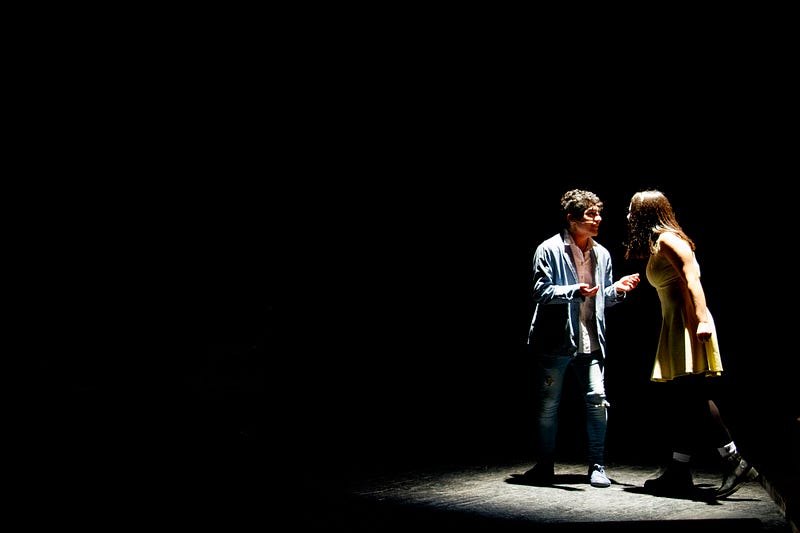
Comedy Improvisation
A lot of people turn to comedy improv classes for confidence reasons. I was one of them — and my estimate is that about a third of the people in the classes with me were there for the same reason.
These classes are the scariest of them all. You’re put up in front of a group with nothing but a scene partner and expected to be funny. It’s terrifying.
A lot of the people in the classes admitted to how terrified they were. One hadn’t slept for three days. Another said he’d been sat on the toilet four times a day for a week. This is the gold star of comfort-zone stretching.
Except it’s not that scary. The scariest part is the days running up to the classes. Because when you’re there, it’s absolutely fine.
The tutors know how scary it is, and everything is tailored to make everyone OK. Everyone is in the same boat. It’s absolutely fine.
We were started off by literally getting up and saying one word. That’s not scary. And then it was built up from there, tiny bit by tiny bit, with techniques to support us at every step. The fear was completely dwarfed by the fun.
But this is the magic of comedy improv classes. Although the fear is largely hidden by the fun and laughter all around, it’s still there. You’re still stretching out of your comfort zone. You’re still getting better, less shy, and more confident. Funnier, too.
It also helps us deal with anxiety because we get to learn to deal with uncertainty in a safe, structured way. Psychologists agree.
It’s wonderfully effective. As therapist Mark Pfeffer says, “It helps us realize that it’s okay to say something silly or stupid.” And that’s a powerful thing to realise when you’re shy.
If I had to guess, I’d say that improv classes were the most effective part of being an actor to deal with shyness. It’s also fair to say that without the rest first, I’d never have been confident enough to try it.
You can find comedy improv classes in cities around the world either in short courses, evening classes, or one-off workshops.
Losing Self-Consciousness
If you search the internet for Meisner technique lessons, you may be lucky enough to find courses in your area. I couldn’t recommend it any more highly. It’s possibly the craziest experience of my life — and I’ve done a few crazy things in my acting filled time.
It involves putting your attention entirely on the other person in an interaction and responding to them impulsively. Essentially, you’re really living instead of just performing.
There’s another big realisation with this method. When your attention is 100% on the outside — be that another person or a task — there’s none left to be inside you too. It’s therefore not possible to be self-conscious or shy. There’s no attention left for your awkwardness or nerves.
This is also one of the factors that comes into personal charisma.
Comfort zone stretching comes into this too — having someone with their attention on you too, calling out every tiny thing you do can make you self-conscious and be very uncomfortable. But after some practice, there’s no room left for that. You’re just alive, having fun and playing. Any thoughts of shyness are long gone. There’s no room for that either in the Meisner technique.
I had an amazing Meisner teacher who’d actually learned under Sandford Meisner himself. When I hinted to him about the therapeutic benefits of the technique, he threw his hands up and said he didn’t want to give the impression it was any more than an acting method. He wasn’t there as therapy. But a little smile told me he knew full well. It’s amazing without even trying to be.
Meisner courses and drop-in workshops can be found in many cities.
Not Shy Anymore
That’s what happens when you do enough acting and drama-related things. You get confident — without trying to be. You don’t need to try hard not to be shy or confident. Almost anything that gets thrown at you in the outside world and real-life feels like nothing compared to the silliness of drama games or the pressure of a film camera right in your face.
You don’t need to try hard to be funny — you’ve got techniques for that. You don’t need to worry about looking stupid — you do that for a pastime. You don’t need to worry about being nervous — you can flip your attention back around and forget all about those nerves.
Life in a drama class or on a stage or in a crazy improvisation course is the same as life but heightened in so many ways. When the volume gets turned back down to normal life, it feels like you can deal with anything.
And yet normal life doesn’t feel boring in comparison because you no longer have to hide from anything. You can jump right in where you never did before.
I can’t believe the difference it’s made. I’m lucky now to be able to work fun jobs on film sets and pass my knowledge onto university students in classrooms who are on similar journeys to what I went through.
And maybe if you’re still here, you’re thinking about dipping your toe into the magic of an acting classroom too.
I highly recommend you do. Life may never be the same again.


