
Books and Hulu: Starting Your Own Zeitgeist With Roam Research

A Zeitgeist is a concept from the nineteenth century Germany Philosophy, meaning “spirit of an age.” Contemporary usage is often to describe a genre or schema of fashion or fads. I’m going to expand that usage to encompass our shared cultural experience in an expansion of Georg Hegel’s usage. We are going to start collecting the data for our personal Zeitgeist from Hulu and novels. Starting this journey will help us create our own recommendation engines.
For most technology companies today, the need to build better and better personalization algorithms is critical for their financial success. With that information, they can segment you with others with similar interests and sell space on your timeline to advertisers. The problem, of course, is that the services these companies offer are enticing, namely recommending content based on our interests. If we want to be less dependent on services where the cost is our information, we have to build our own social media graphs.
This article by Jonah Malin on the new privacy features of iOS represents an exciting change in how companies will be able to track our online consumption:
As a marketer, creative, or tech professional, it’s an important situation to monitor. But anyone who is surprised and unprepared hasn’t been paying attention. User-awareness is the future. And iOS 14.5 was initially scheduled to roll out last year.
Though the tracking changes are significant, we will have to do what we’ve always done — adapt, evolve, and innovate — or fade into obscurity.
With more and more content companies using “social graph” algorithms on their platforms, the media you and I consume can differ. Even if we consume the same media, how we got there can be very different, and therefore our experience is very different. We may get to Watchmen from our interest in history, civil rights content, or Sci-Fi content. Even if we watch the same content, our mutual Zeitgeists only intersected by chance.
Reading
Reading still plays a significant role in our Zeitgeist creation. Books that we read in school are the foundations of that Zeitgeist. As we read more, our Zeitgeist diverges from our classmates, resulting in new and exciting connections. I have found the best way to grow my Zeitgeist is to join a book club.
In a previous article, we talked about how metadata is essential and how Roam Research is a great tool to track it.
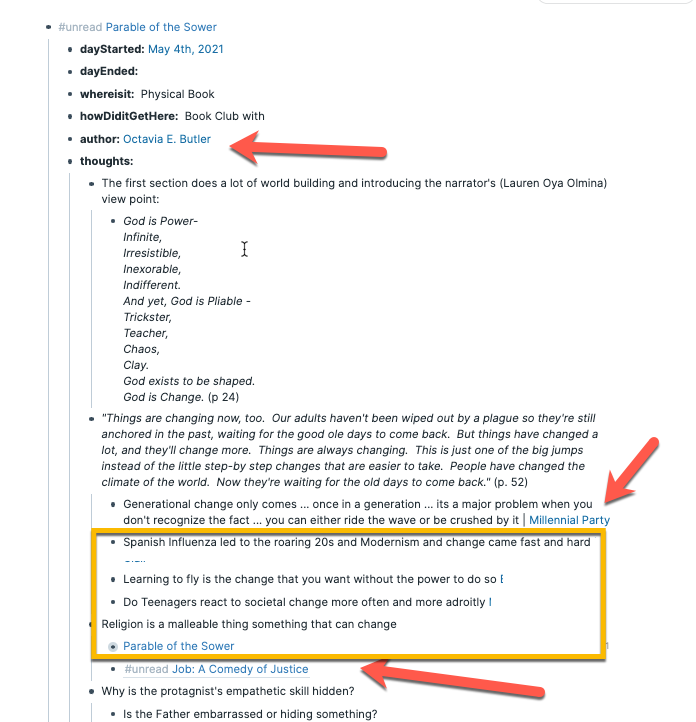
Recently, I started reading Parable of the Sower by Octavia Butler. My notes (you can see to the left) include my thoughts (with page citations). I’ve also expanded on those thoughts that represent new connections (the red arrows). I took notes during the club on what others thought and added those ruminations (those comments are in the yellow box). By taking notes and then consciously pulling ideas out as topics, I’m creating the basis of my Zeitgeist.
In a later article, we will show how to output these data to form other connections and how you can start to share them with others.
Hulu Streaming Content
While collective reading habits may have been the primary driver of our collective Zeitgeists, streaming content has become the most significant influencer. I wanted to include some of the dystopian ideas from The Handmaid’s Tale, so I started with Hulu to bring in my streaming highlights.
Big Mistake. Online companies are mandated by the California Privacy Account to provide the information they collect but are apparently not required to allow for easy distribution and/or offer it in a convenient format.
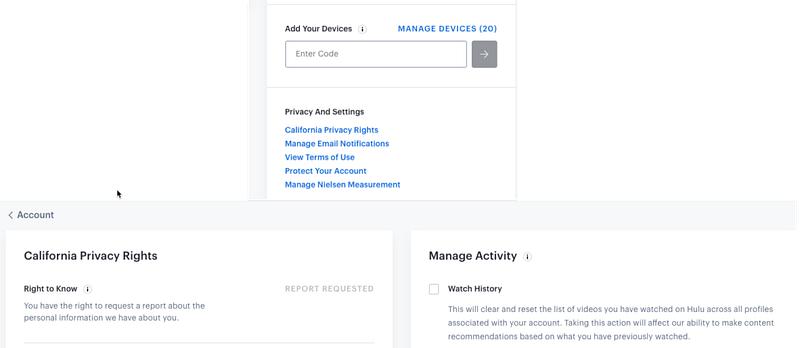
Steps to get Hulu Streaming Information:
- Go to my Account and choose California Privacy Account
- On the next screen, request the report.
- Confirm in an email that you requested the report
- Follow the link in another email to get the report
- Download the report
- See that it is in a PDF … Sigh Heavily
- Use the tool on CleverPDF.com to turn it into Excel
- Combine the multiple pages of viewing history, clean it up, etc.
If you want your Netflix information, you can simply go here and request a CSV.
Importing Content into Roam Research
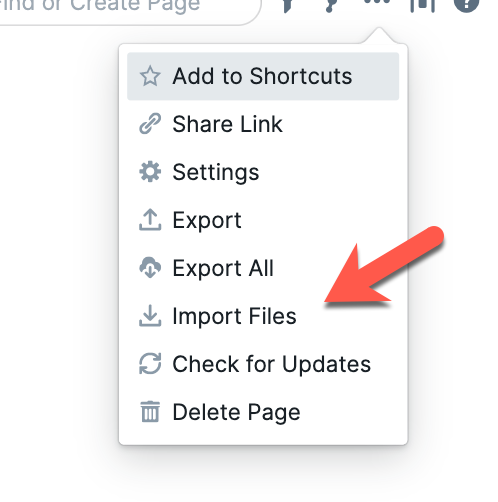
Now that we have it, we turn our viewing history into Markdown Files to import into Roam.
- Get the Series Names
2. Get the episodic information
3. Modify the date so that Roam will connect it to your daily notes
4. Output the markdown files and upload them to Roam.
5. Import and AUGMENT your notes so that you can continue to make connections.
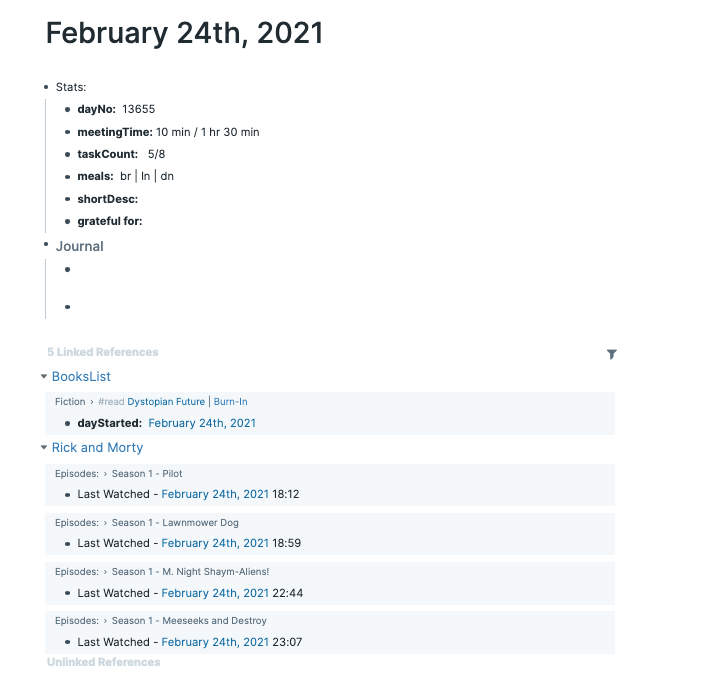
A day with a lot of content
The whole python file ( hulu2roam.py) can be found here, along with a sample markdown file ( futurama.md) to use as your base import.
If you import more viewing history of the same series (i.e., with the same Page name), Roam will append the new data to the page, so you may want to track what you have added in the past so that you can modify your markdown output or change the format.
I would encourage you to start thinking about your content that you consume and determine how you want to record it. The more information that you build now, the more control that you will have over your own Zeitgeist and the less dependent you will be with companies in the future.
If you would like more information about how I use Roam Research to create a Second Brain, please join our mailing list here.

Originally published at https://recursiveautomation.com on May 9, 2021.