
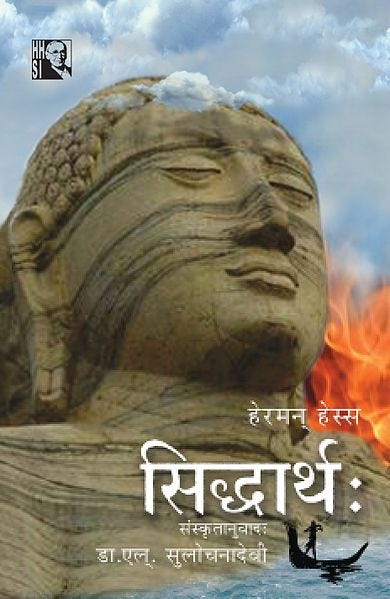
Siddharta by Hermann Hesse
Book Summary
“I can fast, I can wait, and I can think”
Hermann Hesse and Aldous Huxley are two Western philosophers whom we can rely on for understanding the mythical Western philosophy from a Western rational point of view. This, I can say with some authority being an Indian, who has spent half his life in India and half in the UK.
The Story:
“Siddhartha” is not the story of Gautam Buddha, who was known as Siddhartha, when he was a prince before he left it all to seek enlightenment and became Gautam Buddha. However, The Buddha does appear as an important character in the storyline.
The protagonist of this story Siddhartha is the son of a Brahmin (upper caste Hindu) who earns his living by performing rituals and teaching. Siddhartha, a sharp student, learns all the mantras faster than his peers, excels, outshines, and then gets bored.
The knowledge imparted by his father and other teachers to him doesn’t satisfy his curiosity for the bigger questions of life. He finally decides to leave his father’s home and become a Samana (a wandering hermit who begs for alms to survive, lives in extreme austerity away from the mainstream world, and devotes his time to contemplating the bigger philosophical questions of life).
The story is a journey of Siddhartha living with the Samanas (wandering sadhus/hermits), his conversations with the Buddha himself and his disagreements with his philosophy and teachings, his encounters with a prostitute who later becomes his friend, philosopher, and guide, and also the mother of his son, his experiences working for a wealthy businessman, and dealing with the day-to-day issues of the common people, his return back to the forest quitting everything again, and then his encounter with Govinda (portrayed as a commoner with the enlightened wisdom of Vishnu himself), his disappointments with his son, the Chakra of life, and the law of Karma.
When seeking love, when seeking a job, in the materialistic mainstream world he is asked to present his skills, abilities, and qualities — in short, he is asked to present his CV. To all such queries, he has just one answer, the one he learned from living with the Samana for three years, and it went thus -
“I Can Wait, I can Fast, I can Think”
In a nutshell, this sums up the philosophy presented in the book, and then it is up to the reader and their intelligence to be able to apply this to various situations in life.
Core Philosophy:
In the novel, enlightenment is portrayed as a personal journey toward spiritual understanding and fulfillment. It is not something that can be taught or learned from traditional religious institutions or gurus. This was his primary disagreement with The Buddha.
Siddhartha discovers that enlightenment is achieved by following one’s own path, through personal experiences, contemplation, and self-discovery.
Enlightenment is a state of being where a person has gained a deep understanding of themselves, and the world around them. This is also echoed in the teaching of Socrates and one of the fundamental tenets of Western philosophy — “Know Thyself”.
The same is also echoed in the Ramayan, where Vashishtha suggests to Ram to listen to his ‘Soul’, for all big decisions and problems of life. The soul does have a voice, it speaks, but very very softly, and one has to first calm down completely, silence one's external disturbances and distractions, to listen clearly to one’s Soul.
That inner voice of the Soul is what believers call the voice of God. To nursery school kids we teach it as — “Listen to the tiger inside you”.
Visionaries have a vision because they have the ability to listen to their soul. However, they might seem from the outside, but from the inside they are all calm and have the ability to listen to their inner voice.
Soul = An Inbuilt GPS inside all of us
Activating this Inbuilt GPS needs a proper internet connection, which can only be down by calming down, and slowing down, so one can think clearly.
Also to think clearly one needs to be willing to delve into their own psyche and confront one’s fears and weaknesses in a courageous, often ruthless, and unbiased way.
Our social, cultural, and religious biases, peer group pressure, and in many cases our own sheer laziness prevents us from doing a true self-analysis, and hence most of us live in a self-deluded world.
However, those who are willing to embark on this journey will find that the rewards are life-changing and immensely rewarding.
Other Book Summaries:
- … on Artificial Intelligence — Superintelligence by Nick Bostrom
https://readmedium.com/superintelligence-by-nick-bostrom-94940668a614


