
Blowball
A dandelion by any other name… is not accepted by the Spelling Bee
Today’s New York Times Spelling Bee letters:
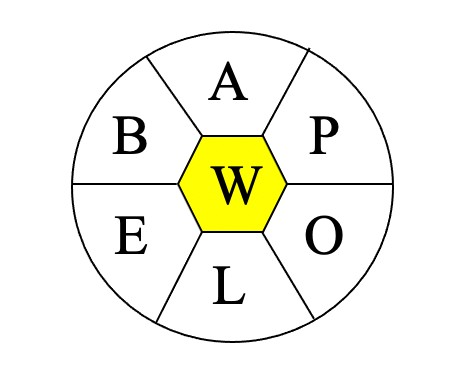
A, B, E, L, O, P, and center W (all words must include W)
Merriam-Webster says…

Silly little dictionary! Don’t you know blowball can’t possibly be a word if the New York Times says it ain’t?
For further fascinating facts, check out the Spelling Bee Master.
What’s your favorite dord* from today’s puzzle?
My Two Cents
Ah, the dandelion. A weed that adults love the hate and kids just love. No one can resist the urge to blow on a dandelion seed head. To paraphrase the old Lay’s potato chip slogan, “Betcha can’t blow on just one!”

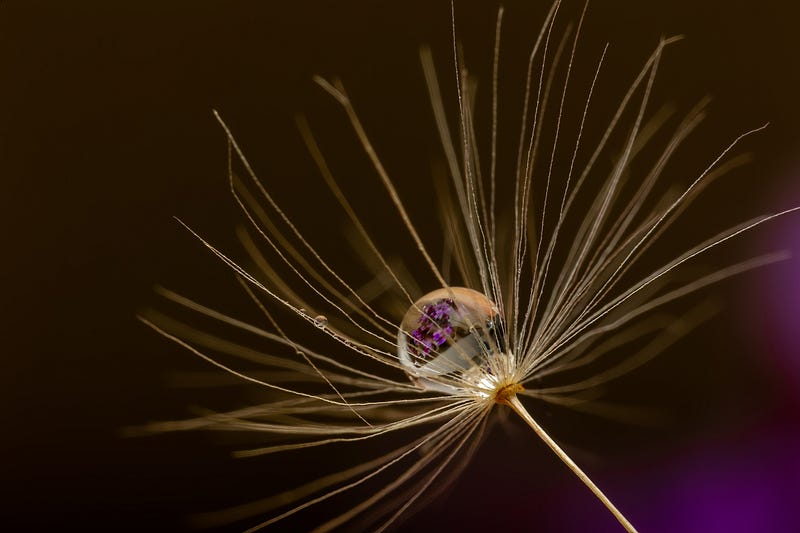
Blow being the operative word when it comes to dandelions, in case you’ve never seen or hear or experienced one of these before. And if you hadn’t, well, that’s why I provided the above photo. You’re quite welcome.
Interestingly, for the top photo, the one at the beginning of today’s column, I didn’t type “dandelion” into the Unsplash search. I entered blowball. Which means even Unsplash, notoriously difficult to search with, recognized the word.
So the big question is… why didn’t the Spelling Bee?!?
What’s in a name?
The term dandelion refers to several species within the genus taraxacum, which when said quickly might sound like what happens at the end of a porno flick featuring that well-known king of dinosaurs, the one with the tiny arms.
Here is a polydactylic handful of them, along with photos.

The one second from the right, Taraxacum officinale, is the commonplace species, which makes sense given that it’s often referred to as the “common dandelion”.
Blowballs were introduced into North America from Europe and now propagate as wildflowers. All the parts of the common dandelion are edible, and the plant has been used in traditional medicine. It is also one of the most important early spring nectar sources for a bunch of pollinators, including bees, for course.
The first known use of the word dandelion was recorded in the 14th century, and the term itself comes from the Middle English dendelyoun, corrupted from Anglo-French dent de lion, literally, “lion’s tooth”. Because the petals look like teeth and are yellow like a lion… I guess? Seems to me the Frenchperson who coined this term had never actually seen a lion up close to examine its teeth. If they had, they probably would have been eaten on the spot, meaning someone else would have had to coin that absurd name.
Wikipedia explains this (with sources): “The plant is also known as blowball, cankerwort, doon-head-clock, witch’s gowan, milk witch, lion’s-tooth, yellow-gowan, Irish daisy, monks-head, priest’s-crown, and puff-ball; other common names include faceclock, pee-a-bed, wet-a-bed, swine’s snout, white endive, and wild endive.”
Ummm… you notice how they also acknowledge the synonym blowball? What gives, New York Times? How hard would it have been to include that word in today’s Spelling Bee?
And yeah, “wet-a-bed”, I know… the French have a similar term, pissenlit, and that’s due to the fact that the dandelion has diuretic properties.
Here are some other varied names for this yellow-petaled blowball:
“In Swedish, it is called maskros (worm rose) after the small insects (thrips) usually present in the flowers. In Finnish and Estonian, the names (voikukka, võilill) translate as butter flower, due to the color of the flower. In Lithuanian, it is known as “Pienė”, meaning “milky”, because of the white latex that is produced when the stems are cut. The Danish name mælkebøtte (sometimes fandens mælkebøtte) means “milk bin” (“the devils milk bin”) and also refers to the milky latex (and its ability to spread). Similarly, it is called “maslačak” in Croatian, the name coming from the word “maslac” or “maslo” (butter and clarified butter, respectively). The Welsh (dant-y-llew), German (Löwenzahn), Norwegian (løvetann), Portuguese (dente de leão) and Spanish (diente de león) names mean the same as the French and the English names [lion’s tooth].”
The science of a blowball
Here’s something I found interesting: the text entry for dandelion in the 1911 edition of the Encyclopedia Britannica is much longer than the one in the latest online edition. Here they are, side by side, for you to compare:
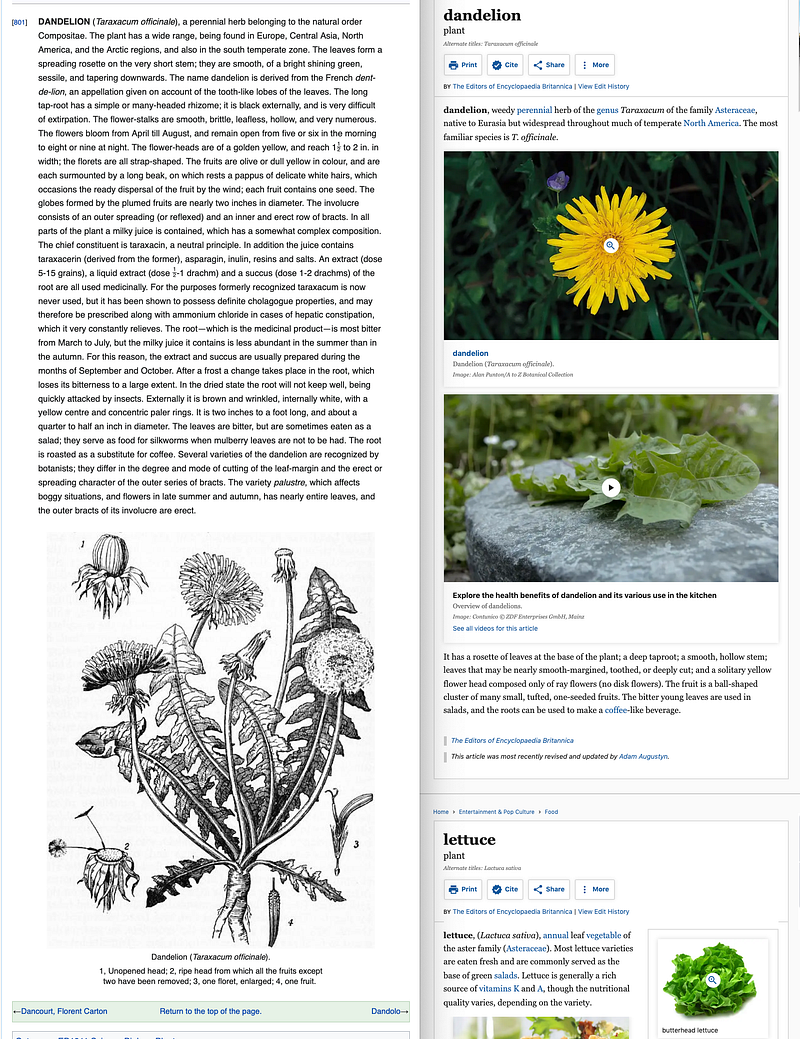
Isn’t that odd, considering we probably know a lot more about dandelions nowadays than we did 111 years ago? Not only that, the 1911 entry is a lot more specific and makes the dandelion sound much more interesting. I highly recommend reading it, even if it’s just for fun.
As I mentioned before, the entire plant is edible; the flower petals (along with other ingredients) can be used to make dandelion wine, and the roots can be ground, roasted, and brewed as a coffee alternative (and caffeine-free… not that I endorse that).
In the last several years, a German conglomerate known as the Fraunhofer Institute for Molecular Biology and Applied Ecology has been developing a variety of blowball suitable for commercial production of natural rubber.
Oh, and extensive research has gone into the actual airflow dynamics involved in carrying dandelion seeds after you’ve blown on the flower. Turns out that some of them may actually travel for miles! The whole science behind this is quite complex, plus I’m running out of time… so I leave you with this short video that will efficiently explain it in my stead:
Despite everything we’ve discussed today, the fact that blowballs are everywhere you look, and that kids love to blow on them… the editors of the Spelling Bee decided that the word blowball is a dord*.
You can check out my previous entry on another dord* here:
*What the heck is a dord, you ask? Here’s the answer:


