avatarHolly Jahangiri

Free AI web copilot to create summaries, insights and extended knowledge, download it at here

8117

Abstract

ta.com</a>) are probably the <b>easiest</b> and fastest to set up and maintain. And they’re easy to change or delete, as well.</p></blockquote><blockquote id="3be8"><p>Two others are more robust, but these are sites <b>dedicated</b> to “blogging” and don’t offer the same useful, customizable news features, or the handheld/wireless-friendly design offered by nPorta.</p></blockquote><blockquote id="8e35"><p><b>Blogger </b>(<a href="https://web.archive.org/web/20010711194139/http://www.blogger.com/">www.blogger.com</a>) and <b>Xanga</b> (<a href="https://web.archive.org/web/20010711194139/http://www.xanga.com/">www.xanga.com</a>) are definitely worth a look. I would recommend Blogger to anyone who wants to integrate their log into their own personal Web site (and has FTP access to upload and download their own files). I would suggest Xanga for anyone who might want to set up a free Web site or log but who doesn’t necessarily want to become an HTML guru in the process. Here are some samples, if you’re curious: my Blogger page, integrated into Scraps & Scribbles (<a href="https://web.archive.org/web/20010711194139/http://users.ev1.net/~hjahangiri/blog/dayjournal.html">http://users.ev1.net/~hjahangiri/blog/dayjournal.html</a>) and my Xanga page (not integrated into the Scraps & Scribbles site, but linking to it; <a href="https://web.archive.org/web/20010711194139/http://www.xanga.com/HollyJahangiri">http://www.xanga.com/HollyJahangiri</a>)</p></blockquote><blockquote id="5d66"><p><b>I Am NOT a Publisher!</b></p></blockquote><blockquote id="eb48"><p>So don’t ask me to publish your writing on my site. I’d be delighted to do it, but I can live without all the potential legal complications.</p></blockquote><blockquote id="5c2d"><p>I will, however, add links to other people’s writing sites. If you send me an email with the subject:</p></blockquote><blockquote id="73ae"><p>LINK for Scraps and Scribbles</p></blockquote><blockquote id="83e3"><p>I will add a link to your site, provided:</p></blockquote><blockquote id="040e"><p>(a) You include your name, email address, URL, and a brief description (no more than 3–5 lines) of your work; and</p></blockquote><blockquote id="c8cd"><p>(b) Your content is not inappropriate (pornographic, hate-mongering, racist, scatological, etc.) Mild erotica, strong opinions (clearly stated as your own and not argued with specious logic), diverse political/religious views, and such are, of course, fine.</p></blockquote><blockquote id="7bc2"><p>* Scraps & Scribbles has been around, in one form or another, since 1994. Debbie Ridpath Ohi (whom I met in GEnie’s Writer’s Ink RoundTable a couple of years before that) was just beginning to build Inkspot into the deservedly popular writers’ site it was soon to become; and her site was one of the very first links added to mine.</p></blockquote><p id="2bbb">Not much has changed, has it?</p><p id="09ff">I may even have found that definition of a weblog that earned me a mention in The Hindustan Times:</p><blockquote id="edf3"><p><b>What,</b> you ask, is a Weblog? A Weblog might be a virtual journal, a daily news update, a group’s bulletin board, or a feature of a Web site. You’re reading a Weblog right now; I use it to post update notices and other tidbits to Scraps & Scribbles, and I can do it from any PC that’s connected to the Internet, any time. This Weblog was created using Blogger (<a href="https://web.archive.org/web/20010604064805/http://www.blogger.com/">www.blogger.com</a>). Blogger lets me create and use my own template, so that my Weblog can be seamlessly integrated into my own Web site. I’m not forced to use someone else’s idea of a cool layout; every element is under my control. I can archive messages, too.</p></blockquote><figure id="e0d7"><img src="https://cdn-images-1.readmedium.com/v2/resize:fit:800/1*jJD2DIAN6Mk1682Umsscnw.png"><figcaption>A Blast from the Past — not the First Incarnation of My Website, Either!</figcaption></figure><figure id="0090"><img src="https://cdn-images-1.readmedium.com/v2/resize:fit:800/1*6iLipa3DWOkocKiJsMx72Q.png"><figcaption>One of My First Blog Hosts! (Hi, <a href="undefined">Ev Williams</a>!)</figcaption></figure><p id="ea0b">I was lazy; I just wanted a way to update the contents of my website without having to log in, download and edit pages, save and re-upload them — there had to be a better way. And that was what I found appealing about Blogger. I could integrate it into my own website, with a little effort, and then update things on the fly, from anywhere.</p><p id="3878">And while I was working, full-time, as a technical writer, designing Windows Help for PCs, and teaching others how to code HTML, other writers moved in and dominated this writing “niche.” Now in 2020, the whole topic of “writing” is so broad that it’s no longer a niche at all, and doesn’t even count as a <i>topic </i>on some websites and indices. We’re all writers, now; writing about writing is so “meta.” But I digress.</p><h1 id="87cb">Back in the Olden Days</h1><p id="a819">Once upon a time, we had “web rings.” These were little bits of code people set up that would act as Previous and Next buttons, but instead of taking you to the next post or page in the blog, Next would take you to the next site in the ring. This is how we turned blogging “social.”</p><div id="68c8" class="link-block"> <a href="https://hover.blog/what-ever-happened-to-webrings/"> <div> <div> <h2>What Ever Happened To Webrings?</h2> <div><h3>If the words GeoCities, Excite or Alta Vista mean anything to you, then chances are that the word 'webring' triggers a…</h3></div> <div><p>hover.blog</p></div> </div> <div> <div style="background-image: url(https://miro.readmedium.com/v2/resize:fit:320/0*rhC1gfdC-YIeE8dz)"></div> </div> </div> </a> </div><p id="7120">The closest thing we seem to have, now, is Linky Tools and InLinkz:</p><div id="0a69" class="link-block"> <a href="http://www.inlinkz.com/new/index.php"> <div> <div> <h2>Inlinkz | Blogging tools for link-ups, blog hops and link parties</h2> <div><h3>Create link-ups, link parties and blog hops. Run challenges and increase your loyal followers with the LinkUp tool…</h3></div> <div><p>www.inlinkz.com</p></div> </div> <div> <div style="background-image: url(https://miro.readmedium.com/v2/resize:fit:320/0*6zq2Dq2M3ais-ecA)"></div> </div> </div> </a> </div><p id="b6dc">And then there were “blogrolls.” I kept asking developers to make mine cinnamon with extra vanilla icing, but they just rolled their eyes and tried to explain that’s not what a “blogroll” meant.</p><p id="ae55">Sometimes, it’s fun to play dumb. Till someone believes you are.</p><h1 id="395c">Rules, Rules — We Don’t Need No Steenkin’ Rules!</h1><p id="83a8">Sharon writes, “We were excited about this new way of sharing our writing and we blogged regularly. There were no rules about how long posts should be or what should be included. There were no images, for the most part. It was just you, your words, and your fellow bloggers.”</p><p id="6687"><b>Except that’s not how I remember it.</b> Some of us were excited about this new frontier and its lack of rules, but others were excited to invent and pontificate <i>at length</i> about what the rules of blogging were, or ought to be. It was almost as if they had nothing else to write about, so they had to tell everyone else how not to write. I have criticized and satirized these early “listicles” to death, and I urge you to hold fast to the notion that there ought not to be any rules but good writing.</p><p id="182b">By “good writing,” I simply mean “that which does not bore the reader to tears and make them beg for death.”</p><div id="2d4f" class="link-block"> <a href="https://jahangiri.us/2017/netiquette-i

Options

n-the-nineties/"> <div> <div> <h2>Netiquette in the Nineties</h2> <div><h3>I have never understood the need to reinvent the wheel. To improve on it, perhaps. To modify it from a wheel suited to…</h3></div> <div><p>jahangiri.us</p></div> </div> <div> <div style="background-image: url(https://miro.readmedium.com/v2/resize:fit:320/0*EMMHmsY6DElNKQR4)"></div> </div> </div> </a> </div><div id="4eef" class="link-block"> <a href="https://jahangiri.us/2013/rules-for-blogging-next-topic/"> <div> <div> <h2>Rules for Blogging? NEXT TOPIC!</h2> <div><h3>Sitting here, enjoying a warm cup of coffee from my "RTFM" mug, I realize some of you aren't even old enough to…</h3></div> <div><p>jahangiri.us</p></div> </div> <div> <div style="background-image: url(https://miro.readmedium.com/v2/resize:fit:320/0*P6dMzZVX94_JYWBW)"></div> </div> </div> </a> </div><p id="3835">You should really read this next one — <a href="undefined">Sharon</a>’s mentioned in it.</p><div id="5eb2" class="link-block"> <a href="https://jahangiri.us/2013/rules-for-blogging-next-topic/"> <div> <div> <h2>Rules for Blogging? NEXT TOPIC!</h2> <div><h3>Sitting here, enjoying a warm cup of coffee from my "RTFM" mug, I realize some of you aren't even old enough to…</h3></div> <div><p>jahangiri.us</p></div> </div> <div> <div style="background-image: url(https://miro.readmedium.com/v2/resize:fit:320/0*P6dMzZVX94_JYWBW)"></div> </div> </div> </a> </div><p id="9d82">See? If you can’t beat ’em, join ’em. And then say, “Here, hold my beer…”</p><div id="6a8c" class="link-block"> <a href="https://jahangiri.us/2013/watch-me-break-blogging-rules-i-created/"> <div> <div> <h2>Here, Hold My Beer - Watch Me Break Blogging Rules I Created!</h2> <div><h3>After I posted " 31 Ways NOT to Use Your Blog," many of you goaded me, egged me on, encouraged me in my mischievous…</h3></div> <div><p>jahangiri.us</p></div> </div> <div> <div style="background-image: url(https://miro.readmedium.com/v2/resize:fit:320/0*iBzbYUZBIflbfTwo)"></div> </div> </div> </a> </div><h1 id="8a7d">Money for Nothin’</h1><p id="ed6a">The Internet is full of some of the laziest people I’ve ever run across. They seem to honestly believe that they can earn money doing absolutely nothing — or by “blogging,” but their definition of it is not Sharon’s or mine, and doesn’t involve writing original material. It means using cheap software and tricks to scrape and spin other people’s content, sell ad space, and earn revenues by getting all their friends to click on the ads.</p><p id="fd50">It means shoveling half that cash back into someone else’s 497 web training program on how to do it faster and better.</p><div id="4738" class="link-block"> <a href="https://readmedium.com/the-story-of-ivan-mor-smirnoff-daa524fc46dd"> <div> <div> <h2>The Story of Ivan Mor Smirnoff</h2> <div><h3>The passive-aggressive take-down of an unrepentant plagiarist</h3></div> <div><p>medium.com</p></div> </div> <div> <div style="background-image: url(https://miro.readmedium.com/v2/resize:fit:320/0*V1GbaHeQe5dK05_r)"></div> </div> </div> </a> </div><div id="7ccc" class="link-block"> <a href="https://readmedium.com/spin-this-9fcdc2db7753"> <div> <div> <h2>Spin THIS!</h2> <div><h3>Your plagiarized writing may earn you a C on your term paper, or a few pennies on Medium, but respect, once lost, is…</h3></div> <div><p>medium.com</p></div> </div> <div> <div style="background-image: url(https://miro.readmedium.com/v2/resize:fit:320/0*oKwCyRdqJ_hLfDev)"></div> </div> </div> </a> </div><div id="31c4" class="link-block"> <a href="https://readmedium.com/plagiarism-and-copyright-violations-on-the-rise-again-4081360de443"> <div> <div> <h2>Plagiarism and Copyright Violations on the Rise Again?</h2> <div><h3>I am not at all flattered that my words are good enough to steal, and you shouldn’t be, either. Would you be flattered…</h3></div> <div><p>medium.com</p></div> </div> <div> <div style="background-image: url(https://miro.readmedium.com/v2/resize:fit:320/0*a0-67HFNXooreQXG)"></div> </div> </div> </a> </div><p id="b263">Or, maybe, they actually did believe they could get rich quick by blogging, and this is why there are 15,973,456,002,009 abandoned blogs and disillusioned former bloggers working in retail and claiming that “blogging is dead.”</p><p id="5a21">Blogging makes great business sense if you have a product to sell and plenty to say about that product. If the product is paper, maybe you write about sustainable forestry or less stinky methods of producing paper products. If you’re selling antivirus software, you’ll never run out of cybersecurity topics to write about. But you do need to be an expert, or hire an excellent freelance writer like <a href="undefined">Sharon Hurley Hall</a> who understands enough about the topic to write credibly about it, or you’ll just end up looking foolish.</p><p id="761b">We all know by now, <i>surely</i>, that only a small percentage of writers get filthy rich, and <i>none </i>of them do it in their sleep. But those folks who keep on churning out crap like, “I Made 34,982 on My Last Medium Story, and You Can, Too!” are just getting rich off P.T. Barnum’s “suckers.”</p><div id="edc7" class="link-block"> <a href="https://readmedium.com/i-dont-care-what-you-do-in-your-sleep-cab60bb55a92"> <div> <div> <h2>I Don’t Care What You Do in Your Sleep</h2> <div><h3>Especially if it involves making more money than Godzilla</h3></div> <div><p>medium.com</p></div> </div> <div> <div style="background-image: url(https://miro.readmedium.com/v2/resize:fit:320/0*cOzhtGqstqR13A5k)"></div> </div> </div> </a> </div><p id="8bf9">They tend to ruin it for the rest of us. How?</p><p id="8db4">By running off the audience.</p><p id="ef9b">In the end, though, those of us who started out blogging for the fun of it, or just to enjoy honing our writing skills on topics of our own choosing, will still be around. Medium feels like that “old school blogging.” There is a community, here, comprised of writers who support and care about one another as people.</p><p id="a892">And slowly, bit by bit, our audience will return.</p><p id="9d43"><a href="https://jahangiri.us/"><i>Holly Jahangiri</i></a><i> is the author of Trockle; A Puppy, Not a Guppy; and <a href="https://amazon.com/author/hollyjahangiri">A New Leaf for Lyle</a>. She draws inspiration from her family, from her own childhood adventures (some of which only happened in her overactive imagination), and from readers both young and young at heart. She lives in Houston, Texas, with her husband, J.J., whose love and encouragement make writing books twice the fun.</i></p><p id="a133"><i>If you are reading this on any site other than Medium or on jahangiri.us, the content may have been stolen.</i></p></article></body>

Blogging: The Last Frontier

Till there’s another new one. Now, get off my lawn.

Photo by Alina Kovalchuk on Unsplash

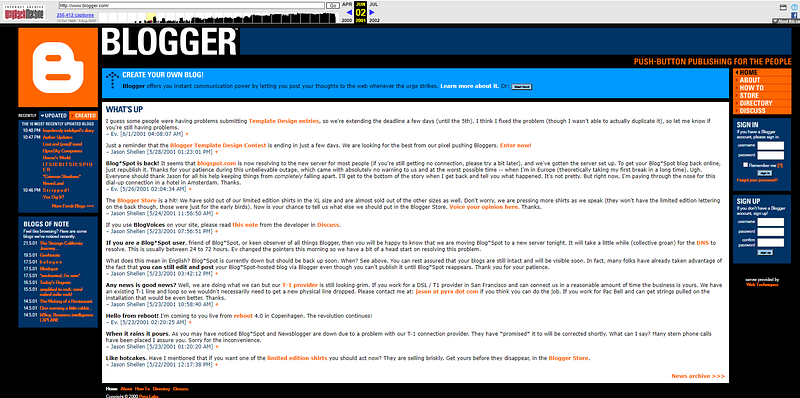
I had no idea Sharon Hurley Hall was so new to blogging! I was blogging when Blogger, co-founded by Medium’s founder, Ev Williams, was still a baby. You might say that I’ve come full circle. You’ll see, in a moment, how little has changed in the past two decades.

Sharon writes, “I wrote this article after a discussion with Ming Qian. Would love it if my early blogging friends like Mitchell Allen and Holly Jahangiri would share their perspective.” So glad you asked, Sharon — and thanks for getting the ball rolling!

There Are Adults Who Haven’t Been Alive as Long as I’ve Been Blogging

One of my first blog posts was me trying to define what the heck “blogging” was — I didn’t imagine anyone else would read it, and no one knew back then that “the Internet is forever.”

You’ll see the proof of this, in just a moment.

At some point, before the term “vanity surfing” was coined, I searched for my own name and found a mention in The Hindustan Times, where my definition of blogging was quoted and I was referred to as a “veteran blogger.”

Once I stopped laughing and realized what a venerable publication that really was, and not some little fly-by-night website like my own, I was stunned. I wrote to their tech columnist, Deepak Mankar, and confessed to him that I was anything but a veteran blogger, but thanked him for the compliment of quoting me in the newspaper and calling me one.

Neither of us can find that clip, now — but at least I made a friend!

Before There Was Blogging

Sharon refers to a time “before social media,” but I’ve been hanging out on social media since before the Internet. That’s right, kids — Mark Zuckerberg did not invent “social media.”

My first online chat happened on CompuServe in 1981, and by 1989, I was working as an unpaid moderator (SysOp) on GEnie. The Writers’ Ink RoundTable — the first to “hire” me — had a forum, a chat room, and a place to store files. I’d say it was at least as much of a “social network” as any overcrowded, contentious platform we think of as such, today. And somewhere in between, there were independent little user-run “bulletin boards” (BBSes) that had chats, online games, and more. Your parents weren’t running around with the dinosaurs, kids.
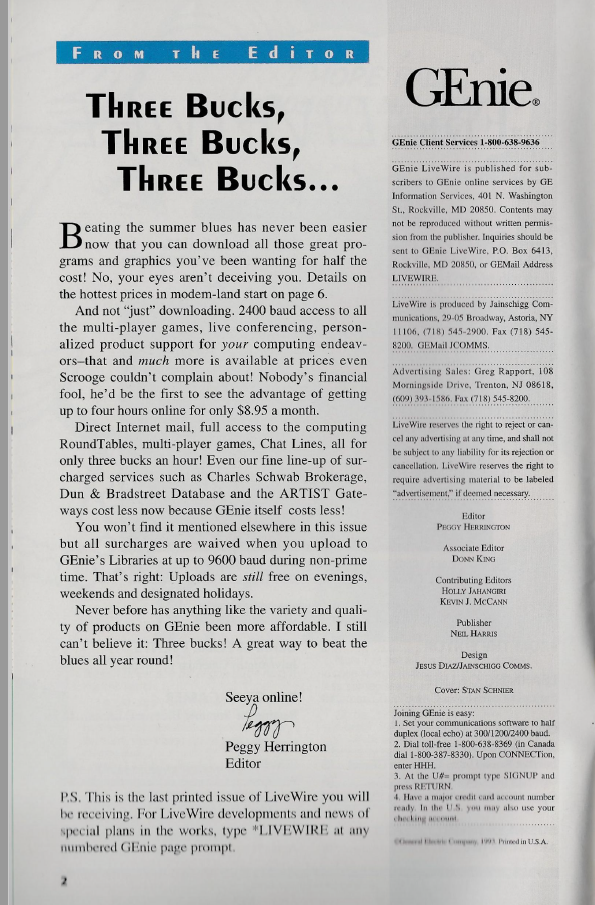
Look REALLY Closely at that Masthead

I See Dead Trees

In the early days of the commercial Internet (around 1994–2002), there were printed directories of websites, categorized like the Yellow Pages, and sold in brick and mortar bookstores. I had no idea, until tonight, that I was featured in one of them!
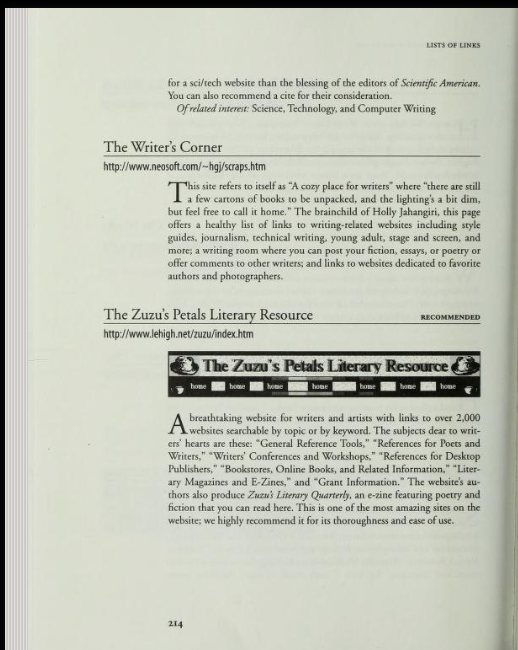
From Writer’s Internet Sourcebook, by Levin, Michael Graubart (1997)

My first website, Scraps & Scribbles, or The Writer’s Corner, was a writing site. It was, as the book above says, “a list of links.” I only started it because I wanted to learn HTML, and all the websites back in 1994 or so consisted of rudimentary lists of programmers’ CD collections. That seemed awfully boring, so I focused on what I knew and started a writing site. There weren’t many, back then. But let me tell you in my own words —from nearly 20 years ago:

Tuesday, April 17, 2001

A Short History of Scraps & Scribbles

When I first started Scraps & Scribbles (originally called The Writers Corner), several years ago*, my main goal was to learn HTML. That didn’t seem like reason enough to add clutter to the Internet, and I couldn’t see me doing another one of those “Hello world, this is me, isn’t my CD collection just the kewlest?” personal home pages.

I was determined, from the start, to provide links to some of the best writing resources on the Internet — not just to collections of other people’s favorite links, but to sites containing primary content of interest to writers and readers.

Turned out to be a fairly time-consuming endeavor. And there weren’t 50 gazillion writers’ sites on the Internet then, as there are now. Just finding some of them proved to be a daunting task.

Always, tucked into a deep corner in the back of my mind, was this nagging feeling that some of that “primary content” really ought to be written by me. The other nagging feeling, not quite relegated to that dark corner of the mental basement, was that I was already spending too much time online! (Anyone here remember the movie, “The Beast in the Cellar”?) Anyway…

Flash forward to January 2001. I discovered two “new” things to play around with, and threw myself into them with zeal. The first was the “pay-per-click” writing sites, like Epinions and Themestream. I wouldn’t have found Themestream, if not for the fact that Epinions temporarily shut down while their site was being redesigned.

Don’t ask me what’s addictive about writing for a site that pays a measly $.02 or less each time someone reads your work. Even though technically it’s worth less than a token payment, like contributor’s copies of a print anthology, it’s money. Legal tender. In four months and 40+ articles, I earned a whole hour’s wages. (I do write for a living.) I’ll never see a penny of it, either. Themestream sent out an announcement last week, saying that the company would cease operations on Friday the 13th (how appropriate) and that it would be highly unlikely that they would be able to pay all their creditors — or their contributors.

But you know what? Thanks in part to Themestream, I finally put my money where my mouth was, got off my duff, and started writing something besides user’s guides — and now I’m able to move most of those articles to my own Web site. I finally have some of that primary content, not just great links, and it’s mine!

The second thing I discovered to play with on the Internet was Weblogs (like this one!). nPorta’s Logs (www.nporta.com) are probably the easiest and fastest to set up and maintain. And they’re easy to change or delete, as well.

Two others are more robust, but these are sites dedicated to “blogging” and don’t offer the same useful, customizable news features, or the handheld/wireless-friendly design offered by nPorta.

Blogger (www.blogger.com) and Xanga (www.xanga.com) are definitely worth a look. I would recommend Blogger to anyone who wants to integrate their log into their own personal Web site (and has FTP access to upload and download their own files). I would suggest Xanga for anyone who might want to set up a free Web site or log but who doesn’t necessarily want to become an HTML guru in the process. Here are some samples, if you’re curious: my Blogger page, integrated into Scraps & Scribbles (http://users.ev1.net/~hjahangiri/blog/dayjournal.html) and my Xanga page (not integrated into the Scraps & Scribbles site, but linking to it; http://www.xanga.com/HollyJahangiri)

I Am NOT a Publisher!

So don’t ask me to publish your writing on my site. I’d be delighted to do it, but I can live without all the potential legal complications.

I will, however, add links to other people’s writing sites. If you send me an email with the subject:

LINK for Scraps and Scribbles

I will add a link to your site, provided:

(a) You include your name, email address, URL, and a brief description (no more than 3–5 lines) of your work; and

(b) Your content is not inappropriate (pornographic, hate-mongering, racist, scatological, etc.) Mild erotica, strong opinions (clearly stated as your own and not argued with specious logic), diverse political/religious views, and such are, of course, fine.

* Scraps & Scribbles has been around, in one form or another, since 1994. Debbie Ridpath Ohi (whom I met in GEnie’s Writer’s Ink RoundTable a couple of years before that) was just beginning to build Inkspot into the deservedly popular writers’ site it was soon to become; and her site was one of the very first links added to mine.

Not much has changed, has it?

I may even have found that definition of a weblog that earned me a mention in The Hindustan Times:

What, you ask, is a Weblog? A Weblog might be a virtual journal, a daily news update, a group’s bulletin board, or a feature of a Web site. You’re reading a Weblog right now; I use it to post update notices and other tidbits to Scraps & Scribbles, and I can do it from any PC that’s connected to the Internet, any time. This Weblog was created using Blogger (www.blogger.com). Blogger lets me create and use my own template, so that my Weblog can be seamlessly integrated into my own Web site. I’m not forced to use someone else’s idea of a cool layout; every element is under my control. I can archive messages, too.
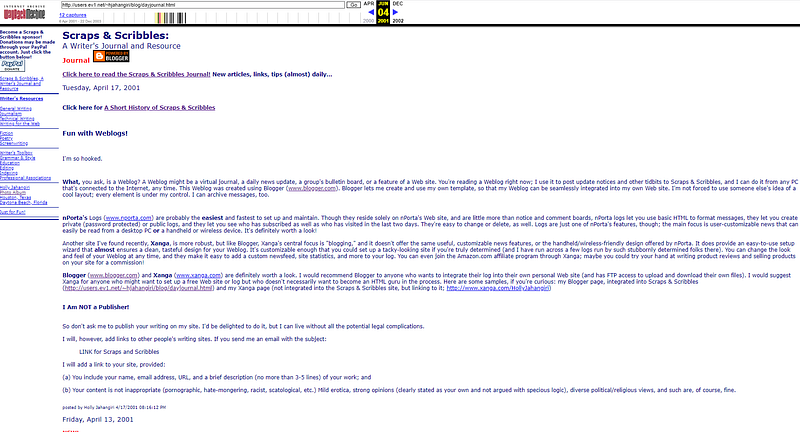
A Blast from the Past — not the First Incarnation of My Website, Either!
One of My First Blog Hosts! (Hi, Ev Williams!)

I was lazy; I just wanted a way to update the contents of my website without having to log in, download and edit pages, save and re-upload them — there had to be a better way. And that was what I found appealing about Blogger. I could integrate it into my own website, with a little effort, and then update things on the fly, from anywhere.

And while I was working, full-time, as a technical writer, designing Windows Help for PCs, and teaching others how to code HTML, other writers moved in and dominated this writing “niche.” Now in 2020, the whole topic of “writing” is so broad that it’s no longer a niche at all, and doesn’t even count as a topic on some websites and indices. We’re all writers, now; writing about writing is so “meta.” But I digress.

Back in the Olden Days

Once upon a time, we had “web rings.” These were little bits of code people set up that would act as Previous and Next buttons, but instead of taking you to the next post or page in the blog, Next would take you to the next site in the ring. This is how we turned blogging “social.”

The closest thing we seem to have, now, is Linky Tools and InLinkz:

And then there were “blogrolls.” I kept asking developers to make mine cinnamon with extra vanilla icing, but they just rolled their eyes and tried to explain that’s not what a “blogroll” meant.

Sometimes, it’s fun to play dumb. Till someone believes you are.

Rules, Rules — We Don’t Need No Steenkin’ Rules!

Sharon writes, “We were excited about this new way of sharing our writing and we blogged regularly. There were no rules about how long posts should be or what should be included. There were no images, for the most part. It was just you, your words, and your fellow bloggers.”

Except that’s not how I remember it. Some of us were excited about this new frontier and its lack of rules, but others were excited to invent and pontificate at length about what the rules of blogging were, or ought to be. It was almost as if they had nothing else to write about, so they had to tell everyone else how not to write. I have criticized and satirized these early “listicles” to death, and I urge you to hold fast to the notion that there ought not to be any rules but good writing.

By “good writing,” I simply mean “that which does not bore the reader to tears and make them beg for death.”

You should really read this next one — Sharon’s mentioned in it.

See? If you can’t beat ’em, join ’em. And then say, “Here, hold my beer…”

Money for Nothin’

The Internet is full of some of the laziest people I’ve ever run across. They seem to honestly believe that they can earn money doing absolutely nothing — or by “blogging,” but their definition of it is not Sharon’s or mine, and doesn’t involve writing original material. It means using cheap software and tricks to scrape and spin other people’s content, sell ad space, and earn revenues by getting all their friends to click on the ads.

It means shoveling half that cash back into someone else’s $497 web training program on how to do it faster and better.

Or, maybe, they actually did believe they could get rich quick by blogging, and this is why there are 15,973,456,002,009 abandoned blogs and disillusioned former bloggers working in retail and claiming that “blogging is dead.”

Blogging makes great business sense if you have a product to sell and plenty to say about that product. If the product is paper, maybe you write about sustainable forestry or less stinky methods of producing paper products. If you’re selling antivirus software, you’ll never run out of cybersecurity topics to write about. But you do need to be an expert, or hire an excellent freelance writer like Sharon Hurley Hall who understands enough about the topic to write credibly about it, or you’ll just end up looking foolish.

We all know by now, surely, that only a small percentage of writers get filthy rich, and none of them do it in their sleep. But those folks who keep on churning out crap like, “I Made $34,982 on My Last Medium Story, and You Can, Too!” are just getting rich off P.T. Barnum’s “suckers.”

They tend to ruin it for the rest of us. How?

By running off the audience.

In the end, though, those of us who started out blogging for the fun of it, or just to enjoy honing our writing skills on topics of our own choosing, will still be around. Medium feels like that “old school blogging.” There is a community, here, comprised of writers who support and care about one another as people.

And slowly, bit by bit, our audience will return.

Holly Jahangiri is the author of Trockle; A Puppy, Not a Guppy; and A New Leaf for Lyle. She draws inspiration from her family, from her own childhood adventures (some of which only happened in her overactive imagination), and from readers both young and young at heart. She lives in Houston, Texas, with her husband, J.J., whose love and encouragement make writing books twice the fun.

If you are reading this on any site other than Medium or on jahangiri.us, the content may have been stolen.

Writing
Blogging
Social Media
History
Internet
Recommended from ReadMedium