
Copyright & DMCA Take-Downs
Plagiarism and Copyright Violations on the Rise Again?
I am not at all flattered that my words are good enough to steal, and you shouldn’t be, either. Would you be flattered if a thief thought you had such great taste in cars that they helped themselves to yours?
Now and then, any writing platform will experience an influx of copycats. People who insist on taking shortcuts in life. People who, frankly, couldn’t write a grocery list on their own, and have to copy one from someone with better culinary taste and skill.
Medium is no exception. But at least they have the will to do something about it when they see it.
See the following for info regarding an instance where you may find your own work, and what you can do about it [UPDATED as of 8/4/2020 — thanks to Medium’s own tireless efforts, AmazonAWS, and all the writers who separately filed their own complaints — the offending site exists no longer!]:
Plagiarism vs. Copyright Violation
Plagiarism is a type of copyright violation. But it is not the only type, and it is important for you understand this.
Simply put, plagiarism happens when someone steals someone else’s words and claims credit for them, or fails to credit them, or attributes them to “Anonymous.”
Copyright violation occurs when someone uses intellectual property in violation of someone else’s rights in the work. It is not enough to lift someone’s poem, publish it on your website, and give them credit. You have to ask permission. And let’s get real: If an author is inclined to be “flattered” by your stealing their work, how much more flattered will they be if you show enough respect to ask their permission first? I don’t know many writers who would refuse a respectful request to use a small part of their self-published work, with proper attribution.
Attribution is Not Enough
The first time I caught someone violating my copyright, I wrote to them and simply asked them to link back to my site, where they’d originally found the poem they stole. Yes, stole. Even though they credited me, I had not given them consent to use my work in the context of embroidering stolen images from Marvel Comics. I heard nothing back from them. Six, twelve months later, I looked to see if they were still there — or if, perhaps, they’d just abandoned their website and that was why they’d never responded to me. They had updated the site recently.
I wrote to them again, this time, demanding payment for the poem that they had used without my permission. Still, there was no response from them. And that’s when I stopped being “nice” about it. I wrote to their web host (AOL) and to Marvel Comics. Marvel’s lawyers thanked me for the heads up. Within three days, the thief had no website to update.
Copyright Ownership is Not (Always) Enough
Did you know that you, as a copyright owner, can commit a copyright violation — with your own work? For example: When you publish on Medium, you grant certain rights in your work to Medium (for them to be legally allowed to do exactly what you’ve asked them to do — to display and promote your work on their site and servers). You can’t sue Medium, now, for doing what you asked them to do. Imagine that you then submit that same story to Scintillating Magazine of the Ether. They love it! They want to buy First North American print rights and exclusive electronic rights for $500. You’re so excited — you cannot sign on the dotted line fast enough.
Not so fast! Medium’s terms are surprisingly author-friendly, but note this important point:
You own the rights to the content you create and post on Medium.
By posting content to Medium, you give us a nonexclusive license to publish it on Medium Services, including anything reasonably related to publishing it (like storing, displaying, reformatting, and distributing it).
Also, pay attention to clauses like this:
You can delete any of your posts, or your account, anytime. Processing the deletion may take a little time, but we’ll do it as quickly as possible. We may keep backup copies of your deleted post or account on our servers for up to 14 days after you delete it.
The reason I say that Medium is “surprisingly author-friendly” is that many sites’ terms (including your own web hosting company, if you have a website) will just say things like this:
“Therefore, you hereby grant and allow for [your web host] the below listed worldwide, royalty-free and non-exclusive licenses, as applicable:
The content submitted or made available for inclusion on the publicly accessible areas of [your web host’s] sites, the license provided to permit to use, distribute, reproduce, modify, adapt, publicly perform and/or publicly display said Content on our network Services is for the sole purpose of providing and promoting the specific area to which this content was placed and/or made available for viewing. This license shall be available so long as you are a customer of [your web host’s] sites, and shall terminate at such time when you elect to discontinue your customership.
Some will make a claim to this forever and ever, amen. This is not to hurt you— it’s a self-protective clause in case they restore a backup and accidentally include one of your older, deleted works. They don’t generally have any plans to create or perform derivative works, either — it’s just a broad “CYA” provision. The Wayback Machine (an online Internet archive) or cached search engine results may go back farther. So never try to sell “exclusive electronic rights” to anything you’ve posted online (even on your own website), at least not without disclosing to the buyer when and where your work has previously appeared online.
Even as the author and “copyright owner,” it’s possible for you to violate someone else’s rights in your work. This is also why only the copyright (or rights) owner(s) have standing to file a copyright violation complaint, and why you are required to sign an affidavit swearing that you have a certainty (or at least a good faith belief) that you own the rights you’re claiming, when you do. It’s a serious allegation.
But going back to simple content theft…
Writers, Have Some Self-Esteem!
Dear Writers: Do not be fooled by imitation writers. If you spot a plagiarist, show no mercy. Do not tell me that you are secretly flattered that someone has stolen your precious words and claimed them for their own. If your words are worth stealing, they’re worth paying for. They are worth quoting properly, and they are worth linking back to, so that you get credit for thinking and writing them in a way that someone thought they were worth stealing. What do people steal? They steal money, jewelry, electronics — things of value. Thieves never take the contents of your wastebasket. Your work is worth more than you are asking for it, and so are you.
It’s fine, if you’re generous enough to give it away — or to accept a few pennies each time someone reads long enough Medium deems it “read.” You choose where to publish your work and whether to charge money for it. You choose how much money to charge for it. None of that puts your work into the public domain and says to some small-time criminal, “Take me, I’m yours!” None of that gives anyone but you and the publisher or platform the right to use your work in any way other than that which you give them explicit consent to do. Posting on the Internet does not strip you of copyright ownership.
Do not be flattered by imitation writers. If you spot someone who thinks that throwing another writer’s words through a salad spinner and chucking them across the Internet to see if they stick like cooked spaghetti is “paraphrasing” (it’s not), show no mercy. There are automated tools that will take your work and mangle it well enough that a plagiarism checker may not immediately flag it as plagiarism. But a human can usually tell.
Here’s a tip: Write distinctively. It’s the generic, bland blog posts that are easiest to spin. It is the inoffensive treatise on a topic, never taking this side or that, blowing in the breeze, lacking any clear opinion and void of a unique take-away, that is easiest to spin. An intriguing word, here and there, will give the spinner away. It will be like reading the pages of a thesaurus, decoupaged onto a dog.
But Why Do They Do It?
Because it’s quick and easy. Don’t be “flattered” — most use automated scraping tools. Those words you sweated bullets over? Those words you bled onto the page? They’re not even reading your precious words. The value to them is simply “content.” Lots and lots of keyword-laden words. Here are just a few of the things rip-off artists do with your lovely, keyword-laden words:
- Create a site or social media platform, get it to rank well for keywords, then sell it to a (possibly unsuspecting) buyer;
- Create a site or social media platform, build a following, then repurpose it to sell crap to unsuspecting buyers;
- Market themselves as creative professionals, using your work as part of their “extensive portfolio” of freelance work;
- Sell your articles to unsuspecting buyers looking for relevant content to build up their own sites.
I have run across several rip-off artists here on Medium, and it feels like an uphill battle. I have a theory about this, and if I’m right, I struggle to judge them too harshly for trying: As this pandemic goes on and on with no clear end in sight, people are struggling. People who were already struggling are desperate. Unemployment is up; food insecurity is a worry for 1 in 6 households in the USA, meaning it is worse in less developed parts of the world.
Hungry people who haven’t got any other talent beyond the ability to log onto an old PC in an Internet cafe or a school computer lab don’t have a lot of respect or concern for other people’s “intellectual property rights,” if they even understand what those are. I can’t blame them for that.
But think for a moment: If they can get online and steal from you — if they can afford to rent server space to warehouse their stolen goods, and are clever enough to copy-and-paste or use an article spinner — they can get a real job. The pay is steadier and will more reliably put food on their table. So, we all feel a little soft-hearted, but show no mercy.
These are the “bums” of the Internet, trying to “get rich quick” on the work of others. They are dishonest cheaters. They are clever enough, but there’s a certain irony when you realize that cheating others can be more labor and time intensive than simply earning a living as a fry cook or a trash collector — essential, honest, respectable jobs.
But What Can I Do If Someone’s Stealing My Work?
I’d be remiss if I didn’t give warm acknowledgment to my friend Jonathan Bailey, who taught me to take down the Ivan Mor Smirnoff’s of the world:
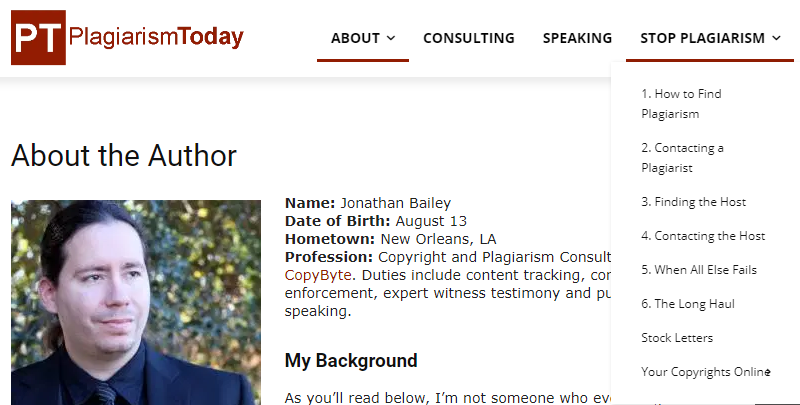
I would start with Step #3. I am one of those people Jonathan describes in #2, people who’ve learned not to deal with criminals and no longer bother with the “direct” approach. Here’s an example of why:
Thieves be warned: My first step, these days, is to talk to your hosting company. Losing your website tends to be a deterrent to the wise.
For my fellow writers, it’s also useful to talk to the copyright lawyers of any other sites that are being scraped or stolen from (like Medium), because they are usually eager to help and have more resources at their disposal.
If recognize another writer’s work being misappropriated, give them the heads up — it’s the kind and professional thing to do. Remember that everyone has to file their own complaints — but it helps to form a united front.
Nothing herein should be construed as legal advice. If you have questions about your own ownership of content, or what to do about it, please consult an attorney. I am not one!
Holly Jahangiri is the author of Trockle; A Puppy, Not a Guppy; and A New Leaf for Lyle. She draws inspiration from her family, from her own childhood adventures (some of which only happened in her overactive imagination), and from readers both young and young at heart. She lives in Houston, Texas, with her husband, J.J., whose love and encouragement make writing books twice the fun.
If you are reading this on any site other than Medium or on jahangiri.us, the content may have been stolen.


