
Blite
The Spelling Bee wiped out at least six plants with its rejection
Today’s New York Times Spelling Bee letters:
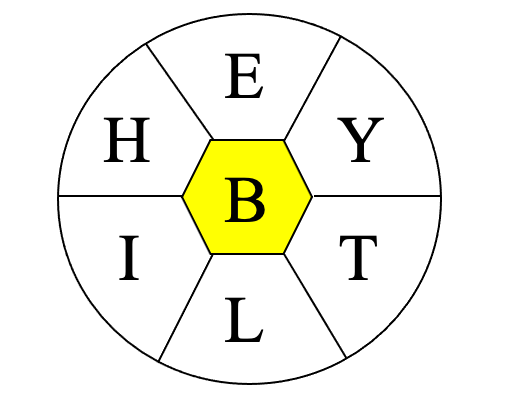
E, H, I, L, T, Y, and center B (all words must include B)
Merriam-Webster says…
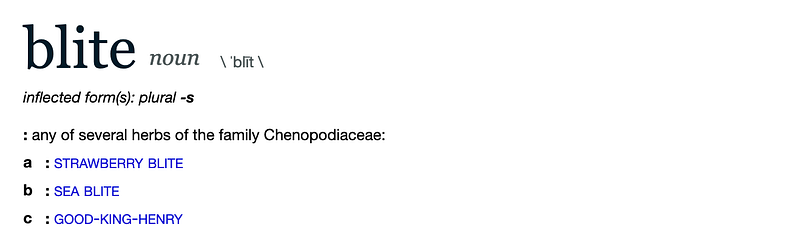
Silly little dictionary! Don’t you know that blite can’t possibly be a word if the New York Times says it ain’t?
For further fascinating facts, check out the Spelling Bee Master.
What’s your favorite dord* from today’s puzzle?
My Two Cents
At first I wanted to pick bilby as my daily dord*. In case you don’t know what a bilby is (and I didn’t, until a few hours ago), it’s an Australian desert-dwelling marsupial also known as the rabbit-eared bandicoot. There used to be two species, but one of them is believed extinct since the 1950s.
Generally speaking, people enjoy reading about animals, and Australian animals, being the odd bunch that they are, seem to pique readers’ curiosity.
So I hate to bum you out by admitting I went for blite, which refers to several plants. Still, if you can find it in yourself to keep reading despite the disappointment, I would much appreciate the few cents it will add to my Medium coffers. I hope to one day collect enough money to buy an actual coffer.
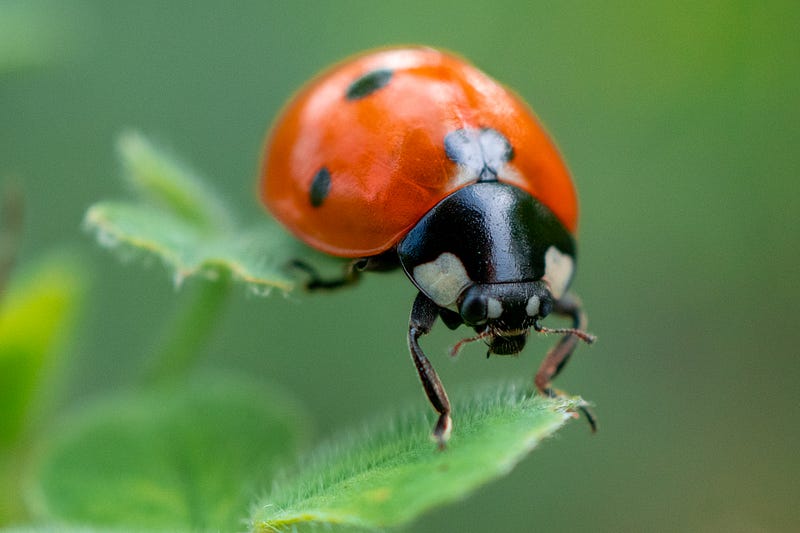
In any case, I did place a photo of a ladybug. Everyone likes ladybugs, right? Well, maybe not at that level of close-up photography.
The dictionary names three plants under blite, but I found others that carry that nickname. And
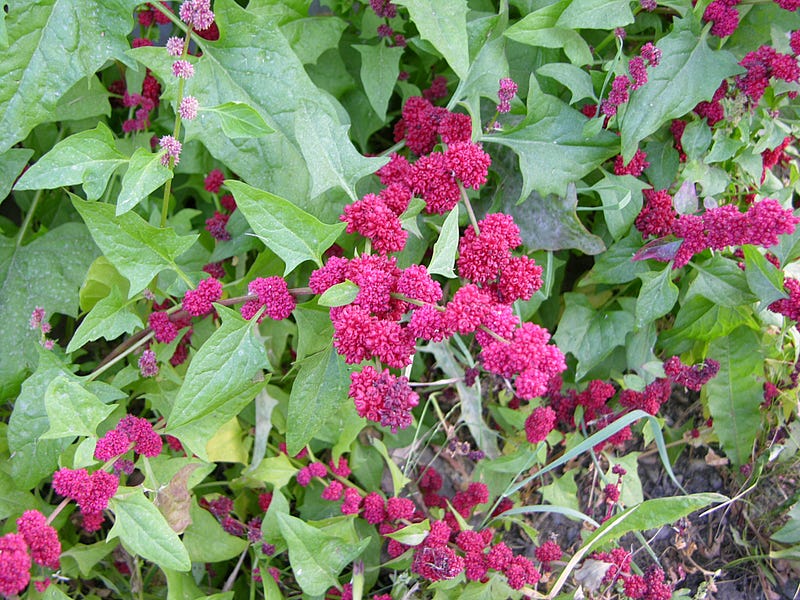
Strawberry, hold the cream
Blitum capitatum is one of the plants in the amaranth family that belongs to the genus Blitum. Native to most of the United States and Canada, it’s also been found vacationing in Europe and working in New Zealand (on the set of the Lord of the Rings movies).
Wikipedia says that strawberry blite is endangered in Ohio, but I think that must be a prank pulled by one of the editors. I mean, can’t Ohio borrow some seeds from neighboring states or even Canada? (Believe it or not, Canada is not a state of the U.S.) Ohio could probably even hire this blite from New Zealand once it’s done with the LORT re-shoots being done next year.
Strawberry blite is also known as blite goosefoot, strawberry goosefoot, strawberry spinach, Indian paint, and Indian ink. The latter two names may be a result of a red dye prepared from the juice of the fruit by Native Americans. The fruit is edible and resembles tine strawberries.
Good ol’ Henry the King
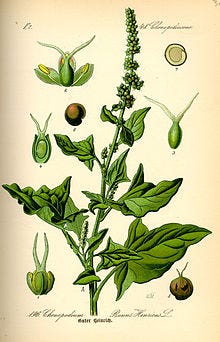
Blitum bonus-henricus, or Good-King-Henry, is also known as poor-man’s asparagus, perennial goosefoot, Lincolnshire spinach, Markery, English mercury, or mercury goosefoot. So many aliases, these two blites. You should be careful if you get an email from them asking for money.
This goosefoot is native to much of central and southern Europe and has been grown as a food item for centuries, although lately it’s mostly considered a weed. Can’t blame people for that, what with all AKAs.
To top it off, this species and the previous one (strawberry blite) were originally classified by Carl Linnaeus as belonging to the Chenopodium genus. Hence their monikers of “goosefoot”. But modern molecular genetic research that Carl could not obtain back then (his DeLorean was in the shop) has revealed that these two plants belonged in the genus Blitum.
Good-King-Henry has two parts that were commonly eaten: new shoots that were cooked like asparagus and the leaves that were cooked a la spinach.
Atriplex
No, that’s not a penthouse with three floors or a movie theater with three screens. It’s a plant genus of which some species may or may not be called blite. What is interesting about this group is that one of them, the atriplex hortensis, is known as the orache.
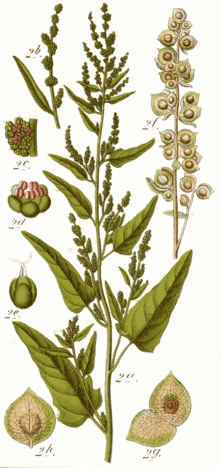
As Merriam-Webster explains, the word blite comes from “Middle English, from Latin blitum orach, from Greek bliton”. So maybe this spinach-y dude was the plant that started all that blite craziness.
A piggish plant?
I don’t know about you, but the plant shown below does not look very porcine to me.
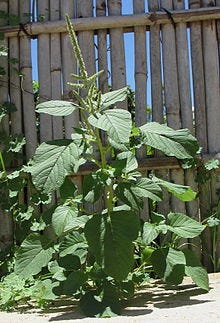
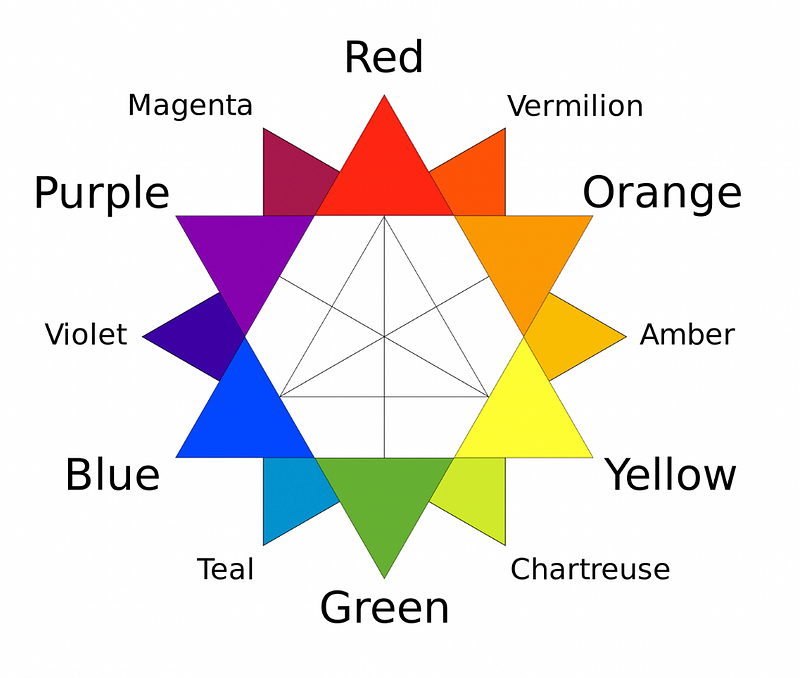
Nonetheless, the Brits decided to call it Guernsey pigweed. Americans gave it the much more attractive name of purple amaranth, although whoever did clearly had not studied the color wheel at all:
Amaranthus blitum, as this plant is scientifically known, is usually not cultivated in gardens, but some people do gather it in the wild and cook the shoots and leaves, serving them with olive oil and salt.
Blite by the sea
The red goosefoot, or coastblite goosefoot, is an annual plant native to North America, Europe, and Asia. In the U.S. it is part of the Native American ethnobotany, its seeds used as food by the Goshute Shoshone of Utah. and yes, it also has several names in that language: on’-tǐm-pi-wa-tsǐp, on’-tǐm-pi-wa, on’-tǐm-pi-a-wa, and on’-tǐm-pai-wa.
The plant is listed as endangered in New Jersey, Maine, New Hampshire, and New York. What is it with American states that they can’t get their act together and borrow plants from other states? This is starting to get frustrating. If you see the plant in this photo, please notify the previously-mentioned states so they can get some for themselves.
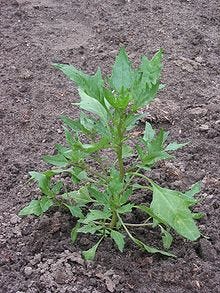
Blite in the sea
Finally, we have the genus Suaeda, with more than 100 species. And I have no clue how many of them prefer to be called blite. In general, these plants are called seepweeds or sea-blites. They enjoy saline soil habitats and usually grow along the coasts of North America and Europe.
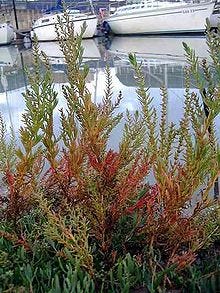
The above species is Suaeda maritima. According to Wikipedia:
“The name Suaeda comes from an oral (non-literary) Arabic name suaed | sawād | suēd for the Suaeda vera species and it was assigned as the genus name by the 18th century taxonomist Peter Forsskål during his visit to the Red Sea area in the early 1760s. Forsskål’s book, Flora Aegyptiaco-Arabica, published 1775, in Latin, declares Suæda as a newly created genus name, with the name taken from an Arabic name Suæd and presents the species members of the new genus.”
And… that’s it for today. Thank you for reading about all these many, many, many plant names, especially if you scrolled down real slow.
But so many species called blite don’t make no difference to the editors of the Spelling Bee, who decided that the word blite is nevertheless a dord.*
You can check out my previous entry on another dord* here:
*What the heck is a dord, you ask? Here’s the answer: