
Bleeding for Country: Why Black Troops under enemy fire refused to give up
Black Heroes who turned the war
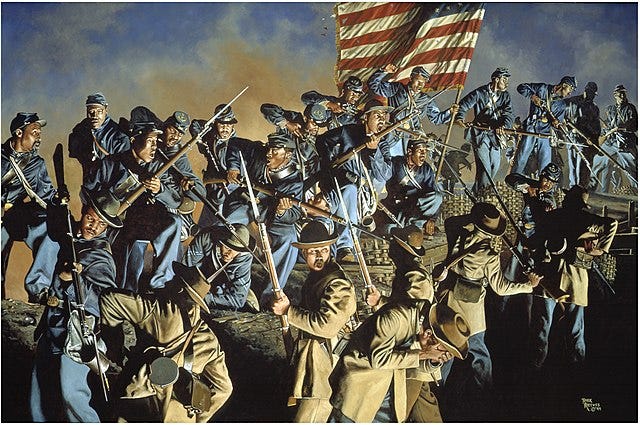
Thundering cannons ripped through blue-clad black bodies. Bullet riddled corpses caught in the gruesome carnage became a bulwark of courage. To the living clawing through the groans and whimpers of the dying, the bravery to fight and bleed for their country, their only pluck.
The recoils from their Enfield rifles were a puny response to the hellish slaughter.
That’s in the past. The far distant past of black history.
Today, rows of imposing sleepy waterfront residences, hide a spiky tip of an antique cannon and a lonely greying wall covered by the tendrils of a creepy Virginian creeper. They are survivors of the ominous citadel, Fort Sumter now a national park.
The sea lapping silence is a disingenuous calm to the long-forgotten battle cries. Slain Black men who for the love of country, bled that summer night to plant the union flag on Fort Wagner.
The day was July 18, 1863, the crimson sun setting over the glass calm waters of the Atlantic Ocean. Whispered a foreboding message. Black troops, the 54th Massachusetts readied to die. Standing on the shore of South Carolina’s Morris Island, these would be the last sunset.
Behind them, stood five Yankee regiments. The Fort stood stout, unfazed, and unscathed. The sacrifice of blood was the prize the Union would pay before the night was over.
The 54th Regiment, the First Black Regiment was ready. Every man lining the shore carried a weight. They carried the weight of both their past and future.
Their ancestors beckoned from the far-off past. Their progeny celebrated in the distant future. What they had to do this night would seal their right to the land.
“Rise up in the dignity of our manhood, and show by our own right arms that we are worthy to be freemen.” Frederick Douglass’s words echoed their single resolve. As one man they calmly faced death.
What was about to follow would seal the fate of the Civil War. The Black troops knew they were at the crossroads of history.
Charleston, was the prize. Capturing the South’s most important port was the Union’s mission. Fort Wagner stood before their prize. The Confederacy wasn’t letting go not to black troops. Fort Sumter was the Confederacy’s defensive citadel. It bristled with Confederate cannon.
The Black troops didn’t know it, but they were walking to their slaughter.
The Confederates had broken the Union’s codes, secretly under the cover of darkness, 1600 more troops had been moved to fortify the Fort. The 54th knew they were facing 300 hundred Confederate troops.
“Fort Wagner was the key to Morris Island, and Morris Island was the key to Fort Sumter,” wrote the author of Gate of Hell: Campaign for CharlestonHarbor, Stephen R. Wise.
If Union forces captured it, they would penetrate the harbor, seize the city and strike inland. The men were ready to “Rise up in the dignity of our manhood, and show by the right to arms they were worthy to be freemen.”
At 7:30 p.m Robert Gould Shaw, their commander raised his voice. “We shall take the fort or die there!” The men roared. With one last instruction, Shaw bellowed, “Now I want you to prove yourself men!!”
“It was now or never. For the love of country, blue-clad ranks began to move forward across the sand. Walking to their death. Undercover the men marched with quickening stride along a narrow beach road.
As the blue-clad black troops neared Fort Wagner. the naval guns firing from the sea fell silent. Smoke hung over the fort’s sloping, shell-pocked earthen rampart. Nothing seemed to move.
Six hundred yards from the fort, Colonel Shaw ordered the men to fix bayonets. At 200 yards, Confederate fire opened up. At 100 yards Shaw gave the order to charge; the men broke into a run. Running to a bloody confrontation.
At 80 yards, Confederate infantrymen suddenly appeared on the parapet. Fort Wagner erupted. Fiery death engulfed the men. Bullets ripped through their blue uniforms.
An observer would comment, “The silent and shattered walls of Wagner all at once burst forth into a blinding sheet of vivid light,” Men fell like wheat on a sickle. Still, the thundered on. The living, shielded by the dying.
They carried the hopes of millions of their black brethren. Black people had to earn a right to citizenship. The sacrifice was their blood. As the bullets ripped through their black bodies, they bled as one man.
“The eyes of the nation were on them,” a civil rights historian would write.
The Confederate soldiers weren’t ready to give up the Fort. They certainly weren’t prepared to surrender to black troops.
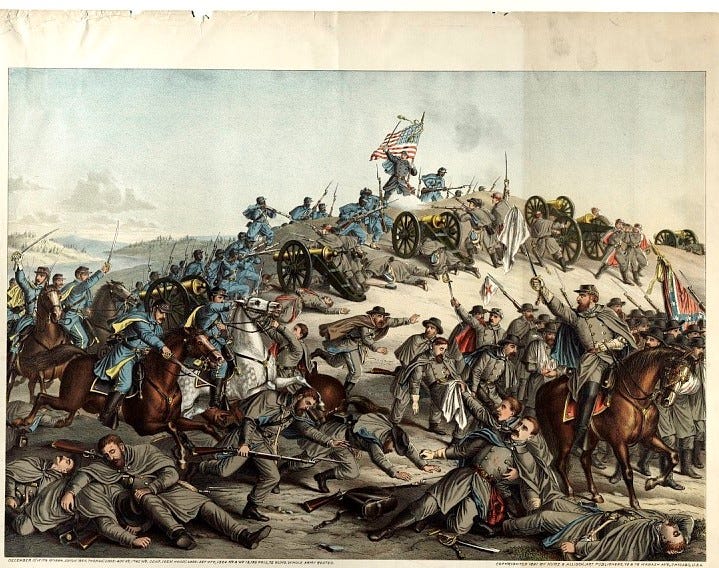
The black troop’s show of bravery hinged on taking the Fort. They plunged into the fort’s foot-deep moat. Men swarmed up the rampart, clambering over the bodies. They leaped down among the cannon, miraculously reaching the parapet.
“Onward, boys!” shouted Shaw. “Forward, Fifty-Fourth!” He roared. He raised his sword only to topple over, shot dead.
With brutal ferocity Black Men fought. Men hacked at each other with bayonets and swords, hammered with musket butts, gun rammers, and handspikes. It was a harrowing sight.
“Men fell all around me,” Frederick Douglass’ son Lewis would recall. “A shell would explode and clear a space of twenty feet, our men would close up again, but it was no use — we had to retreat.”
The survivors edged back over the parapet onto the fort’s outer slope, where against all odds they hung on tenaciously
Confederate howitzers posted on the sand dunes swept the front wall of the fort with a devastating crossfire, while the fort’s defenders rolled hand grenades and lighted shells down on the black regiment.
In the words of one Confederate officer, the Black men “drove back the enemy with frightful slaughter.” The Black troops refused to retreat.
Dawn revealed stupefying carnage. White and black corpses lay entangled three feet deep. The pale beseeching faces of the living looked out from ghastly corpses. Their lips parched, groaning for water.
The 54th Regiment had proved their worth sending a resounding message, ‘They were men worth of Freedom.’
History records that, — The 54th was the only regiment to maintain discipline after the repulse, helping Union troops form a defensive line across the island. It enabled survivors from broken units to regroup without fear of a counterattack from Confederate soldiers.
“The significance of the 54th’s attack on Fort Wagner was enormous,” says PrincetonUniversity historian James M. McPherson, author of Battle Cry of Freedom: The Civil War Era.
“Its sacrifice became the war’s dominant positive symbol of black courage. It was an impetus to the Lincoln administration’s to recruit more black soldiers.
President Abraham Lincoln would publicly in 1864 that the Union cause could not prevail without the immense contribution and sacrifice of black soldiers.
Their story was captured by Hollywood. The movie Glory, directed by Ed Zwick, whose cast included Morgan Freeman and Denzel Washington became a blockbuster.