avatarDark Energy Articles

Free AI web copilot to create summaries, insights and extended knowledge, download it at here

2102

Abstract

resting among white sponges against a rocky seabed.</b> Researchers estimate it has a diameter of about 10 cm and features what resembles a central opening. During a press conference, scientists stated that they are uncertain about the nature of this peculiar sphere. Initially, it was thought to be a dead sponge (Porifera) or a fragment of coral.</p><p id="f8b8">Researchers also noted that there are known deep-sea animals, including fish (including sharks), that lay eggs on the ocean floor. This reduces the likelihood of the eggs being washed away by ocean currents. However, the object does not resemble the eggs of known creatures. Scientists admitted that this is not surprising, as the ocean floor is still poorly explored, with only a few percent surveyed.</p> <figure id="7e5c"> <div> <div> <img class="ratio" src="http://placehold.it/16x9"> <iframe class="" src="https://cdn.embedly.com/widgets/media.html?src=https%3A%2F%2Fwww.youtube.com%2Fembed%2F-R0FqypOsiY%3Ffeature%3Doembed&amp;display_name=YouTube&amp;url=https%3A%2F%2Fwww.youtube.com%2Fwatch%3Fv%3D-R0FqypOsiY&amp;image=https%3A%2F%2Fi.ytimg.com%2Fvi%2F-R0FqypOsiY%2Fhqdefault.jpg&amp;key=a19fcc184b9711e1b4764040d3dc5c07&amp;type=text%2Fhtml&amp;schema=youtube" allowfullscreen="" frameborder="0" height="480" width="854"> </div> </div> </figure></iframe></div></div></figure><h1 id="4648">Horror-Like Egg</h1><blockquote id="2c97"><p>“Discovering new species during research missions is not unusual, but usually, it is possible to place them within a broad taxonomic category. We often encounter new creatures, but typically, we have a fairly good idea of what they are,” says Prof. Kerry Howell, a deep-sea ecologist from the University of Plymouth, in an interview with The Guardian.</p></blockquote><blockquote id="2c48"><p>“In this case, what’s incredible is that we’re not sure at all what this might be. We only know that it is of biological origin. However, whether it’s an egg or an unknown sponge, we don’t know,” the s

Options

cientist adds.</p></blockquote><p id="7d20">Researchers believe that if DNA studies confirm that the object is indeed an egg, it will be an extraordinary discovery. Firstly, eggs are usually laid in larger clutches, not individually. Secondly, its size is truly impressive.</p><blockquote id="81b3"><p>“If the sphere turns out to be an egg, the next question will be: whose? It’s really large, so it would have to be laid by a powerful creature.”</p></blockquote><div id="4aa8" class="link-block"> <a href="https://readmedium.com/a-new-crater-has-appeared-on-the-moon-it-is-known-how-it-was-formed-4b1aacd1dad"> <div> <div> <h2>A new crater has appeared on the Moon. It is known how it was formed.</h2> <div><h3>NASA has published photos of the Moon showing a new crater. It resulted from the impact of Luna 25, the lander meant to…</h3></div> <div><p>medium.com</p></div> </div> <div> <div style="background-image: url(https://miro.readmedium.com/v2/resize:fit:320/1*Ij6pkBT2zctxpP_pDUzyFA.jpeg)"></div> </div> </div> </a> </div><h1 id="ff07">Attention all readers!</h1><p id="1499"><b><i>As content creators on Medium.com, we face minimal compensation for our hard work. If you find value in my articles, please consider supporting me on my “<a href="https://www.buymeacoffee.com/oconnel">Buy Me a Coffee</a>” page. Your small contributions can make a big difference in fueling my passion for creating quality content. Thank you for your support!</i></b></p><figure id="e033"><img src="https://cdn-images-1.readmedium.com/v2/resize:fit:800/0*zw4KcYWlizSHnyZU.png"><figcaption><a href="https://www.buymeacoffee.com/oconnel">https://www.buymeacoffee.com/oconnel</a></figcaption></figure><figure id="25d7"><img src="https://cdn-images-1.readmedium.com/v2/resize:fit:800/0*V-mfxq74oc1edaZp.png"><figcaption><a href="https://www.buymeacoffee.com/oconnel">https://www.buymeacoffee.com/oconnel</a></figcaption></figure></article></body>

Bizarre Golden Sphere Found Deep in the Ocean — Is It the Enigma of a Sea Monster’s Egg?

Off the coast of Alaska, scientists found a peculiar golden sphere at a depth of over 3 kilometers underwater.
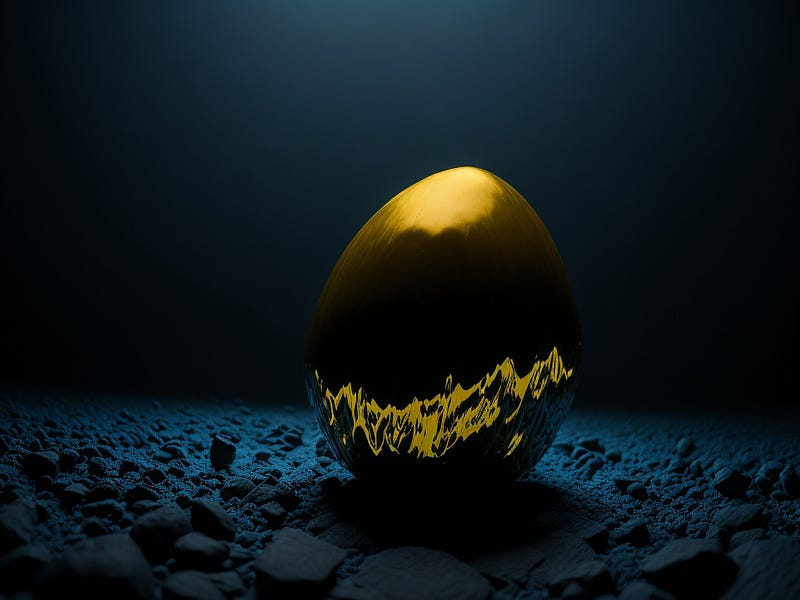
[Image generated by AI, Free to use]

NOAA scientists were researching the ocean floor near Alaska, with a mission to delve 6.5 kilometers deep into the Alaska Gulf, investigating coral, sponge habitats, and local geological formations.

The Golden Sphere on the Ocean Floor

However, researchers wonder if it might be the egg of a previously unknown marine species. “There’s a fairly large hole on the surface of this object. Either something tried to get inside, or it attempted to get out,” speculate the authors. “We were just hoping that when we touched it, something wouldn’t decide to come out. It sounds like the beginning of a horror movie,” joked one of the researchers.

Scientists guided a remotely operated vehicle (ROV) to touch the golden sphere. Researchers noticed that its outer structure resembled tissue similar to skin. The robot also collected a small sample of the object for DNA analysis in the laboratory.

During a live broadcast on August 30th, NOAA crew members mentioned that the golden color of the object was, in fact, an illusion created by the remote vehicle’s reflectors. Laboratory analysis revealed that the structure was brownish-yellow in color.

Researchers deployed a remotely operated and unmanned submersible vehicle, known as an ROV, into the water. The machine was tasked with exploring an area with little sunlight penetration. At a depth of approximately 3,300 meters, the device encountered the enigmatic golden sphere.

The discoverers published photos showing the golden object resting among white sponges against a rocky seabed. Researchers estimate it has a diameter of about 10 cm and features what resembles a central opening. During a press conference, scientists stated that they are uncertain about the nature of this peculiar sphere. Initially, it was thought to be a dead sponge (Porifera) or a fragment of coral.

Researchers also noted that there are known deep-sea animals, including fish (including sharks), that lay eggs on the ocean floor. This reduces the likelihood of the eggs being washed away by ocean currents. However, the object does not resemble the eggs of known creatures. Scientists admitted that this is not surprising, as the ocean floor is still poorly explored, with only a few percent surveyed.

Horror-Like Egg

“Discovering new species during research missions is not unusual, but usually, it is possible to place them within a broad taxonomic category. We often encounter new creatures, but typically, we have a fairly good idea of what they are,” says Prof. Kerry Howell, a deep-sea ecologist from the University of Plymouth, in an interview with The Guardian.

“In this case, what’s incredible is that we’re not sure at all what this might be. We only know that it is of biological origin. However, whether it’s an egg or an unknown sponge, we don’t know,” the scientist adds.

Researchers believe that if DNA studies confirm that the object is indeed an egg, it will be an extraordinary discovery. Firstly, eggs are usually laid in larger clutches, not individually. Secondly, its size is truly impressive.

“If the sphere turns out to be an egg, the next question will be: whose? It’s really large, so it would have to be laid by a powerful creature.”

Attention all readers!

As content creators on Medium.com, we face minimal compensation for our hard work. If you find value in my articles, please consider supporting me on my “Buy Me a Coffee” page. Your small contributions can make a big difference in fueling my passion for creating quality content. Thank you for your support!


https://www.buymeacoffee.com/oconnel
Nature
Animals
Science
Life
Water
Recommended from ReadMedium