
Bitcoin Mining vs. the Environment — Part 1
Why the power consumption issue may not be as simple as you think

I recently wrote an article about how Bitcoin’s mining operations could ultimately end up being good for the planet.
Some considered it controversial and pointed me to various facts and surveys indicating how damaging it is, many of which I had considered when doing research for the piece.
They’re right, of course. There’s little doubt that if we carried on down the existing path, Bitcoin’s mining impact could have a significantly adverse effect on the planet in the long term.
But the overriding point made in that article is that I firmly believe that the path we’ll ultimately end up on is not the same one as we’re on now. Further, I feel I am uniquely placed to argue the point since I am both a Bitcoin miner and an environmentalist — a seemingly irreconcilable position.
But I’m also a sort of “cynical optimist,” in that I am well aware of just how flawed we are as a species, but also how incredibly good we are at solving problems, especially when it aligns with our own self interest.
And nowhere is that clearer than in this case, as will become self evident in due course.
What’s the damage?
There are three main problems with Bitcoin mining that I touched on previously. They are:
- Power consumption
- Production of heat
- Recycling of machines
I’m excluding any environmental issues about manufacturing and transportation of mining equipment as these are (or at least should be) subject to all the normal rules and regulations that all industries must (or, again should) adhere to.
These three items, however, cannot be explained away or excused so easily. They are real problems. But each one has solutions that are being developed as we speak and there are genuine reasons to be hopeful.
In this article, we’re going to look at the first one of these, and in later articles we’ll look at the other two.
The Problem with Power
As we’ve previously seen, the facts and figures around energy use are vague, contested and almost impossible to work out accurately.
However, even without knowing what those numbers are, the one thing we can all agree on categorically is that Bitcoin mining uses a lot of power and demand for that power is growing in proportion to hash rate and dollar value.
But that summary is far too simple. Hidden behind those top-line numbers are many levels of factors to consider, such as where the power comes from, how many machines are in operation to produce the current hash rate, how efficient those machines are, and so on.
As many analysts before me have discovered, getting exact data on any of this stuff is next to impossible due to the global and disparate nature of the beast, so all we can do is view this in broad terms and use repeating examples from across the planet to identify trends of where we are most likely to end up.
And on that basis, there’s a number of really quite positive conclusions we can draw.
The long-term and clean power
For reasons that will become clear in due course, I am going to deal with the long-term future of Bitcoin mining first, as I believe it is inextricably linked to the long-term trends of our global power production.
It has taken decades for us humans to understand that we need to make the effort to produce power without damaging the planet, using a combination of not only solar, but also wind, hydro and other renewables, rather than lazily burning anything we can get our (almost literal) grubby little hands on. But, like everything we do, once we start a course globally, it becomes impossible to stop.
Just think how much harder it is to justify building a coal burning power station in most modern democracies today than it was even a mere twenty years ago. Not only is it unthinkable from an environmental point of view, the very idea of burning stuff to create power in and of itself seems completely old fashioned, kept alive until recently only by the relative cheapness of doing so.
However, this has all changed, and advances in technology and manufacturing techniques now mean that solar power is the cheapest form of energy production according to, well, pretty much any authoritative source you care to look at.
It’s easy to overlook what a wonderful situation this is to be in.
This now means that the cheapest way to produce as much power as we want is something that a) works for the planet and b) lines our own pockets because we can make a profit doing it. It is inevitable, based on human behavior alone, that we will produce most of our power this way in the future, supported by a mix of other renewables such as wind, tidal, geothermal, biomass and hydro.
In other words, it doesn’t really matter if this happens for entirely for the wrong reasons, the end result is still the same.
The data also bears this out, both in terms of the power the sun could provide and how much the world is turning toward this type of technology.
Consider this amazing statistic from the U.S. Department of Energy:
Each hour 430 quintillion Joules of energy from the sun hits the Earth, but the total amount of energy that all humans use in a year is 410 quintillion Joules.
In other words, the earth receives more energy from the sun in a single hour than we use across the entire planet in a year. The math behind this simple statement is incredibly complex, but it can be viewed here.
Now, it’s true that this is a 2015 estimate in terms of power used (but not in power received, those numbers are consistent), and even if we said it was 50% higher now (it isn’t), that would still only be one and one and a half hours of global sun time.
To put it another way, we could theoretically increase our total global consumption by 8,760 times before we came close to running out of sun power.
Applying simple math, that would be the equivalent power consumption of 70,776 billion people on the planet, if we all used power in the same way we do today, against a current population of more than 7 billion.
Of course, we’d be facing other problems by then with a population of that size, but, in theory at least, power would not be one of them. The point is that enough completely green power production is known to be possible, even discounting every other production method on the planet.
It should be clear that I am simplifying to make the point, and there are enormous efficiency, logistical and operational issues that have yet to be resolved, but trends point to the resolution of this being the most likely outcome. Additionally, the growth in solar production over the last few years clearly shows where we’re going as can be seen in this graph:
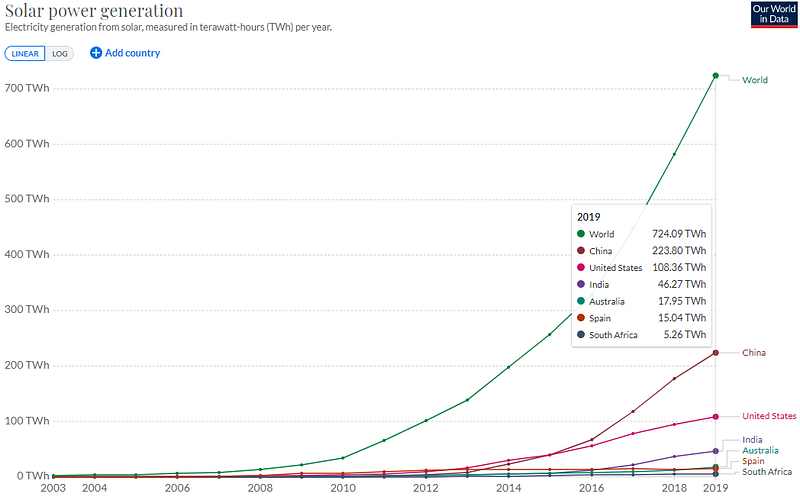
So, the question we have to ask ourselves is do we see this trend reversing over time resulting in a resurgence of legacy fossil based power production?
It’s unlikely at this stage.
In the simplest terms possible, Bitcoin mining will become increasingly based on renewables as time goes by, based entirely on trends, economics and common sense.
In fact, a significant percentage already uses green energy due to the simple economics of basing the operation in areas where excess power is produced, which is common with some forms of renewable energy. The amount, however, is hotly disputed, with estimates ranging between 45% and 78%, and everywhere in between, depending on whose opinion you subscribe to.
What is the bottom line? No one knows for sure. But we can be certain that Bitcoin miners will always follow the cheapest production rather than the greenest. When the two meet, as is already happening, the conclusion is pretty obvious.
That said, “dirty” energy will still play an important role in the short-term, but even that might actually yield a net positive overall.
The short-term and ‘dirty’ power
Now that I have made you feel happy and positive about a wonderful green future where Bitcoin miners can use whatever power they want without any repercussions, I am going to completely undo that feeling with one simple chart:
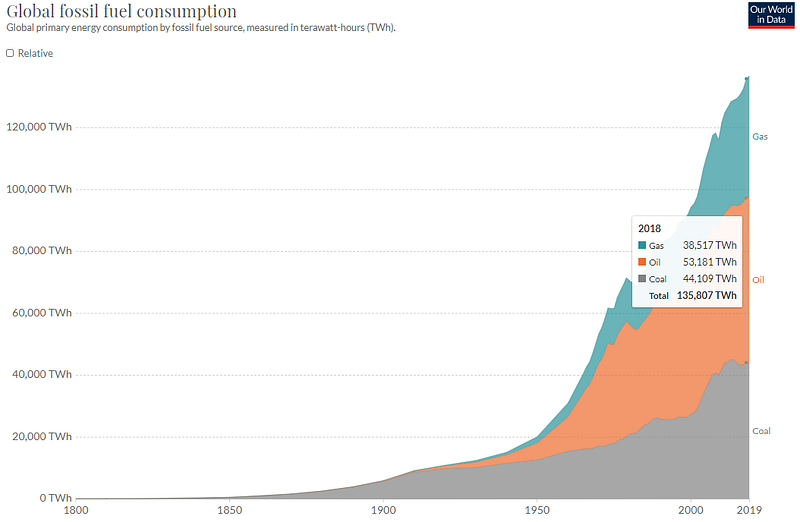
While green energy is growing, so is fossil based-energy production. Where is all this consumption going?
The answers are exactly where you would expect to find them: increased consumerism, proliferation of devices, increasing transportation, industry and agricultural requirements and, of course, the continuing development of power grids in third-world countries on their way to becoming first-world entities.
Even when we balance against the historical data the trends of moving to electric vehicles, small (but significant and growing) parts of the population moving to sustainable vegan and vegetarian diets (large scale dairy and meat farming is one of the biggest consumers and polluters on the planet) and the increase in green energy discussed above, it is clear that we are years away from that utopian balance, possibly even decades.
So, how can we justify Bitcoin mining in that context?
Positive comparisons involving the banking, food or transportation sectors are all well and good, but they overlook the fact that Bitcoin still adds to the mix on a net basis, no matter how you classify it on a technical level. Wouldn’t it be great if there were some way that Bitcoin mining could solve a few environmental issues while we work through this transition process across the planet?
Well, surprisingly, there is. And what started as a small, almost anecdotal, exercise may well develop into something much larger and provide a significant net positive.
Oil fields have a real problem with natural gas which is often trapped within reserves. There are times where it can be sold off if the producer has access to the infrastructure to transport it, but as the market is oversupplied anyway, this is not always economically viable.
In many cases, the gas is simply “flared” — literally burnt off — in what is surely one of the most wasteful and shameful activities of modern-day production. The numbers are terrifying, with some 145 billion cubic meters of gas being flared in 2018 (Source: World bank), roughly 5% of total natural gas production.
In reality, the numbers are probably much higher, because strict limits imposed by many countries give strong incentives for these figures to be downplayed. These limits exist because the act of flaring is extraordinarily bad for the planet, producing large quantities of methane, a gas that is around 25 times more damaging than the carbon dioxide created when it is used for electricity production.
As a result, an increasing number of oil producers have started creating partnerships with Bitcoin mining operators, creating power generation systems on site and selling cheap power on a consistent basis.
For the producers, it means remaining compliant with venting quotas, ensures uninterrupted oil extraction and provides a much higher (and steadier) income than would be achieved by trying to sell to the grid.
In other words, a perfect example of self-interest leading to an environmental benefit.
Like everything else related to power production and Bitcoin mining, it’s almost impossible to quantify the benefits realized, but we can be certain of two things:
First, that this process works, is economically advantageous and is already in operation in various parts of the world. Examples include Equinor’s operation in North Dakota, which uses a system known as “Digital Flare Mitigation” developed by Crusoe Energy Systems Inc. In fact, this turnkey solution now services at least 20 other sites in North America, providing a solution for even the smallest oil fields.
But they’re not the only ones. EZ Blockchain also operates in North America and Upstream Data has developed a similar solution for Canadian wells. Other solutions exist for other countries, and many more are in development, taking advantage of the fact that Bitcoin mining can be carried out almost anywhere on the planet.
Second, there is no question that solving the gas flaring problem would be considerably less damaging for the planet as we move to more sustainable energy forms in the longer term. Therefore, with every solution that is deployed, the numbers are instant and beneficial and, even better, the Bitcoin hash rate is increased on a net negative environmentally damaging basis.
If we ever needed proof that we are incredibly creative when it comes to matters such as these, especially when linked to self interest, the developments of these systems are surely it.
But there’s yet more to consider.
Machine Efficiency
Previously I have written about how we are in the “gold rush” stage of Bitcoin mining and the fight for every last drop of processing power is forcing an upgrade cycle with ever more powerful — and efficient — machines.
Take a look at this simple table of popular mining rigs manufactured by Bitmain between 2014 and 2018:
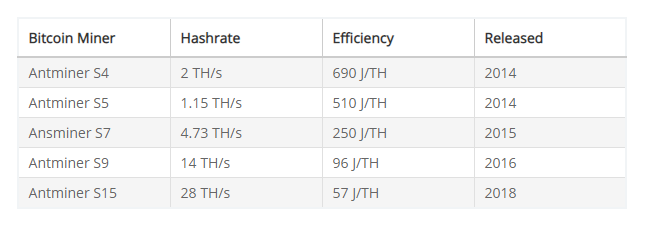
The key column here is labeled “Efficiency.” Notice how, over time, the power of the machine goes up, but the energy required for each terahash goes down, as measured in joules. In fact, the latest range of S19’s have an efficiency score of around 30J/TH.
This trend is, of course, completely normal for any new technology, and at some point in the future, it will plateau at a certain level of efficiency, making the incremental increases in power insufficient to upgrade each time.
That level of efficiency will, of course, be a level that has optimum profitability for the miner. This is, after all, a business that is entirely about the numbers on a scale like no other.
Put simply, the less power you use, the more money you will make. We can rely, therefore, on human nature to ensure power consumption is as low as possible.
The bottom line
Bitcoin mining is a messy, power hungry free-for-all activity that is uncoordinated, secretive and decentralized. There are thousands of ever changing parties and organizations involved, and its true free-market status means we may never really know the exact numbers that lie behind the network.
However, we can be absolutely certain that the picture is not as negative as some make out, and it’s just as clear that it is ultimately in the miners’ interests to ensure that they use the least amount of power possible.
Over time, this will lead to a far greener equilibrium, even if it is likely to be dominated by that most environmentally unfriendly sector — oil and gas — for at least a few years yet.
But of course we’re only dealing with one issue out of three very significant ones.
Even if we assume that every best case scenario outlined above comes true and we achieve a truly perpetual renewable energy solution that works for everyone, we simply move the environmental bottleneck to another point on the production line.
And that’s something I’ll be examining next in this article:
Due to my long standing relationship with CyberianMine, I am able to offer a very attractive referral link to anyone who is looking to get into sustainable Bitcoin mining. Using this link, you will have 45 euros credited to your account to start with, a further 25 euro and 2.5% credited back on your first miner purchase and 10 euro and 1% of every miner after that. It’s a cracking scheme, so click here to use the link and register!
If you enjoy reading stories like these and want to support me as a writer, consider signing up to become a Medium member. It’s $5 a month, giving you unlimited access to stories on Medium. If you sign up using my link, I’ll earn a small commission.
Want free access to articles, analysis, podcasts and related webinars? Why not subscribe to the ‘Bitcoin and Global Finance’ newsletter? Subscribers over 18, resident in Europe (see list on subscription page) & new to Bitcoin can claim £10’s worth of Bitcoin on joining! Unsubscribe at any time.
OTHER READING:
If you hold Bitcoin, should you sell? If you don’t hold Bitcoin, should you buy it? How do you make the right call?
Is the line starting to blur between state sponsored and commercial mining? If so, what are the implications going forward?
If you still don’t own any Bitcoin, you may want to consider this article. A tiny investment could make all the difference — but time is of the essence:
Disclosure: The author of this opinion piece has been heavily involved with bitcoin for several years and holds a substantial cryptocurrency portfolio, including bitcoin. He also has a mining operation running the SHA-256 algorithm based in Siberia and is a published author on the subject of promoting the understanding of cryptocurrency. Jason is an analyst at Quantum Economics. This article first appeared on Voice.com
Disclaimer: This content is for educational purposes only. It does not constitute trading advice. Past performance does not indicate future results. Do not invest more than you can afford to lose. If you found this content interesting, and have an interest in commissioning content of your own, check out Quantum Economics’ Analysis on Demand Service.