
Bitcoin is Not a Ponzi Scheme
A rational explanation for doubters and cynics

I’m getting pretty sick of reading stories claiming that Bitcoin is a Ponzi scheme. The last straw was this rambling tirade, which claims that Bitcoin “doesn’t exist” because you “cannot hold it in your hand”…
Enough is enough.
In this post, I will present a clear explanation of why Bitcoin is not a Ponzi scheme using the art of logic and rational thinking…
Let’s begin.
What is a Ponzi Scheme?
Rather than construct our own definition, let’s use the wording from the Securities and Exchange Commission (SEC) as a starting point.
A Ponzi scheme is an investment fraud that pays existing investors with funds collected from new investors. Ponzi schemes are named after Charles Ponzi. In the 1920s, Ponzi promised investors a 50% return within a few months for what he claimed was an investment in international mail coupons. Ponzi used funds from new investors to pay fake “returns” to earlier investors.
Ponzi scheme organizers often promise high returns with little or no risk. Instead, they use money from new investors to pay earlier investors and may steal some of the money for themselves.
With little or no legitimate earnings, Ponzi schemes require a constant flow of new money to survive. When it becomes hard to recruit new investors, or when large numbers of existing investors cash out, these schemes tend to collapse.
So Ponzi schemes:
- Are illegal
- Promise high returns with little risk
- Pay earlier investors with funds from later investors
- Have no legitimate earnings
A famous example is The Madoff Ponzi, which resulted in Bernie Madoff being arrested by the FBI and dying in prison. If Bitcoin were a Ponzi scheme it would be the biggest such scheme of all time, more than 10 times the value of the Madoff scheme.
What is Bitcoin?
Bitcoin is a digital currency created in 2009 by an anonymous entity identifying as Satoshi Nakamoto.
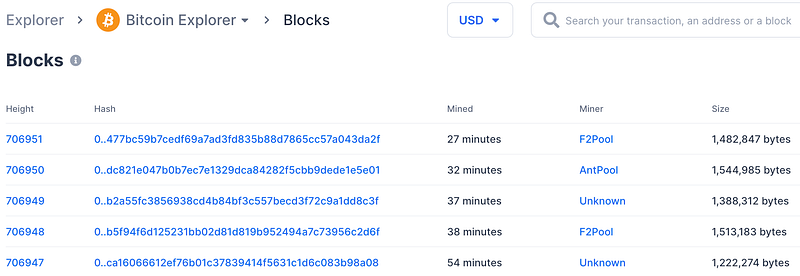
It was conceived as a secure payment system that would avoid the need for money to pass through the traditional banking system. It achieves this through a decentralized network of computers that maintain a public ledger of transactions. Each block of transactions is cryptographically verified by the network.
Because the network is large, and the calculations required are difficult for computers to perform, a lot of electricity is needed. The owners of these computers, therefore, get rewarded with a Bitcoin payment when they verify a block of transactions.
This process is called “mining”. In simple terms: electricity gets used to securely verify transactions, and miners get paid in Bitcoin for doing this work.
There are also some limitations on how transactions can be recorded:
- Only 21 million Bitcoin can ever exist
- Only one block of transactions is processed every 10 minutes
- Roughly every four years the Bitcoin mining reward gets halved
These rules are hard-coded into the Bitcoin protocol, and have some very important implications:
- Bitcoin is mathematically scarce. 90% of the total Bitcoin supply is already in circulation.
- Bitcoin operates in lengthening cycles with diminishing returns over time
This means that as Bitcoin becomes more widely adopted, scarcity increases, value increases, and volatility decreases.
Is Bitcoin a Ponzi Scheme?
We can see Bitcoin has the following properties:
- As more people invest, the price goes up
- People who invested the earliest benefit most from price increases
- Some Bitcoin holders who have become billionaires as a direct result of later investors buying Bitcoin
It’s tempting to conclude that since a Ponzi scheme also shares similar properties, Bitcoin is therefore a Ponzi scheme.
However, this is a classic example of a logical error known as affirming the consequent. This is when we make an assertion like “all dogs are animals, therefore, all animals are dogs”.
In this case it would be:
- All Ponzi schemes are speculative investments
- Therefore all speculative investments are Ponzi schemes
- Bitcoin is a speculative investment
- Therefore Bitcoin is a Ponzi scheme
Clearly the logic doesn’t scan.
Something that would make logical sense is:
- All Ponzi schemes are fraudulent
- Bitcoin is not fraudulent
- Therefore Bitcoin is not a Ponzi scheme
Who is the Charles Ponzi of Bitcoin?
Another component of a Ponzi scheme is that it has a central mastermind behind it. This need not be one person, it could be a company. The key is that it should be a single co-ordinated entity.
Some hedge funds have created Ponzi schemes, for example.
This begs the question: who is the Charles Ponzi of Bitcoin?
Most articles claiming Bitcoin is a Ponzi scheme, suggest that Bitcoin whales in general make up the entity running the Bitcoin scam. This article, for example mentions MicroStrategy, Fidelity, and Grayscale. The idea is that together these institutions make up the Charles Ponzi of Bitcoin.
There are several problems with this line of thinking. The first is that when Bitcoin started out there were no “whale” holders, as the currency was essentially worthless. People became whales as the network grew and gained in value.
The inherent value of the Bitcoin network created the billionaire whales and not the other way around.
Some billionaires did join Bitcoin after it had already reached a very high valuation. Michael Saylor of MicroStrategy is an obvious example. Saylor didn’t start buying Bitcoin until 10 years after its inception. At that point the currency had already increased in value by a factor of more than 10,000!
The likes of MicroStrategy have the most to gain if more buyers purchase Bitcoin, but unlike the owner of a Ponzi Scheme, they also have the most to lose if Bitcoin fails.
Most importantly, companies like MicroStrategy are not committing fraud. They simply own and promote Bitcoin.
Final Thoughts
A Ponzi scheme is defined by the SEC as:
an investment fraud that pays existing investors with funds collected from new investors
Bitcoin is a currency based on an open blockchain protocol. The source code for the Bitcoin network is public and can be viewed here. Every Bitcoin transaction ever processed is available for public viewing here.
Bitcoin is therefore the antithesis of a fraud. It constitutes the most accountable and open monetary system ever created.
Bitcoin is not a fraud, owning Bitcoin is not a fraud, selling Bitcoin is not a fraud, and promoting Bitcoin is not a fraud.
Therefore Bitcoin is not a Ponzi scheme!
Thank you for reading! If you would like to support me in writing more stories like this, consider signing up to become a Medium member. It’s only $5 a month and gives unlimited access to stories on Medium. If you sign up using my link, I’ll earn a small commission.