CURRENCY DRIVEN BY TECHNOLOGY
They Laughed When I Told Them Bitcoin Is A Glorified Ponzi Scheme
But when they heard the questions, they leaned in and took notes.
In 2016, I was part of a four-person team hired by the Wealth Management Division of a large insurance company. Our primary deliverable was a report on our findings of the business viability of including Bitcoin as part of their investment strategy. The stakeholders for the report were part of the senior management team of the insurance company.
Before I list some of the main questions in the report we produced, it would be helpful to touch on more recent events in the bitcoin world as reference points. Hopefully, these events will partially or entirely justify the questions we raised as our primary concerns in 2016.
The Rise of Crypto exit scams
This article is but one of dozens of articles on the rise of Crypto exit scams. The Africrypt scam is reported as one of the largest scams thus far. It now runs in the billions. Because it also affected Turkish citizens, the Turkish government banned Bitcoin and other cryptocurrencies to use as payment for goods and services. Other governments are soon to follow suit.
There are some underground evil networks involved in these scams, and they have some serious brainpower, computing power, and sheer grit to outwit the average investor. The year 2021 is said to be the worst year so far in terms of crypto scams. Since Bitcoin prides itself on being called the leader, let’s award that title to them.
These scams are a complete and utter shame. People are losing their life savings as I am writing this
The Elon Musk, Jack Dorsey conversation on Twitter
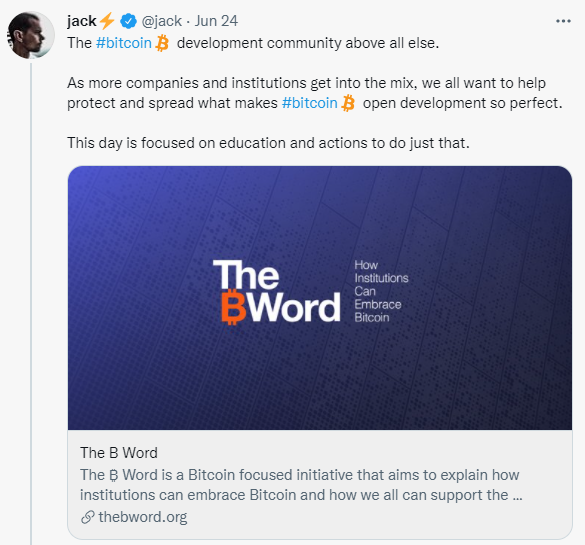
Around June 25th of this year, there was a Twitter conversation between Elon Musk and Jack Dorsey. To save some screen real-estate on this article, I took a screenshot of the tweet that started the conversation, followed by the text version of the tweets.
As with most things these guys do on Twitter, some of their tweets can sometimes sound cryptic ( pun intended) until you read the comments section to get to the real meaning. The tweets started with Jack Dorsey announcing a full-day event to engage with the developer community for the Bitcoin blockchain software stack.
Why would high-level senior executives be interested in attending a conference by software developers for software developers? In the business world, this does not usually happen.
Does strategy trump technology, or does technology trump strategy? By the way, Jack Dorsey, the CEO of Twitter, has the word BITCOIN as his complete BIO on Twitter. Nothing about the platform itself? Strange?
JD:24 Jun 2021: —
EM:25 Jun 2021 — Bicurious?
JD:25 Jun 2021: — Bizarre! Let’s you and I have a conversation at the event. You can share all your curiosities…
EM:25 Jun 2021 — Lmfao omg
JD:25 Jun 2021: — Let’s have THE talk
EM:25 Jun 2021 — The comments in this thread are solid gold
JD:25 Jun 2021: — Meaning you want @PeterSchiff to join our conversation? Or…
EM:25 Jun 2021 — For the Bitcurious? Very well then, let’s do it
JD:25 Jun 2021: — Done! Will set up
The Billionaire Club joins the conversation offline
More high-profile people joined the conversation for some days after that, as is mentioned in the following tweet. This is a tweet as recently as August 26th, 2021. The discussion is still raging.
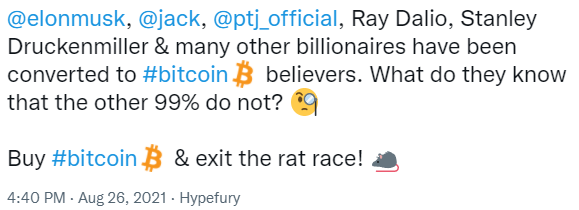
What is happening here is entirely open for interpretation and personal research. The question remains. What do they know that we don’t? Is there an exit by the private club members, and could that be fuelling the EXIT scams? I don’t know. You don’t know. Nobody knows.
We have always trusted Charles Ponzi, the man who created the concept of a Ponzi Scheme. After all, if you rob Peter to pay Paul, society is inclined to make you a martyr. We know this from the days of Robin Hood.FTC Chairman Robert Pitofsky once told a Senate subcommittee, “when all is said and done, the Internet is merely a vehicle for swindlers to reach their victims. What is new — and striking — is the size of the potential market and the relative ease, low cost and speed with which a scam can be perpetrated.”
With that more contemporary backdrop, here are some of the main questions we raised in our 2016 report. This report was for an executive-level audience, so techno-jargon was deliberately sidestepped.
Did you know Bitcoin cannot exist without blockchain technology?
Blockchain is, first and foremost, a network protocol. In his 1982 dissertation “Computer Systems Established, Maintained, and Trusted by Mutually Suspicious Groups” the Cryptographer David Chaum first proposed a blockchain-like protocol. The first APPLICATION deployed on the blockchain technology stack was BITCOIN back in 2008. A mysterious person referred to as Satoshi Nakamoto developed the application. This person’s whereabouts and location remain unknown.
Business Risk: The business could potentially rely on an application that has transformed itself into a currency developed by a person who does or does not exist. Is the company willing to invest given the uncertainties?
If Bitcoin is Blockchain and vice versa, then complexity is inherited.
The blockchain technology introduces an entirely new vocabulary that needs to be understood by all the relevant stakeholders. The technology and the application, BITCOIN, usually are only truly understood by a relatively small specialized group of people.
Business Risk: Is the business willing and able to invest in the capability to acquire a more profound knowledge of both the technology and the currency?
Are you prepared to run your own Bitcoin Node?
Since Bitcoin runs on its own blockchain network, the concept of a node is extremely important for business. While the network is open to join, the architecture of certain components, like a node, remains private.
If you opt to run a full-blown node, you become a contributor to network size and the traditional scalability challenges of any network. The Bitcoin network responds better to security attacks and grows more robust as the number of nodes increases in the network.
The technological and business trade-off becomes a decision hedged in the amount of investment in computing power to host a node. The more computing power the business invests in, the more bitcoins can be mined.
Business Risk: Ownership of a node could create the perception of having joint control of the network’s overall security. This is not necessarily true if adjacent nodes leave themselves exposed, thereby compromising parts of the network or the whole network. This is an issue that requires more in-depth study.
Will the Network Speed impact business transactions?
Since the speed of a network is related to the size of a network, the two concepts pose the same business risk.
Business Risk: As with traditional networks, slow network speeds directly impacts business transactions.
Will Transaction Costs remain stable?
Bitcoin claimed to have ‘near free’ transaction costs for the first few years of its existence. That is not necessarily the case now, and further increases in transaction costs are inevitable.
As of 2016, it can only process about seven transactions per second, and each transaction costs about $0.20 and can only store 80 bytes of data.
Business Risk: Higher transaction costs will directly affect the business’s bottom line in its investment.
Will the underlying blockchain technology be subject to Human Error?
The phrase ‘garbage in, garbage out’ is an age-old saying that holds true for any database. Since blockchain is used as a database to store information, the same argument applies.
If the information stored is not of high quality, then it is not trustworthy. The data needs to be stored accurately for the data in the network to be trusted.
Business Risk: Quality control or the lack thereof could affect the quality of business information.
Is the business willing to live with the ‘51% attack’ problem?
There is an inherent security flaw in a blockchain network that was first highlighted when BITCOIN was launched. It is commonly called the ‘51% attack.’ Blockchain cannot assess whether an external input is accurate or ‘truthful’ — this applies to all off-chain assets and data digitally represented on blockchain.
If more than 50% of the nodes on a network tell a lie, the lie will become the truth. Blockchain is not a ‘truth machine’.
This ‘truth’ is governed by a loosely defined policy monitored by the community.
Business Risk: With no proper Risk Mitigation Strategy, this will cause business disruption.
Can the Business Navigate The Politics in Bitcoin as a Currency?
Any node that is mining bitcoins has the opportunity to apply its governance model at that point. The challenge is to reach a consensus first before being allowed to use the model.
Consensus is not always reached without its fair share of disagreements. This is intrinsic to the blockchain industry, and it usually creates what is called a ‘fork’ in a component of the technology or a change with majority approval.
Business Risk: Not having influence and participation in the decision-making process.
Will Open-Source Blockchain create more confusion?
The current trend to open-source the technology will lead to an explosion of both the variants of the technology and applications running on the technology.
These new types of blockchain technologies and accompanying applications will be both GOOD and BAD for business.
The two safest strategies to follow as of 2016 are to either fork a home-grown version of blockchain or partner with a technology company to buy an off-the-shelf version of their software. The company can use the COTS version from the technology partner under the same software maintenance contracts currently in place.
2016 In Hindsight.
I am somewhat reluctantly adding this at the time of publication. The wisdom of hindsight is an unforgiving teacher. So, given the 2016 picture and the current picture we painted, let’s work our way up towards the Ponzi Scheme theory.
- The explosion of open-source blockchain is growing and will continue to grow. There are now use cases in just about every industry sector. Mostly GOOD.
- There is also an explosion in cryptocurrencies. Even a dog owner in Alaska can now have his/her very own cryptocurrency. Mostly BAD
- At the time of writing, 1 BITCOIN will set you back 51 000 USD. That is FIFTY-ONE THOUSAND DOLLARS. This is something that you could buy for less than 250 USD when it all started back in 2008/2009. This COIN does not exist. You cannot hold it in your hand. It is a string of 1’s and 0'1 with the smallest unit a byte. 8 BITS at a time. Mostly CRAZY BAD.
- The creator of BITCOIN hardcoded the maximum number of BITCOIN to 21 million. The HARD CAP. Since this guy, Satoshi Nakamoto, is nowhere to be found, that number will likely remain the same forever. It is hidden somewhere in an obscure module in the software. This is SATOSHI BAD.
- BITCOIN is released in BLOCKS every ten minutes. That SATOSHI guy decided back in 2009 that ONE BLOCK will contain 50 BITCOINS. So he or they or their ghosts chose to release 50 coins every 10 minutes. Somewhere in the code, they had an IF/THEN/ELSE statement that the block’s size must be reduced by 50% roughly every four years. The size of a BLOCK at the time of writing is 6.25 BITCOINS. That’s how many BITCOINS are released every 10 minutes. This is A PIECE OF A BITCOIN BAD.
- In February 2021, they have mined a total of 18.638 million BITCOINS. They only have 2.362 million bitcoins left to be mined. This is SOMEBODY MUST SURELY START ASKING QUESTIONS BAD.
- The 18.638 million coins already mined is not the actual number of coins in circulation. Why? Some people lose their crypto keys to access their BITCOINS. People die without leaving their essential instructions to anyone. This is WHAT DOES THE SOFTWARE DO WITH LOST KEYS AND DEAD PEOPLE BAD.
- What do they know that we don’t?
- The Finance Bro’s seized the opportunity and created things like Smart Contracts, Digital Assets, Crypto Wallets, and a whole lot of other things that allow you to buy a PIECE of a BITCOIN. You read that right. People do not own BITCOINS. They hold pieces of a coin. Suppose you want to ask me how the crypto key works for a BITCOIN portion. I honestly would not know. We asked the same questions in the 2016 report. This is a PIECE OF A COIN BAD
- You can buy a piece of a BITCOIN using another cheaper cryptocurrency. So you, with your $5 cryptocurrency, can purchase portions of the BIG WHALE cryptocurrency. There is a catch, however. You can only buy pieces from somebody that knows somebody that knows somebody else that has a couple of whole bitcoins. This is FIAT CURRENCY PRINTER BAD.
- What do they know that we don’t?
- So what will they do when all 21 million bitcoins are released? That is when all the fun starts spelled the WHOLE BITCOIN way. They will create BITCOIN mining rewards. They will have complete control of transaction costs. It will be transactions on whole bitcoins and trades on the 5$ cryptocurrency that wants to parade as whales. Who are they? I don’t know. I did not see this coming in the 2016 report.
- What do they know that we don’t?
- So who is holding the whole bitcoins? Not the two coiners, five coiners, 50 coiners, or even the 100 coiners. I mean the BIG WHALE coiners. I think if you scroll up a few pages to the Billionaire Club, you might find somebody that knows something that we don’t.
- From GOLD to FIAT. From FIAT to CRYPTO. From CRYPTO to madness?
If you got to this line, I want to thank you for taking the time to read this.