avatarDan Pfeifer

Summary

The article provides an overview of the Blue Jay, detailing its physical characteristics, behavior, diet, and nesting habits, as well as its year-round presence in Central NY and less understood migration patterns.

Abstract

The "Bird Spotlight-A Series" article focuses on the Blue Jay, a larger and bold bird compared to the previously highlighted Black-Capped Chickadee. It notes the Blue Jay's year-round residence in Central NY, where the author has observed their nesting and feeding habits. The Blue Jays, known for their skittish nature, prefer platform feeders and a diet of sunflower seeds, mixed seeds, and peanuts. Their aggressive behavior necessitates the use of tube feeders for smaller birds. Despite being local to the area, their migration patterns remain a mystery, with some Blue Jays migrating while others do not. The article also mentions the longevity of Blue Jays, with one banded individual living over 26 years, and acknowledges other Jay species found in different regions of the United States.

Opinions

  • The author expresses admiration for the Blue Jay's beauty and acknowledges its bold personality.
  • There is a sense of personal enjoyment and connection, as the author has witnessed Blue Jays nesting and raising young in their yard.
  • The author finds Blue Jays challenging to photograph due to their skittish behavior.
  • The article suggests that Blue Jays are bossy and aggressive at feeders, implying a need for specific feeder types to accommodate smaller birds.
  • The author indicates a level of mystery and intrigue regarding the Blue Jay's migration patterns, noting the inconsistency and lack of understanding of their migratory behavior.
  • The mention of the oldest banded Blue Jay seems to convey a sense of respect for the bird's longevity and resilience.

Bird Spotlight-A Series

Blue Jay-#2
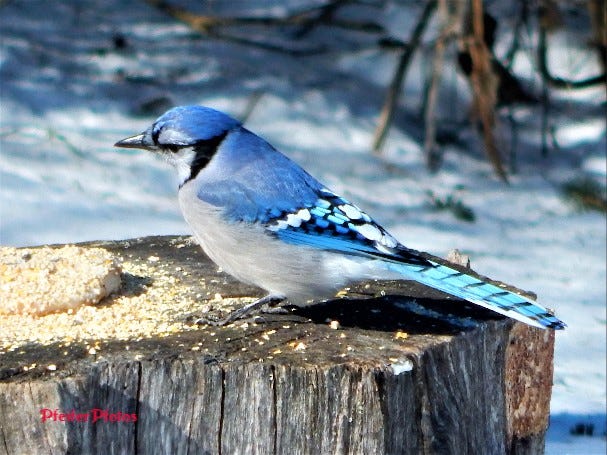
Pfeifer Photo

In my first article, I highlighted the Black-Capped Chickadee. This bird, the Blue Jay, is very different for sure, but beautiful none the less. The Blue Jay is much larger, with a bold personality for sure.

One similarity is that these birds also live in Central NY year-round. In fact, we had the Blue Jays nest in our yard this summer and enjoyed watching the young ones. We didn’t find the nest but could tell approximately where it was by observing their activity. They normally build their nest 10 to 25 feet high in trees, which we have (tall pines) bordering the North and West side of our property.
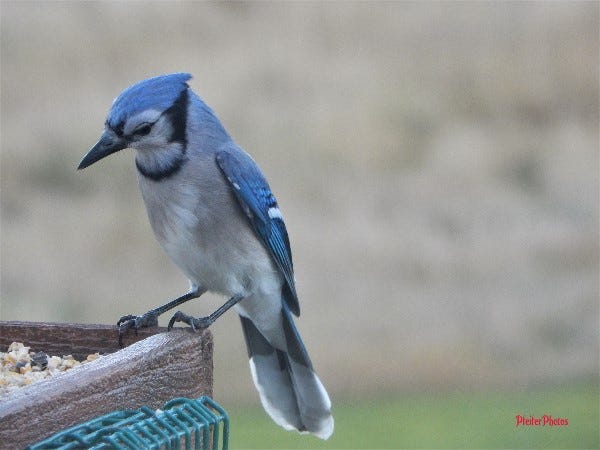
Juvenile Blue Jay/Pfeifer Photo

You will normally find that Blue Jays prefer to eat from platform feeders and enjoy sunflower seed, but will eat mixed seed. They also love peanuts. It is well known that they are bossy and aggressive, so it is important to have feeders that the smaller birds can use such as tube feeders.

Along with the Black-Capped Chickadee, these birds are normally the first to arrive at my feeders in the morning. They are hard to photograph since they are very skittish.

Even though they are in our area year-round, they do migrate (some of them) but their migration patterns are not well understood. Sometimes they migrate, sometimes not. When they do, not all do.

Interesting Facts

The oldest banded wild Blue Jay was older than 26 years when it was found dead trapped in some fishing gear.

There are other types of Jays in other areas of the country including the Florida Scrub-Jay, Steller’s Jay, Woodhouse’s Scrub-Jay, and the California Scrub-Jay.

Birds
Photography
Nature
Outdoors
Blue Jays
Recommended from ReadMedium
avatarAuthor, D. Denise Dianaty
Citrus Cake

My son’s favorite birthday cake

5 min read