
Biologically Diverse Haikus
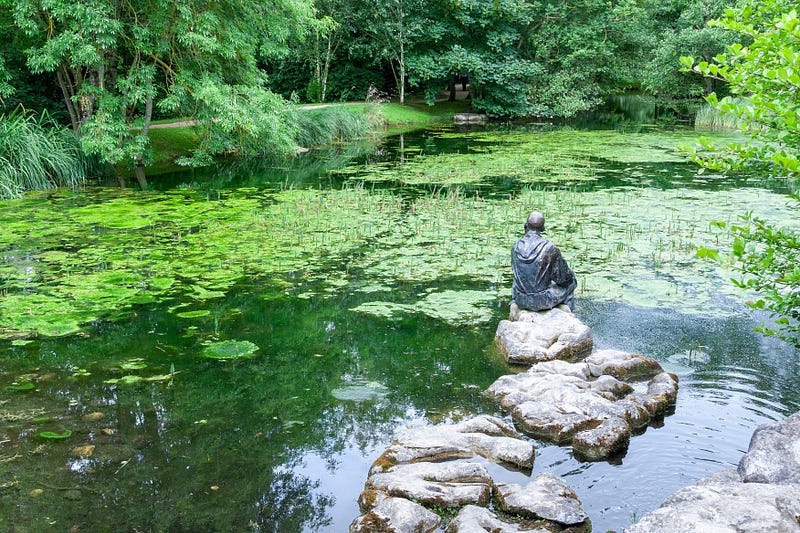
Day 26 response: So many life forms, struggling on to procreate, sunlight on a pond…
Nature versus Nature
First Life eats Sunlight. Second Life consumes First Life. Circle of Life Starts.
The first life forms which we might recognize as living organisms were probably chemotrophs or phototrophs. Troph is Greek for eater, and chemo is Greek for chemical, so a chemotroph eats chemicals in its environment. Thus a phototroph is something that “eats” light. Like plants today. But the first life were not plants but closer to bacteria or single-celled algae. These first arose perhaps 3.7 billion or more years ago (at least that is the oldest rocks in which we’ve found fossil evidence suggesting life). For the first couple billion years, there were only single-celled phototrophs or chemotrophs.
Then, about a billion years ago, the first organism arose, which ate those simpler organisms. In order for one cell to eat another cell, biology required some machinery in which to effectively open the eating cell to engulf the prey cell. We have a mouth, which requires a mechanism, composed of a structure and a motor. We have a jaw bone that acts as the structure to support our digestive system's opening and closing to food. And we have muscles that move the jaw.
Cells need an analogous system, structures, and motors, to move their cellular body in a way to engulf another cell. Here is a video that illustrates some of the biochemicals which act as structures (actin, tubulin, etc.) and motors (kinesins, dyneins, myosins, etc.)
These structures and motors are the same ones needed for processes like cell division in more complex cells like ours. One possibility is that the evolution of eating in single-celled bacterial organisms led to more complex cells, which evolved a nucleus and other organelles like ours. This led to an explosion of diversity.
In any case, the first origin of cells which eat other cells jump-started the cycle of life which we recognize today, in which sunlight feeds plants and other organisms at what we consider the base of the life cycle, and where plants, in turn, feed the next level of organisms, that act as prey to an ever-complexifying web of organisms leading to what some consider the apex predator at the top of the food chain. These organisms then die and feed the base of the food web, and the cycle begins anew.
I wrote about some aspects of the evolution of complexity, especially organelles in single-celled organisms, here:
Struggle
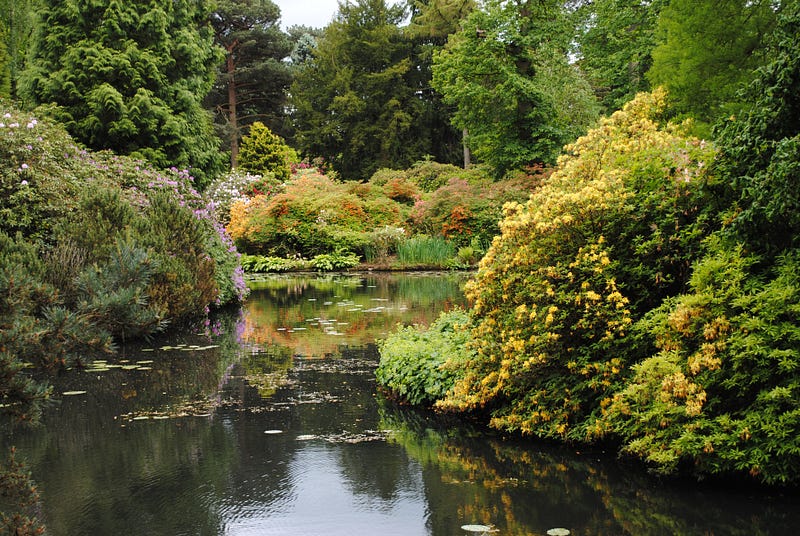
So many life forms… struggling on to procreate. Sunlight on a pond.
Today we see the world getting smaller and smaller. The pandemic reminds us of just how small. A person who doesn’t know they are infected gets on a plane, travels across the world, and seeds the spread of the pandemic in a new place.
But to a micro-organism, this world of ours is a universe. A few feet or a few inches away, the environment may be so different as to preclude life. The dark, damp, warm confines within soil might be home for an organism, while a few inches above on the surface, the blasting rays of the sun might be instant death. This diversity of environments, though, is what drives evolution to fill those various niches and create a diversity of life. And the various organisms all evolve through a desperate struggle to survive and procreate.
One imperfect but easy measure of diversity is simply the size of organisms. We can start with viruses, even though we may not consider them technically alive, yet they are an essential part of our ecosystem.
Viruses come in a wide range of sizes, from tens to hundreds of nanometers. A nanometer is one-billionth of a meter. None of us understand what that is, so let me rely on some illustrations I generated for another article on size scales, which I wrote here:
Just for fun, let’s cherry-pick a few representative organisms at each arbitrary level of size. Remember that there is a continuous variation of organisms and sizes that fill in the full range we will review here.
Here is one simple illustration showing circles that are (magnified to scale) about the size of the coronavirus plaguing us now, up to one about the size of a red blood cell:
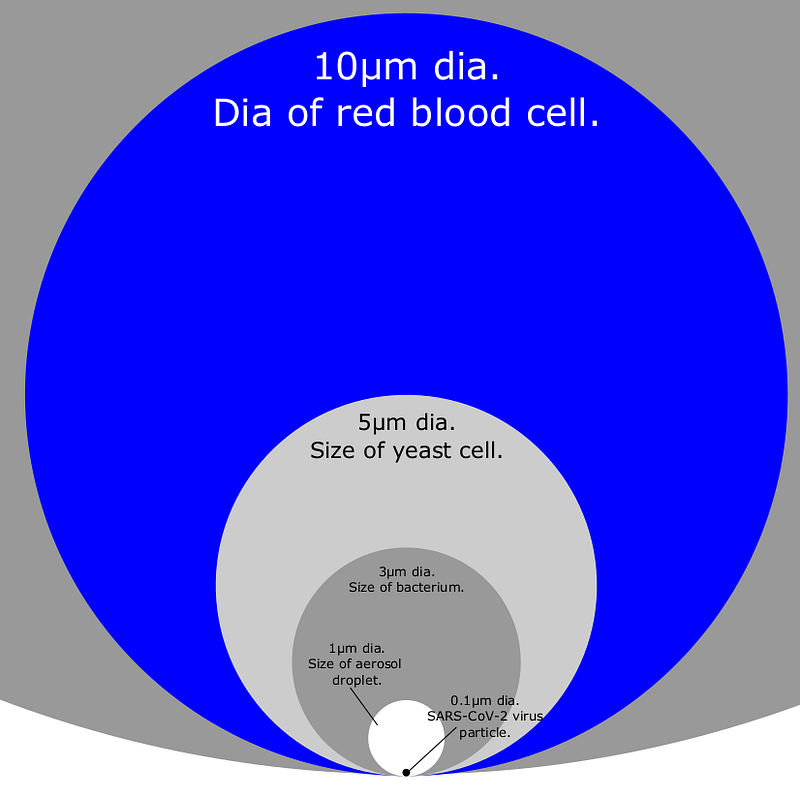
The smallest black speck at the bottom is the coronavirus, which is one of the larger viruses at 100 nanometers, or 0.1 micrometers. A micrometer is one-millionth of a meter—still not a lot of help, and not any more imaginable than a nanometer.
The white circle is 10 times larger than the coronavirus and is about the size of an aerosol droplet that you breathe out regularly and which wafts across the room on faint air currents. The white circle is also about the size of smaller bacteria species.
The blue circle is 10 times larger than the white circle, and is roughly the size of a red blood cell (sorry for the color dissonance), one of the smaller cells in our body because it does not have a nucleus. The difference between the diameter of the virus and the red blood cell is about 100 times.
From here, let’s just go up in increments of ten. The next image shows exactly the above, yet scaled up by a factor of ten to include a circle with approximately the diameter of a human hair or a very large cell-like a human egg:
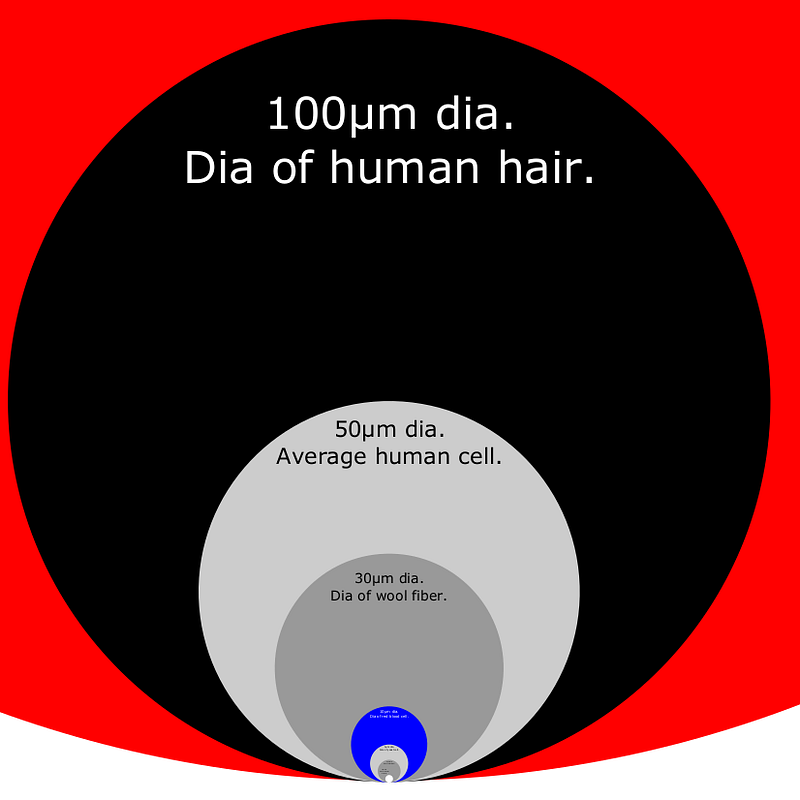
The black circle is 10 times larger than the blue circle in the previous image. If you could zoom into the blue circle, you would see the previous image exactly.
The 100-micrometer diameter of the black circle is the same as one-tenth of a millimeter. Still too small for most of us to have a practical feeling for. You can see that the virus particle is no longer visible at all.
Let’s zoom out another ten-fold.
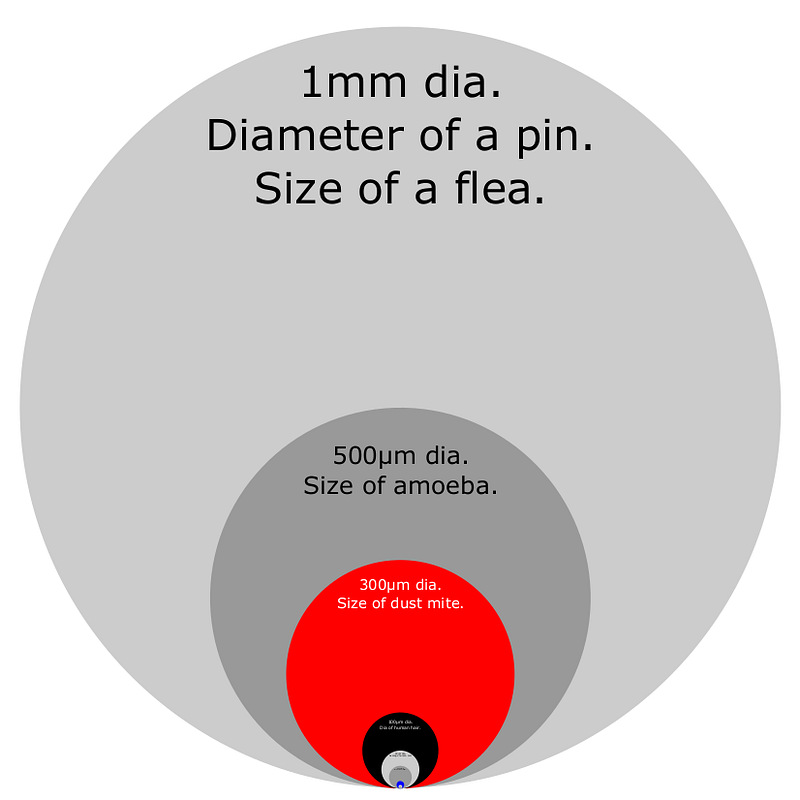
The previous two images are now scrunched up into this last image. The light gray circle is 10 times larger than the black circle from the previous image. It is 1 millimeter in diameter, about the size of a flea. Most of us can see and imagine something one millimeter in size.
Now that we have a sense of scale, what a ten-fold and 100-fold difference in size looks like, we can scale up in tens.
A flea is about a millimeter in length.
Some of the smallest vertebrates are tiny frogs about a centimeter in size, ten times larger than a flea.
A typical hummingbird is around 10 centimeters, ten times larger than the smallest frogs.
A small child is around 100 centimeters or 1 meter, ten times larger than a hummingbird.
A whale shark, the world’s largest shark, is around 10 meters or more, ten times larger than a small child.
The tallest redwood tree is just shy of 100 meters, or ten times larger than a whale shark.
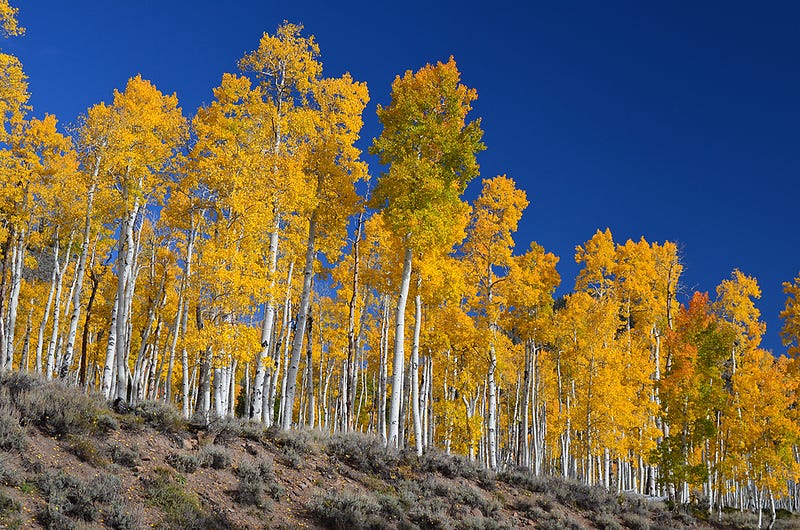
There are clonal colonies of organisms such quaking aspen and Neptune’s grass, which cover immense areas. Quaking aspen are trees that sprout from a common, massive root system. A given tree is a genetic clone of all the trees sprouting from the same root mass. Neptune’s grass is similarly a clonal colony, and these organisms may easily extend a kilometer or more across.
And this is one of the simplest ways to view the diversity of life on our lonely blue planet.
For More on the #30DaysOfScikuChallenge: